Table of Contents
Need Official Legal Templates or Documents?
Access attorney-reviewed, fully editable Word (.docx) contracts and printable PDF guides formatted for immediate legal protection.
- ✓ Fully Editable: Includes Word (.docx) & printable PDF
- ✓ Key Clauses: IP transfer, non-solicitation, indemnification & remedies
- ✓ Practitioner Guide: Includes line-by-line filling instructions
Select the specific document below that best fits your requirements:
The Major Branches of Law: An Organized Map of the Entire Legal Field
Understanding the architecture of jurisprudence requires more than just reading isolated statutes or studying individual court opinions. The legal system operates as a interconnected framework composed of distinct, specialized domains—each governed by its own doctrines, procedural frameworks, standards of proof, and constitutional boundaries. Whether resolving private commercial disputes, regulating corporate market activities, prosecuting offenses against the state, or reviewing the constitutional boundaries of government agencies, every legal issue falls within a specific branch of law.
This comprehensive taxonomy breaks down the entire legal field into its fundamental components. By examining the overarching dichotomies between Public and Private law, Substantive and Procedural law, and Civil and Criminal jurisprudence, this comprehensive map provides legal scholars, law students, and researchers with an authoritative operational guide to modern law.

Key Takeaways
- The Public vs. Private Law Divide: Law is fundamentally divided by the identity of the parties and the nature of the interest at stake. Public law governs the relationship between private citizens and state entities (Constitutional, Administrative, and Criminal law), whereas Private law resolves disputes between private individuals or corporate entities (Contracts, Torts, Property, and Family law).
- Substantive vs. Procedural Dichotomy: Substantive law codifies concrete rights, legal duties, and statutory prohibitions (e.g., what constitutes a breach of contract or homicide). Procedural law dictates the procedural mechanics, jurisdiction, evidentiary rules, and court mechanisms required to enforce those substantive rights.
- Standards of Proof: Civil law disputes require a lower standard of proof—typically a preponderance of the evidence (or clear and convincing evidence in specific equity proceedings)—and focus on monetary restitution or injunctive relief. Criminal law requires the state to meet the highest standard of proof: beyond a reasonable doubt, carrying consequences of incarceration, structural probation, or capital punishment.
- Administrative Agency Promulgation: The growth of the administrative state has elevated Administrative Law into one of the most pervasive legal fields, governing executive agency rulemaking, administrative adjudications, and judicial review under constitutional and statutory authority.
- Dynamic Intersections: Modern emerging branches—such as Cyber/AI Law, Environmental Law, Intellectual Property, and International Public Law—regularly cross traditional boundaries, combining public administrative oversight with private commercial litigation.
Key Legal Facts & Statutory Reference
To navigate the major branches of law accurately within US jurisdiction, researchers must rely on primary statutory codes, constitutional provisions, and procedural rules. Below is a foundational reference guide to the core authorities governing each major domain, complete with links to the Cornell Law School Legal Information Institute (LII):
| Legal Branch / Taxonomy | Primary Governing Authority & Codification | Standard of Proof / Enforcement Burden | Primary Remedies & Legal Outcomes |
| Constitutional Law | U.S. Constitution (Articles I–VII; Amendments I–XXVII) | Judicial Review / Strict, Intermediate, & Rational Basis Scrutiny | Declaratory judgments, preliminary/permanent injunctions, invalidation of unconstitutional statutes. |
| Administrative Law | Administrative Procedure Act (APA), 5 U.S.C. § 551 et seq. | Arbitrary & Capricious Standard; Substantial Evidence Rule | Agency rule vacatur, administrative remands, cease-and-desist orders. |
| Criminal Law (Federal & State) | Title 18 of the U.S. Code (18 U.S.C.) & State Model Penal Codes | Proof Beyond a Reasonable Doubt (100% burden on prosecution) | Incarceration, criminal fines, restitution orders, supervised probation. |
| Civil Procedure | Federal Rules of Civil Procedure (FRCP Rules 1–86) | Preponderance of the Evidence (>50% probability) | Compensatory damages, punitive damages, specific performance, quiet title. |
| Contract & Commercial Law | Uniform Commercial Code (UCC Articles 1–9) & Common Law Restatements | Preponderance of the Evidence | Expectation damages, reliance damages, restitution, rescission. |
| Tort Law | Common Law Precedent & Restatement (Third) of Torts | Preponderance of the Evidence | Special damages (medical/lost wages), general damages (pain/suffering), punitive damages. |
| Property Law | State Real Property Codes & Common Law Estates | Preponderance / Clear & Convincing Evidence (for Adverse Possession) | Quiet title decrees, ejectment, partition, injunctive relief against nuisance. |
| International Law | Charter of the United Nations & Vienna Convention on the Law of Treaties | Diplomatic Dispute Resolution & International Court Bench Decisions | Diplomatic sanctions, treaty renegotiation, international tribunal awards. |
Theoretical Foundations: How the Legal System is Structured
To visualize how individual legal claims move through the courts, law is traditionally organized along three overarching axes:
- Public Law vs. Private Law
- Substantive Law vs. Procedural Law
- Civil Law vs. Criminal Law
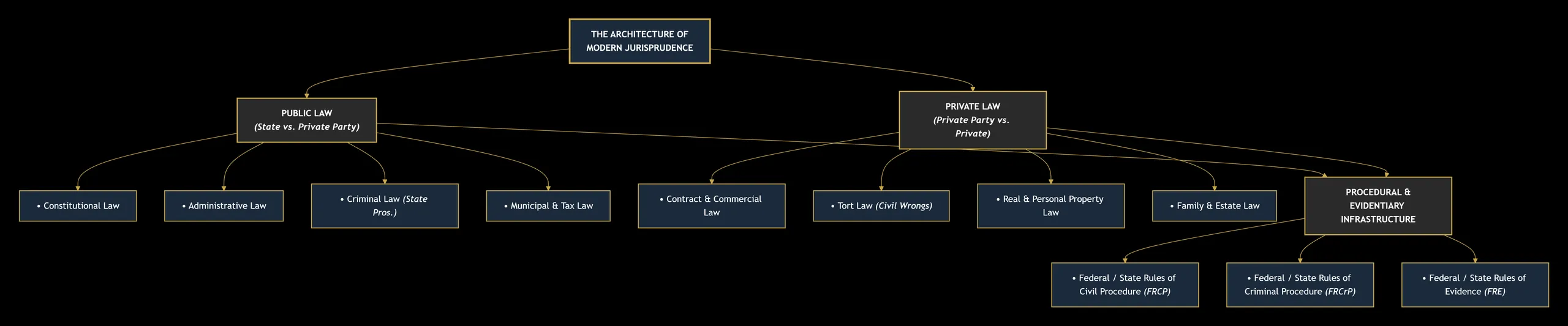
1. Public Law: Regulating State Power and Governance
Public law encompasses the branches of jurisprudence that define, regulate, and limit the power of government entities, while governing the direct relationship between the sovereign state and individuals or organizations within its jurisdiction.
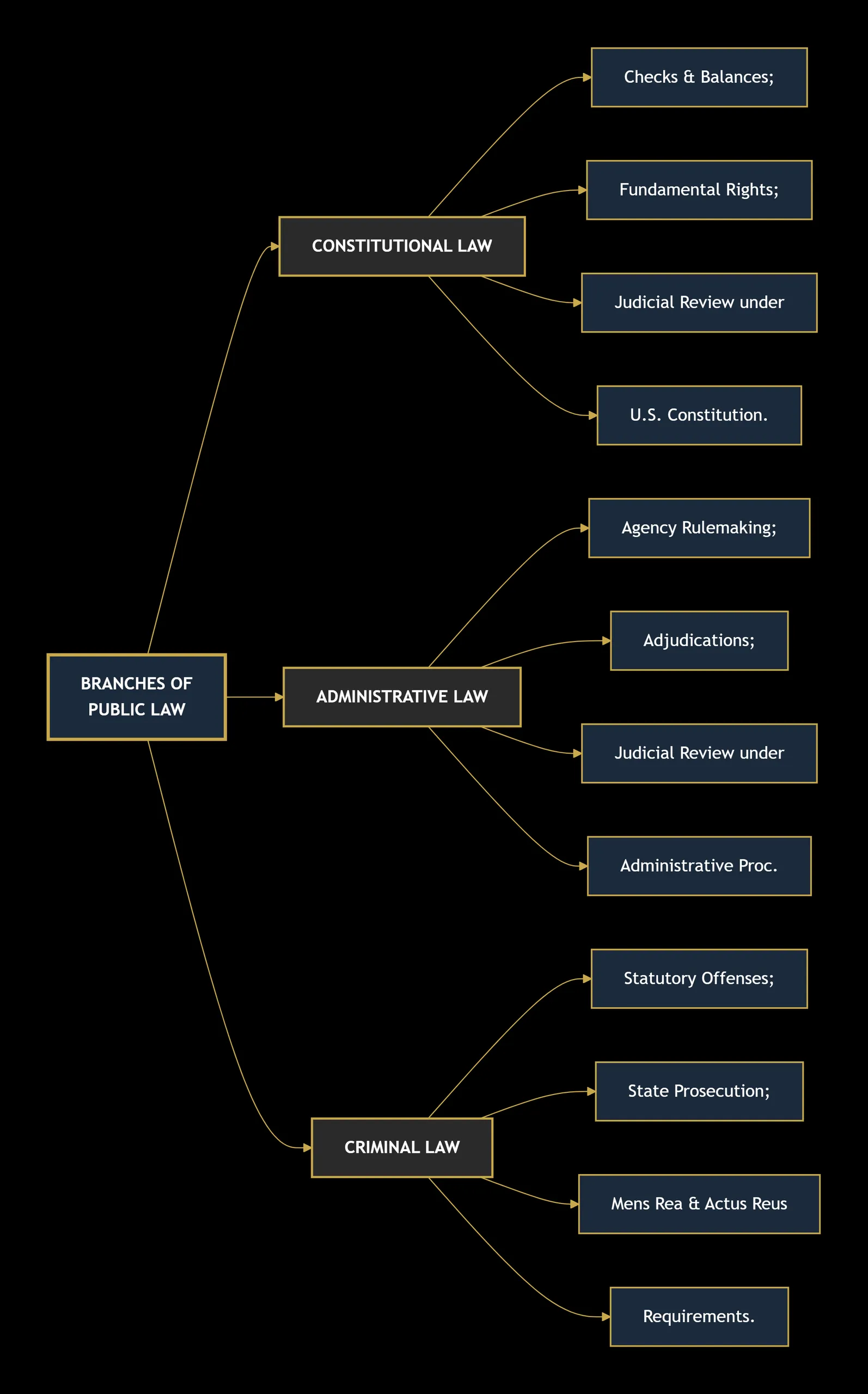
A. Constitutional Law
Constitutional law is the foundational pillar of the entire legal framework. It interprets and applies the fundamental text of the sovereign state’s constitution. Under US jurisprudence, constitutional law governs two primary areas:
- Structural Constitutional Law: Defines the allocation of state authority via the separation of powers across the Legislative, Executive, and Judicial branches (Articles I, II, and III of the US Constitution), as well as the federalism principles allocating power between national and state governments.
- Individual Rights & Civil Liberties: Regulates government overreach through the Bill of Rights and subsequent amendments. Key litigation fields involve the First Amendment (Free Speech, Free Exercise of Religion), Fourth Amendment (Search and Seizure), Fifth and Fourteenth Amendments (Due Process and Equal Protection Clauses).
Courts evaluate government actions using varying levels of judicial scrutiny:
- Strict Scrutiny: Applied to fundamental rights or suspect classifications (e.g., race). The law must further a compelling state interest using the narrowly tailored means.
- Intermediate Scrutiny: Applied to quasi-suspect classifications (e.g., gender). The law must be substantially related to an important government objective.
- Rational Basis Review: Default standard for general economic or regulatory legislation. The law needs only a rational relationship to a legitimate government interest.
B. Administrative Law
Often termed the “fourth branch of government,” administrative law governs the creation, operation, and judicial oversight of executive administrative agencies (such as the EPA, FTC, SEC, and OSHA). Agencies operate under delegated authority granted by legislative statutes called enabling acts.
Under the federal Administrative Procedure Act (APA), administrative law regulates two core agency actions:
- Rulemaking: The formal or informal (notice-and-comment) process by which administrative agencies formulate legislative rules that carry the force of law.
- Adjudication: The administrative court proceedings where administrative law judges (ALJs) resolve regulatory disputes, assess compliance fines, or revoke licenses.
When private entities challenge administrative actions in court, judiciary review is guided by deferential standards, such as assessing whether an agency action was “arbitrary, capricious, an abuse of discretion, or otherwise not in accordance with law” under 5 U.S.C. § 706(2)(A).
C. Criminal Law
Criminal law governs conduct deemed harmful to the peace, safety, and moral order of society as a whole. Because criminal acts are considered offenses against the state, criminal prosecutions are brought by government prosecutors (e.g., District Attorneys or US Attorneys) rather than private victims.
Criminal liability generally requires the state to prove two core elements beyond a reasonable doubt:
- Actus Reus: The committed physical act, unlawful omission, or prohibited conduct.
- Mens Rea: The requisite culpable mental state (e.g., strict liability, negligence, recklessness, knowledge, or specific intent).
Criminal law is divided into broad statutory categories:
- Felonies: Serious offenses punishable by death or imprisonment in state or federal penitentiaries for terms exceeding one year (e.g., murder, armed robbery, grand larceny).
- Misdemeanors: Lesser offenses punishable by fines or local jail detention usually under one year (e.g., simple assault, petty theft, trespass).
- Infractions / Violations: Non-criminal administrative violations typically resolved through monetary assessments (e.g., minor traffic violations).
2. Private Law: Resolving Disputes Between Private Parties
Private law—often referred to generally as Civil Law—regulates rights, obligations, and private legal relationships between individuals, business entities, and organizations. When a private legal right is violated, the aggrieved party files a civil lawsuit seeking equitable relief or monetary compensation.

A. Contract and Commercial Law
Contract law governs enforceable agreements voluntarily entered into by two or more legal entities. It establishes the rules for forming, performing, and enforcing agreements, protecting reasonable commercial expectations.
The essential elements of a legally binding contract include:
- Offer: A clear expression of willingness to enter into a bargain under definite terms.
- Acceptance: Unconditional assent to the terms of the offer (following the common law “mirror image rule” or statutory variations under UCC § 2-207).
- Consideration: A bargained-for exchange of legal value between the parties.
- Legal Capacity & Legality: Parties must have the mental capacity to contract, and the underlying subject matter must not violate public policy or statutory law.
When a breach occurs, courts grant remedies designed to put the injured party in the economic position they would have occupied had the contract been fully performed (expectation damages), or order specific performance for unique goods or real estate sales.
B. Tort Law
Tort law addresses civil wrongs (unrelated to contractual duties) that cause injury, financial loss, or harm to an individual’s body, property, or reputation. The primary goal of tort law is to compensate the victim (restoration) and deter future harmful conduct.
Torts are categorized into three main liability frameworks:

Free Presentation
Manslaughter
Homicide without the intent that defines murder.
A short, downloadable slide deck explaining this term in depth — free to open this week, no account needed.
Open This Week's Presentation →All-Access subscribers get the entire growing library, any time — see the full catalog.
- Intentional Torts: Harmful acts committed intentionally or with substantial certainty of resulting injury (e.g., assault, battery, false imprisonment, defamation, intentional infliction of emotional distress).
- Negligence: Unintentional injuries caused by a failure to exercise reasonable care under the circumstances. A successful claim requires proving four elements: Duty of Care, Breach of Duty, Causation (both actual/in-fact and proximate/legal cause), and Quantifiable Damages.
- Strict Liability: Liability imposed regardless of fault, negligence, or intent due to the inherently dangerous nature of the activity (e.g., defective products liability, wild animal keeping, blasting operations).
C. Property Law
Property law establishes and regulates rights of ownership, possession, transfer, and use over tangible and intangible assets. Property is divided into two broad classes:
- Real Property: Land, buildings, attached fixtures, and subsurface/air rights. Property law defines land estates (e.g., fee simple absolute, life estates, leaseholds), co-ownership structures (tenancy in common, joint tenancy), encumbrances (easements, mortgages, covenants), and title transfers via deeds or adverse possession.
- Personal Property: Movable physical objects (chattels) such as vehicles, equipment, and livestock, as well as intangible personal property such as bank accounts, stocks, and debt instruments.
D. Family and Estate Law
Family law governs domestic relationships, legal status changes, and family structures. It includes marriage formation, prenuptial agreements, dissolution of marriage (divorce), child custody determinations, child support calculations, and adoption proceedings.
Directly related is Estates and Trusts Law, which regulates the preservation, management, and post-mortem distribution of an individual’s wealth. Key areas include drafting wills, establishing inter vivos or testamentary trusts, managing probate courts, and appointing guardians or legal powers of attorney.
3. Substantive Law vs. Procedural Law
Every major branch of law is further categorized by its focus: whether it defines abstract rights or governs court execution.
| Attribute / Focus | Substantive Law | Procedural Law |
| Core Definition | Legal rules that create, define, and regulate specific legal rights, liabilities, and obligations. | The mechanics, rules, and procedures that govern how court proceedings are conducted. |
| Primary Question | “What are my legal rights, liabilities, and statutory prohibitions?” | “How do I enforce my legal rights in a court of law?” |
| Primary Sources | Penal codes, tort principles, contract principles, statutory property acts. | Federal/State Rules of Civil Procedure (FRCP), Rules of Criminal Procedure (FRCrP), Rules of Evidence (FRE). |
| Illustrative Examples | Defining first-degree murder (18 U.S.C. § 1111) or setting the elements of negligence. | Setting a 30-day window to file an Answer (FRCP Rule 12) or determining hearsay admissibility (FRE Rule 801). |
4. Specialized and Emerging Branches of Law
As global economic structures, scientific developments, and digital technologies evolve, new specialized legal sub-disciplines develop. These branches merge elements of public administrative oversight with private commercial litigation.
Global legal system traditions.. Source: Wikimedia Commons / File:Map of the Legal systems of the world (en).png – Wikimedia …
A. Intellectual Property (IP) Law
IP law protects intangible human creations, technological inventions, and brand equities. It grants creators exclusive economic rights for limited periods. The four primary components of IP law are:
- Patents: Protect novel, useful, and non-obvious inventions or industrial processes (35 U.S.C.).
- Copyrights: Protect original works of authorship fixed in tangible mediums of expression, such as literature, music, and software code (17 U.S.C.).
- Trademarks: Protect distinctive brand names, slogans, trade dress, and logos used in commerce to indicate source origin (15 U.S.C. / Lanham Act).
- Trade Secrets: Protect confidential, proprietary business information that derives independent economic value from not being generally known (governed by state law and the federal Defend Trade Secrets Act).
B. Environmental & Natural Resources Law
Environmental law regulates human interaction with the natural environment to minimize pollution, protect ecosystems, and control industrial resource extraction. This field is primarily administrative and relies heavily on major federal legislation:
- Clean Air Act (CAA): Regulates stationary and mobile air emissions under EPA enforcement (42 U.S.C. § 7401).
- Clean Water Act (CWA): Regulates pollutant discharges into navigable waters of the United States (33 U.S.C. § 1251).
- CERCLA / Superfund: Imposes strict, joint, and several liability for clean-up costs on parties responsible for hazardous substance releases (42 U.S.C. § 9601).
C. Corporate, Securities, & Tax Law
This field regulates corporate entity formation, governance, financing, mergers and acquisitions, and capital markets:
- Corporate Law: Governs fiduciary duties of directors and officers (duty of care, duty of loyalty) under state incorporation acts (such as Delaware General Corporation Law).
- Securities Regulation: Regulates public capital raising, insider trading prohibitions, and corporate disclosures under the Securities Act of 1933 and the Securities Exchange Act of 1934 (15 U.S.C. § 78a).
- Tax Law: Regulates statutory tax obligations imposed on income, capital gains, corporate earnings, and estates under the Internal Revenue Code (Title 26 of the U.S. Code).
D. Cyber, AI, and Data Privacy Law
One of the fastest-growing fields in modern law, cyberlaw addresses legal issues arising from digital communications, artificial intelligence deployment, data privacy mandates, and cybersecurity breaches. Key areas of focus include compliance with global data privacy frameworks (such as GDPR and state laws like CCPA), civil liabilities for corporate data leaks, regulatory oversight of AI governance models, and liability for digital algorithmic decisions.
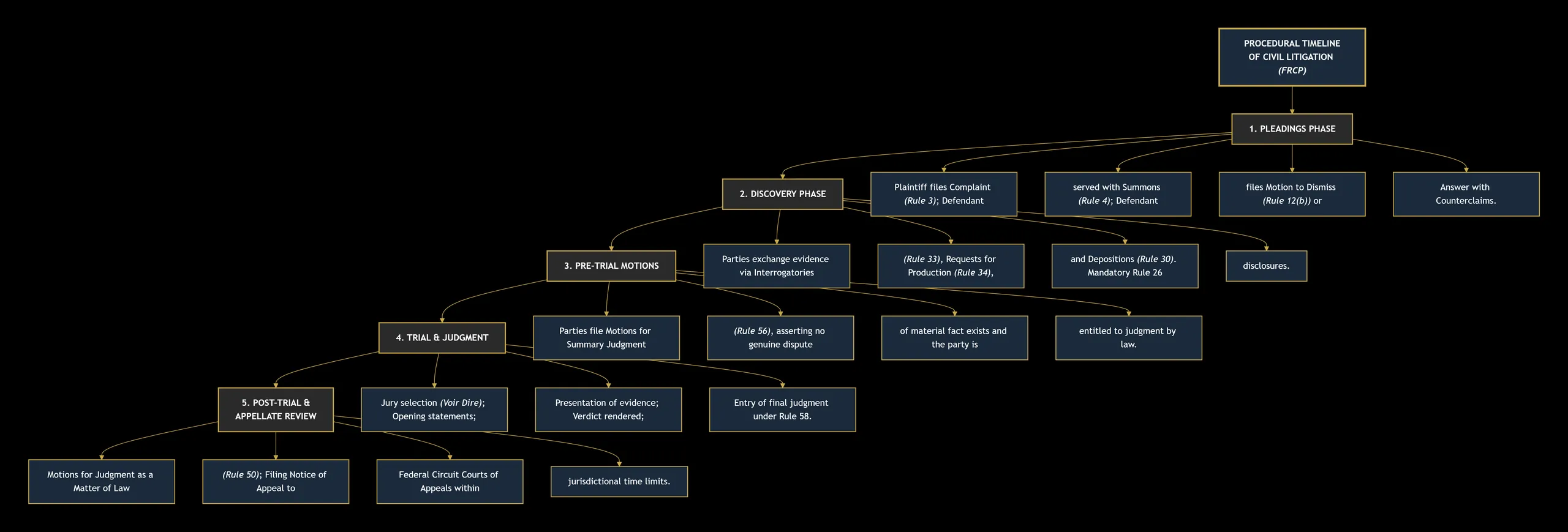
Frequently Asked Questions (FAQs)
What is the main difference between civil law and criminal law?
Civil law resolves private disputes between individuals, businesses, or organizations, focusing on compensating the injured party through monetary damages or injunctive relief. Criminal law deals with behavior that threatens or harms society as a whole, prosecuted directly by the government with potential penalties including fines, probation, or incarceration.
What is the distinction between public law and private law?
Public law governs the relationship between private individuals (or entities) and the state, including constitutional, administrative, and criminal law. Private law governs the legal relationships, duties, and disputes purely between private citizens or corporate entities, such as contracts, torts, property, and family law.
How do substantive law and procedural law work together?
Substantive law defines your actual legal rights, statutory prohibitions, and duties (e.g., what constitutes a breach of contract or theft). Procedural law sets the formal machinery and mechanics for enforcing those rights in court, such as filing deadlines, evidentiary rules, and jurisdictional requirements.
Why is administrative law considered so influential in modern practice?
Administrative law regulates executive branch agencies (such as environmental, labor, or financial regulators) that create and enforce daily operational rules. Because these agencies issue binding regulations and conduct administrative hearings, their decisions directly affect commercial operations and governance far more frequently than daily court trials.
What standard of proof is required in civil versus criminal cases?
Civil litigation typically requires a “preponderance of the evidence,” meaning the claim is more likely true than not (>50% probability). Criminal cases require the highest legal standard: “beyond a reasonable doubt,” requiring the prosecution to eliminate any reasonable uncertainty regarding the defendant’s guilt.
How do emerging fields like Cyber and AI law fit into traditional legal structures?
Emerging fields do not replace traditional categories; instead, they combine elements across public and private law. For instance, data privacy involves public administrative oversight (regulatory fines) alongside private civil litigation (class-action lawsuits for data breaches or intellectual property violations).

Daily Quiz
Contract Law
10 questions, new every day. See how many you get right — then come back tomorrow for a new category.
Question 1 of 10
What is "promissory estoppel"?
Promissory estoppel lets courts enforce a promise — even one made without formal consideration — when someone reasonably relied on it and would be unfairly harmed if the promise were not kept.
Question 2 of 10
Contracts for the sale of goods are generally governed by which body of law in the U.S.?
The UCC (adopted, with variations, in every U.S. state) governs contracts for the sale of goods, with somewhat different rules than the common law that governs contracts for services or real estate.
Question 3 of 10
What is a "condition" in contract law, broadly speaking?
Conditions are a core structural tool in contract drafting — they let parties make performance contingent on events (financing being approved, an inspection passing) rather than making every promise absolute and unconditional.
Question 4 of 10
When might a court order "specific performance" instead of money damages?
Specific performance is an equitable remedy, reserved for situations where money genuinely cannot make the injured party whole — the classic example is real estate, since every parcel of land is considered legally unique.
Question 5 of 10
What is an "adhesion contract"?
Adhesion contracts (like many standard consumer terms of service) are enforceable in general, but courts scrutinize unusually one-sided or buried terms within them more closely than terms in a contract both sides genuinely negotiated.
Question 6 of 10
What is a "quasi-contract" (or contract implied in law)?
Quasi-contract is not a real contract at all — it is a remedy courts impose to prevent one party from unfairly keeping a benefit received from another without paying for it, even absent any actual agreement.
Question 7 of 10
What does it mean for a contract to be "unconscionable"?
Unconscionability is a narrow doctrine — courts use it sparingly, for contracts so oppressive or one-sided (often combined with unequal bargaining power) that enforcing them would be fundamentally unfair.
Question 8 of 10
What does a "severability" clause do?
Severability clauses protect the overall deal — without one, a single unenforceable provision could sometimes threaten to unravel an entire contract; with one, courts can strike just that provision and leave everything else intact.
Question 9 of 10
What's the usual remedy when one party breaches a contract?
Contract law is generally compensatory, not punitive — the standard remedy is "expectation damages," designed to put the non-breaching party in the position they'd have been in if the deal had gone through.
Question 10 of 10
What is an "option contract"?
An option contract is created when the offeree pays (or otherwise provides consideration) to keep an offer open for a set period — unlike an ordinary revocable offer, the offeror cannot simply withdraw it during that period.
Come back tomorrow for Property Law.
Enjoyed Contract Law? Go deeper:
Take the free Contract Law course → Try the Contract Negotiation Simulator →A quick trivia game for general legal knowledge — not legal advice, and not affiliated with any bar exam or licensing body.
Advance Your Legal Analysis
Explore our interactive decision trees, litigation pipeline builders, and procedural court simulators designed specifically for law students and practitioners.
Access Interactive Tools →Related in Foundations of Law
The information provided in this article ("The Major Branches of Law: An Organized Map of the Entire Legal Field") is for general educational and informational purposes only and does not constitute formal legal advice. Reading this content does not create an attorney-client relationship. Laws vary by jurisdiction; consult a licensed attorney for specific legal matters.


0 Comments