
Comprehensive Guide to Property Law: Core Principles, Rights, and Legal Structures
Table of Contents
Module 1: Foundations and the Conceptual Framework of Property
Property law forms the structural foundation of organized society, defining how individuals, groups, and governments interact with physical and non-physical resources. Rather than merely regulating objects, property law establishes legally enforceable relationships between people regarding things.
Definition of Property Law
Property law is the legal domain governing the ownership, use, possession, and transfer of resources. It codifies the rights and duties owed by individuals and entities toward economic assets.
In legal jurisprudence, “property” does not refer to the physical object itself—such as a piece of land, a vehicle, or a patent—but rather to the legal relationship recognized by the state between an owner and everyone else concerning that resource. To understand the full scope of these legal relationships, explore our foundational overview on What Is Property?
.
Why Societies Recognize Ownership
Societies establish and enforce property rights for several fundamental reasons:
- Conflict Avoidance: Clear ownership rules replace system-wide disputes over resources with an orderly legal framework.
- Resource Management: Assigning property rights incentivizes owners to maintain, protect, and improve assets, preventing the “tragedy of the commons” where unowned resources are overexploited.
- Capital Formation: Legal recognition enables property to be pledged as collateral, borrowed against, and invested, fueling dynamic economic activity.
- Individual Autonomy: Ownership gives individuals a protected sphere of independence from external interference, including unauthorized interference by the state.
The Economic and Social Importance of Property Rights
From an economic perspective, well-defined property rights lower transaction costs and encourage long-term investment. An investor will not build a factory on land if a third party or government can seize it without compensation.
Socially, property law balances individual freedom with community obligations. Through mechanisms like zoning ordinances, environmental regulations, and eminent domain, property law enforces public goals while upholding private rights.
Property Rights vs. Contractual Rights
A critical legal distinction exists between rights in rem (property rights) and rights in personam (contractual rights):
| Property Rights (In Rem) | Contractual Rights (In Personam) |
| Enforceable against the entire world (erga omnes). | Enforceable only against specific parties to the agreement. |
| Attach directly to the resource or asset itself. | Attach to personal promises made between parties. |
| Persist even if the asset changes hands (subject to registration/notice). | Generally terminate upon performance, breach, or discharge. |
| Example: Owning a plot of land allows you to exclude anyone from trespassing. | Example: A contract with a painter allows you to sue only that painter if they fail to paint your house. |
The “Bundle of Rights” Metaphor
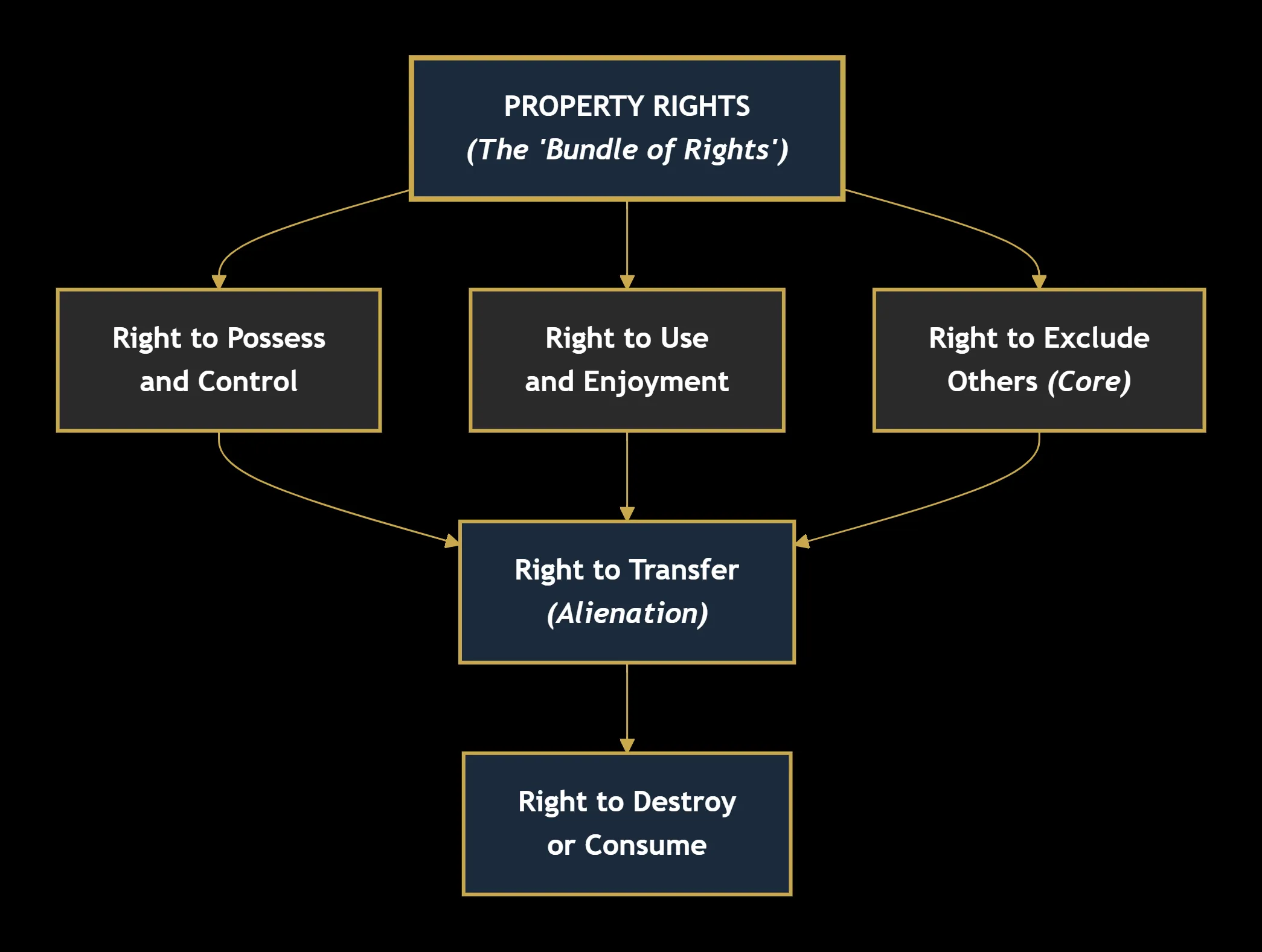
Legal scholars describe property not as a single monolithic right, but as a “bundle of sticks,” where each stick represents a distinct legal power over a resource. An owner may hold all the sticks or transfer individual sticks to others:
The Property Bundle:
- Right to Possess: The right to physically occupy or control the property.
- Right to Use: The right to harness, enjoy, or exploit the property for productivity or pleasure.
- Right to Exclude: The fundamental right to prevent others from entering, using, or interfering with the property.
- Right to Transfer (Alienation): The right to sell, gift, lease, or bequeath the property.
- Right to Destroy or Consume: The right to alter, exhaust, or dismantle the asset (subject to statutory limits).
Ownership vs. Possession
While laypeople often use these terms interchangeably, the distinction between title and control is a central concept in property law.
.
- Ownership (Title): The ultimate legal right and entitlement to an asset recognized by the law.
- Possession: The physical control or custody of an asset, coupled with the intent to exercise that control, regardless of whether legal title is held.
Public, Private, and Common Property
Property is classified by who holds the legal bundle of rights:
- Private Property: Owned by private individuals, corporations, or legal entities. Access and usage are controlled by the titleholder.
- Public Property: Owned by governmental bodies for public benefit (e.g., state parks, municipal roads, public schools).
- Common Property (The Commons): Owned and managed collectively by a group or accessible to all members of a community under shared rules (e.g., communal pastures or public water systems).
Module 2: Classification and Categories of Property
Understanding how property law categorizes assets is essential because different rules govern transfer, taxation, inheritance, and dispute resolution depending on the asset’s classification.
Real Property vs. Personal Property
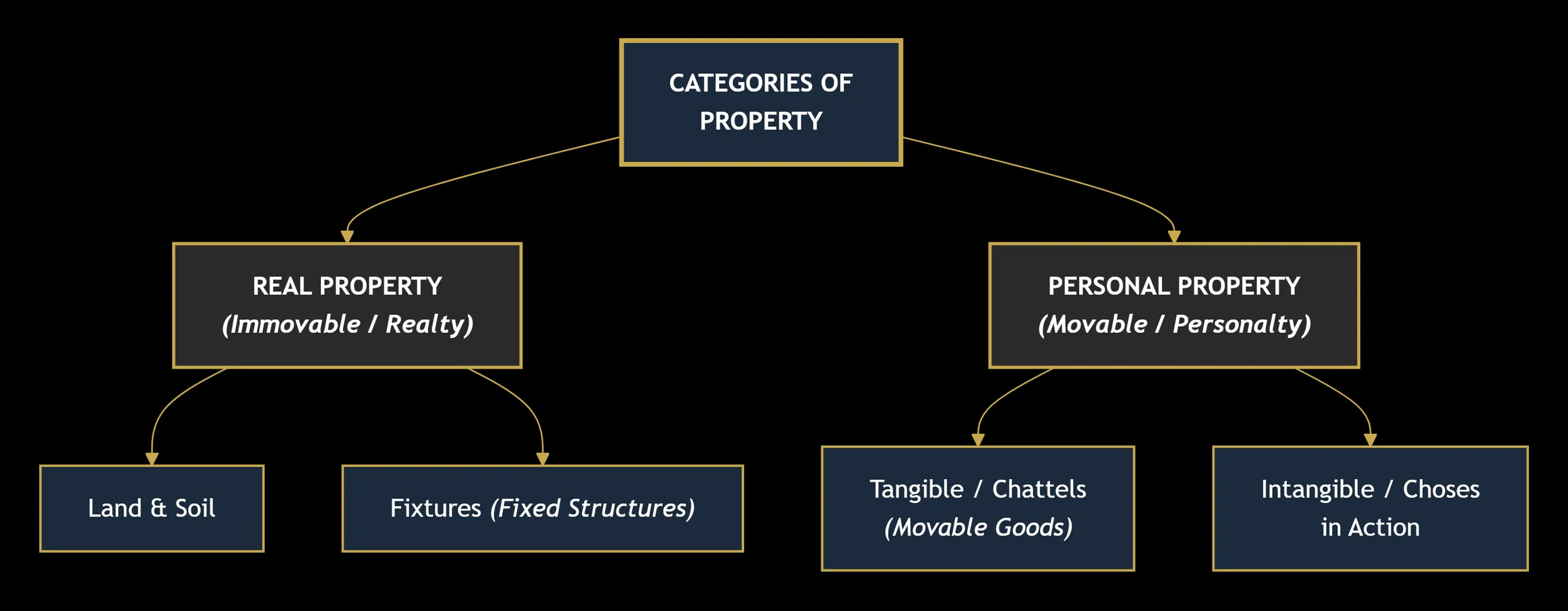
The fundamental division in common law property systems separates immovable property from movable items.
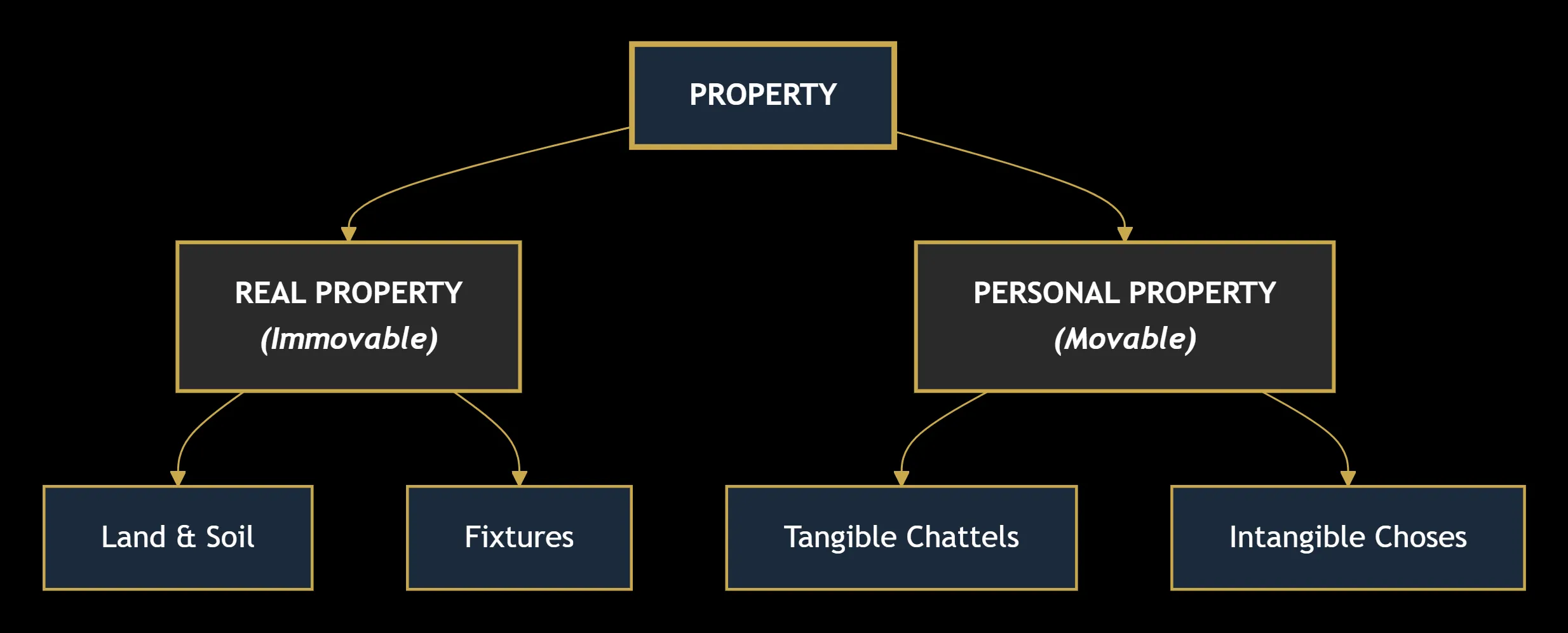
- Real Property (Realty / Immovable Property): Consists of land, everything beneath the surface, the air space above, and permanent structures or items affixed to it. Real property cannot be moved without changing its identity or destroying its form.
- Personal Property (Personalty / Chattels / Movable Property): Consists of any asset that is not land or permanently affixed to land. This includes physical goods, money, vehicles, and intangible legal rights.
Fixtures vs. Chattels
A frequent legal issue arises when personal property becomes attached to real property, transforming a chattel into a fixture. To explore the legal tests used by courts to resolve these disputes, review our detailed resource on Fixtures and Chattels
.
The Three-Part Fixture Test:
- Degree of Annexation: How firmly is the item attached to the land or structure? Can it be removed without causing damage?
- Purpose/Object of Annexation: Was the item affixed for the permanent improvement of the real estate, or temporarily for the enjoyment of the item itself?
- Intention of the Annexing Party: What was the objective intention of the party who installed the item at the time of installation?
Trade Fixtures Exception
Items installed by a commercial tenant to conduct business (e.g., display cases, industrial ovens, specialized lighting) are classified as trade fixtures. Tenants generally retain the right to remove trade fixtures prior to the expiration of the lease, provided they restore the premises to their original condition.
Tangible vs. Intangible Property
Personal property is subdivided based on physical existence:
- Tangible Personal Property (Choses in Possession): Physical items that can be touched, held, and physically moved (e.g., jewelry, vehicles, livestock, machinery).
- Intangible Personal Property (Choses in Action): Assets that represent value but lack physical substance. They are legally protected claims enforced through legal action (e.g., corporate stocks, bank accounts, intellectual property like patents and copyrights, debts, contract rights).
| Feature | Real Property | Tangible Personal Property | Intangible Personal Property |
| Physicality | Physical / Immovable | Physical / Movable | Non-Physical / Conceptual |
| Governing Law | Local Land Laws & Registries | Uniform Commercial Code / Sales Laws | Contract, IP, & Financial Law |
| Transfer Method | Deed & Registration | Physical Delivery / Bill of Sale | Assignment / Digital Transfer |
| Examples | Farms, houses, minerals | Cars, furniture, inventory | Trademarks, debts, shares |
Module 3: Ownership Structures, Co-Ownership, and Title Types
Ownership structures define how legal entitlements to property are held, managed, and divided among one or more individuals or entities.
Legal Ownership vs. Equitable Ownership
Common law legal systems distinguish between holding title recognized at law and holding beneficial entitlement recognized in equity:
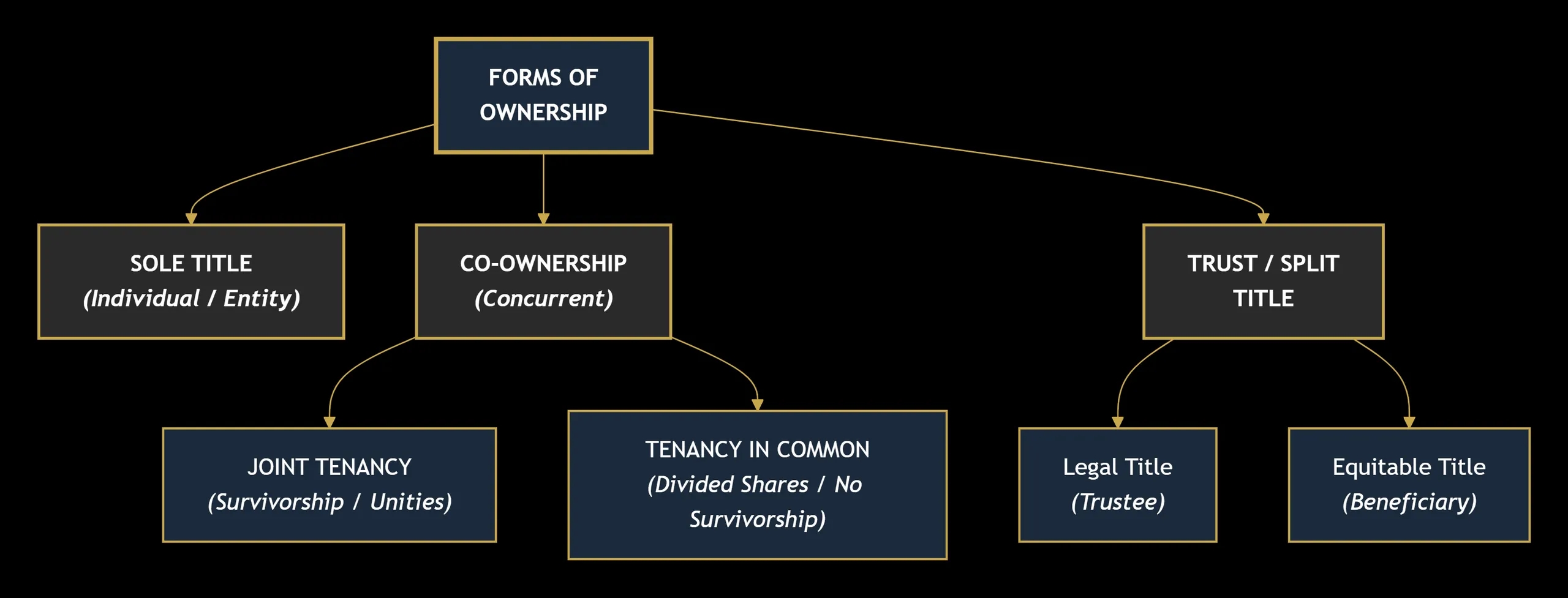
- Legal Ownership: The legal titleholder named in official registries or deeds. The legal owner holds formal managerial power over the asset.
- Equitable (Beneficial) Ownership: The entity entitled to the economic benefit, use, and enjoyment of the property.
Example: In a land trust, a corporate trustee holds the legal title and manages the property, while the beneficiary holds the equitable title and receives rental income or occupies the premises.
Sole Ownership vs. Concurrent Ownership
- Sole Ownership (Ownership in Severalty): Property held by a single natural person or legal entity (such as a corporation). The sole owner holds all rights in the bundle.
- Concurrent Ownership (Co-Ownership): Property owned by two or more individuals or entities simultaneously.
Co-Ownership Models: Joint Tenancy vs. Tenancy in Common
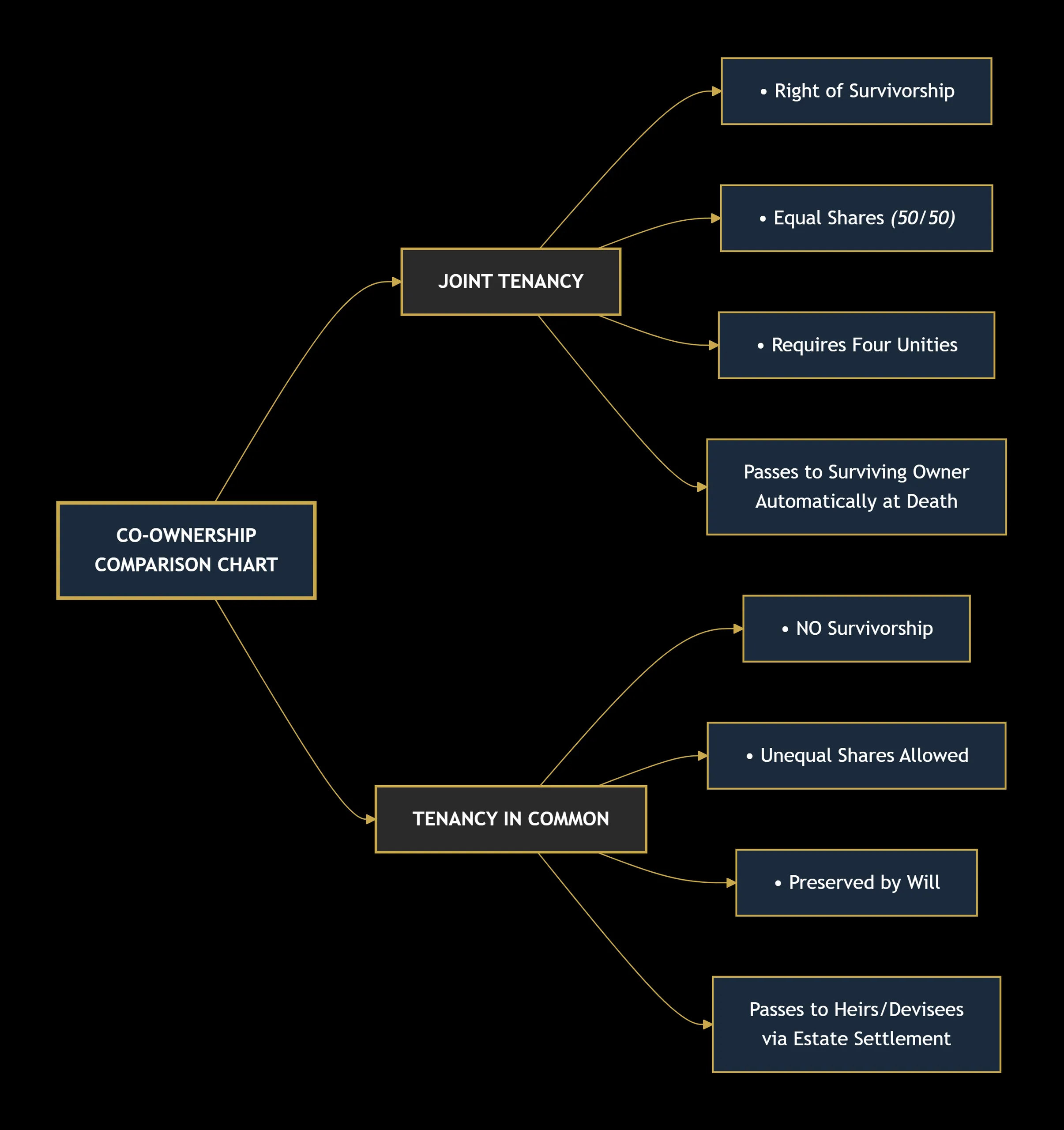
When multiple parties hold title to real or personal property, the law assigns specific rights and duties to each co-owner. To understand these structures, review our detailed guides on Joint Tenancy and Tenancy in Common.
Joint Tenancy
Joint tenancy features the Right of Survivorship (jus accrescendi). When one joint tenant dies, their interest automatically terminates and vests equally in the surviving joint tenants. The interest does not pass through the deceased tenant’s will or estate.
To create a valid joint tenancy, traditional common law requires the Four Unities:
The Four Unities of Joint Tenancy:
- Unity of Time: All owners must acquire their interests at the exact same time.
- Unity of Title: All owners must acquire title through the exact same legal instrument (deed or will).
- Unity of Interest: All owners must hold equal percentage shares and identical estate durations.
- Unity of Possession: All owners must hold an equal, undivided right to possess and enjoy the entire property.
Severance: If a joint tenant transfers or mortgages their interest to a third party, the unity of title and time is broken. This severs the joint tenancy with respect to that share, converting it into a Tenancy in Common.
Tenancy in Common
Tenancy in Common (TIC) is the default form of co-ownership when multiple parties acquire title without explicit survivorship language.
- No Right of Survivorship: When a tenant in common dies, their share passes to their named heirs in a will or through statutory intestate laws.
- Flexible Ownership Shares: Tenants in common can hold unequal shares (e.g., Party A owns 70%, Party B owns 30%).
- Single Unity Required: Only the Unity of Possession is required—each tenant in common has the right to occupy the entire property regardless of their percentage share.
| Feature | Joint Tenancy | Tenancy in Common |
| Right of Survivorship | Yes (Passes automatically to surviving owners) | No (Passes to deceased owner’s heirs/estate) |
| Ownership Shares | Must be strictly equal | Can be divided in any percentage |
| Creation Requirements | Requires Four Unities (Time, Title, Interest, Possession) | Requires Unity of Possession only |
| Termination / Severance | Severed by conveyance or agreement; becomes TIC | Terminated by agreement, partition, or merger |
Partition Actions
When co-owners cannot agree on how to manage, lease, or dispose of real property, any co-owner can file a lawsuit for partition:
- Partition in Kind: The court physically divides the land into separate parcels matching each owner’s share.
- Partition by Sale: The court orders a public or private sale of the entire property and distributes the net proceeds proportionally among the co-owners based on their ownership percentages.
Module 4: Possession, Estates, and Interests in Land
Possession is a foundational legal concept, while the doctrine of estates provides the framework for structuring land rights across time.
The Law of Possession
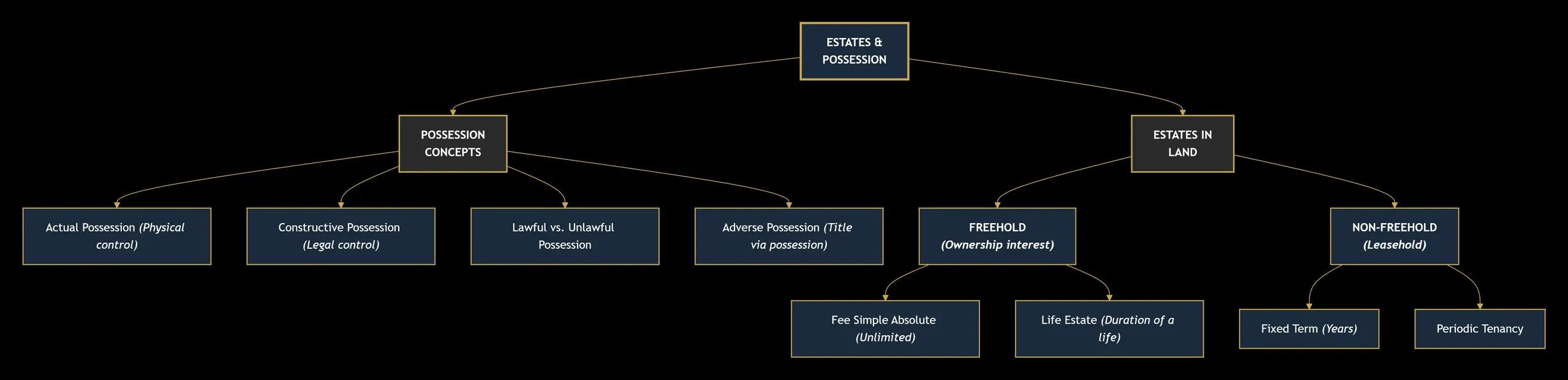
Possession requires two elements: physical control (corpus) and the intention to control (animus possidendi).
.
- Actual Possession: Direct physical control over property (e.g., driving your car or holding a tablet).
- Constructive Possession: Control over property without direct physical contact, supported by legal authority and the power to control (e.g., owning items inside a rented storage locker when you hold the key).
- Lawful Possession: Exercising physical control based on valid legal rights (e.g., a owner or a tenant under a valid lease).
- Unlawful Possession: Exercising physical control without legal entitlement (e.g., a trespasser or a holdover tenant).
Adverse Possession
Adverse possession allows a non-owner who occupies land without permission to acquire legal title if their possession meets strict statutory standards for a set period (typically 5 to 20 years depending on the jurisdiction). For a comprehensive breakdown of statutory periods and legal requirements, consult our guide to Adverse Possession
.
Elements of Adverse Possession (HOEAC):
- Hostile (Adverse): Possession occurs without the permission of the true legal titleholder and infringes on their rights.
- Open and Notorious: Occupation is visible and obvious, putting a reasonable property owner on notice.
- Exclusive: The adverse possessor does not share control with the public or the legal owner.
- Actual: The adverse possessor uses the land as a true owner would, relative to the nature and location of the property.
- Continuous: Possession continues uninterrupted for the full statutory time frame.
Estates in Land (Doctrine of Estates)
Common law jurisdictions measure interests in land by duration or time. An “estate” represents a legal ownership interest in land that is defined by its duration.
Freehold Estates
Freehold estates involve an ownership interest of uncertain or indefinite duration:
- Fee Simple Absolute: The largest and most complete estate in land recognized by law. The owner holds full rights to possess, use, transfer, and inherit the land forever, subject only to governmental powers (taxation, eminent domain, police power, and escheat).
- Defeasible Fee Estates: Fee simple ownership that automatically terminates or may be ended by the original grantor upon the occurrence or non-occurrence of a specified event (e.g., “To City, so long as used as a public park”).
- Life Estate: An estate measured by the natural lifespan of a designated individual (the life tenant).
- Life Estate Pur Sa Vie: Measured by the life tenant’s own lifespan.
- Life Estate Pur Autre Vie: Measured by the lifespan of a third party.
- Doctrine of Waste: Life tenants must preserve the property’s value for future interest holders. They cannot commit voluntary waste (affirmative damage), permissive waste (neglect), or ameliorative waste (unauthorized structural changes that alter the character of the land, even if those changes increase its value).
Future Interests
A future interest is a present, legally protected right to take physical possession of land at a later date:
- Reversion: A future interest retained by the original grantor when they convey an estate of shorter duration than what they held (e.g., Grantor conveys a Life Estate; upon the life tenant’s death, possession reverts to the Grantor).
- Remainder: A future interest granted to a third party that takes effect immediately upon the natural expiration of a preceding estate (e.g., “To Person A for life, then to Person B”).
- Vested Remainder: Granted to a designated person with no conditional prerequisites.
- Contingent Remainder: Dependent on a specified condition occurring or granted to an unidentified individual.
Module 5: Property Transfer, Title Systems, and Conveyancing
The legal process for transferring rights from one owner to another requires specific formalities to ensure stability and public notice.
Modes of Property Transfer
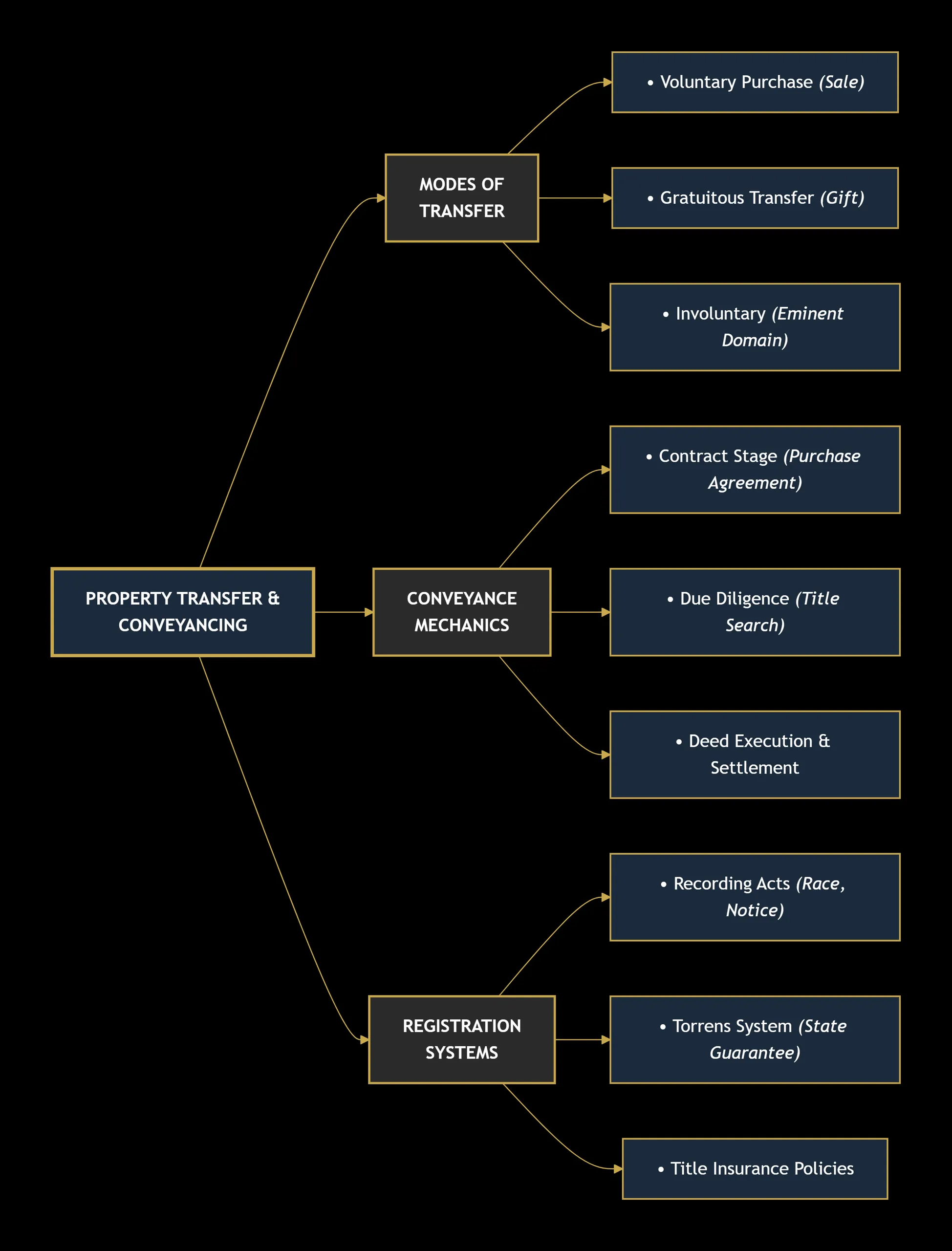
- Sale (Purchase and Sale): The most common voluntary transfer, where ownership rights are exchanged for valuable consideration (money or traded assets).
- Gift: Voluntary transfer made without financial consideration. A valid legal gift requires three elements:
- Donative Intent: The donor intends to transfer ownership permanently.
- Delivery: The donor surrenders physical or constructive control over the asset.
- Acceptance: The recipient accepts the gift (presumed unless expressly rejected).
- Inheritance: Property transferred upon death through a valid will (testate succession) or via statutory rules when no valid will exists (intestate succession).
- Involuntary Transfers: Property transfers that occur without owner consent, including foreclosure sales, tax sales, adverse possession judgments, and government takings via eminent domain.
The Conveyancing Process
Conveyancing is the legal and administrative procedure that transfers legal title to real estate from a seller to a buyer. To learn more about standard transaction workflows, examine our overview on Conveyancing
.
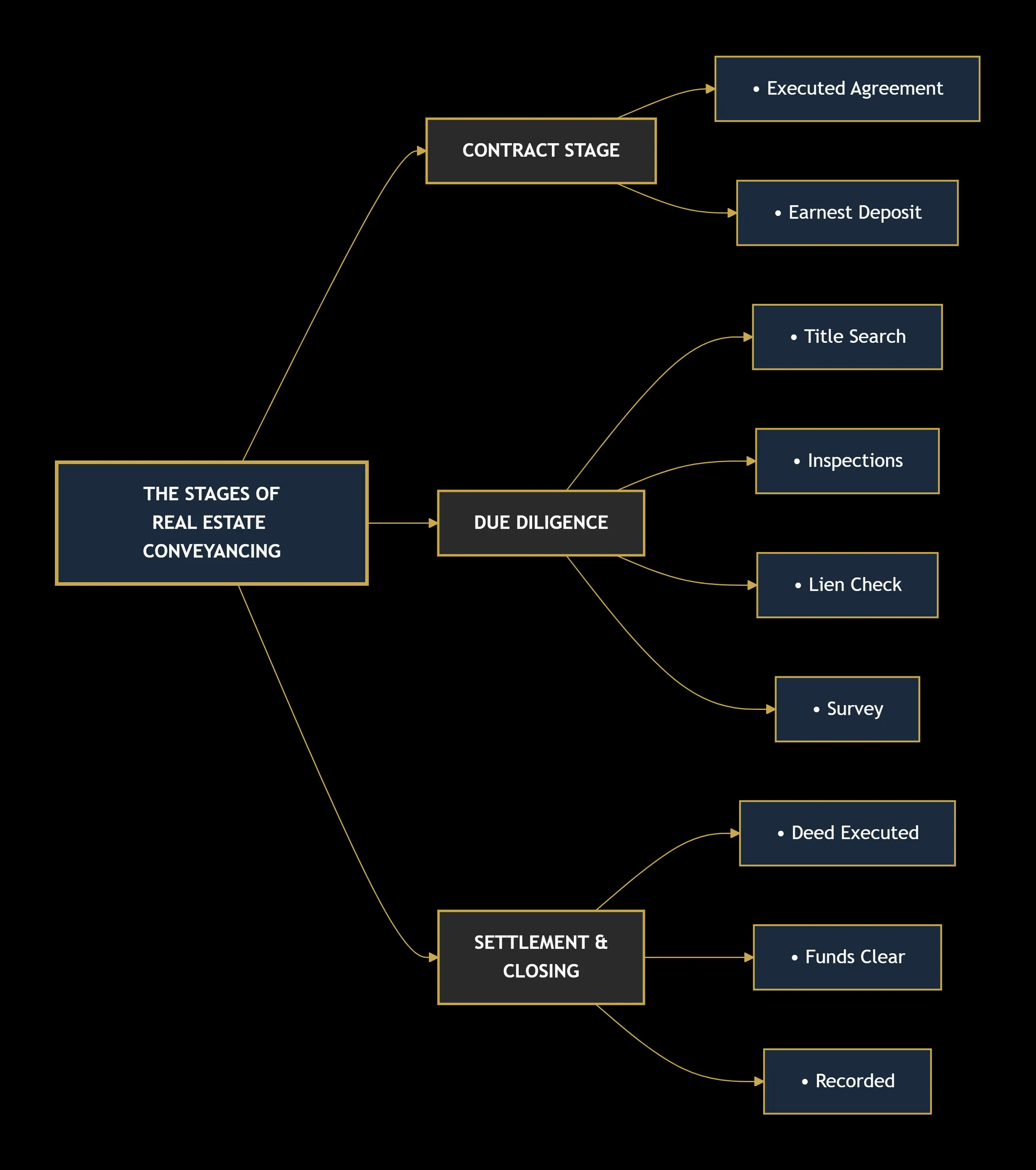
- Contract Stage: Seller and buyer sign a binding real estate sales contract detailing price, terms, contingencies, and closing dates.
- Due Diligence Stage: The purchaser conducts inspections, secures financing, performs property surveys, and investigates legal title.
- Settlement and Closing: Consideration is paid, seller executes and delivers a property deed, and settlement documents are finalized.
Property Deeds
A deed is a formal written legal document used to transfer legal title to real property. For a complete comparison of transaction documents, see our detailed guide on Property Deeds
.
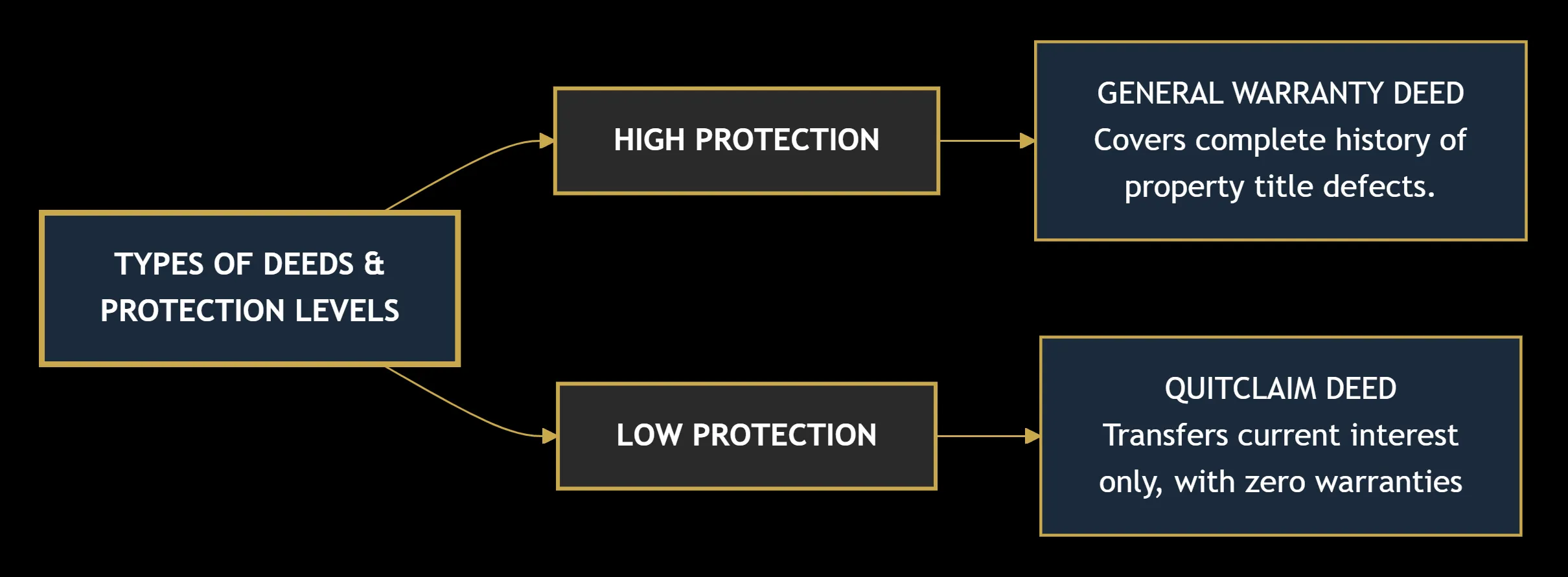
- General Warranty Deed: Offers the highest level of buyer protection. The grantor guarantees clear title and warrants against all defects, even those originating prior to the grantor’s ownership.
- Special (Limited) Warranty Deed: The grantor guarantees only that they have done nothing to cloud title during their ownership period.
- Quitclaim Deed: Transfers whatever interest or title the grantor holds in the property without warranties or guarantees. Often used to clear title defects or transfer property between family members.
Land Registration and Title Systems
A clear title system ensures purchasers receive clean title and provides public notice of property ownership.
.
Legal Title vs. Equitable Title in Conveyancing
Once a real estate sales contract is executed, the buyer acquires equitable title (the enforceable right to acquire legal ownership), while the seller retains legal title as security for payment until closing. Upon closing, legal title transfers through the deed.
Public Recording Acts
In many jurisdictions, public land record offices maintain chronological registries of deeds, mortgages, and encumbrances. When conflicting claims to the same property arise, courts resolve disputes based on local recording statutes:
- Race Statutes: Whichever party records their deed first in public records wins title, regardless of whether they knew about prior unrecorded deeds.
- Notice Statutes: A subsequent good-faith purchaser who pays value without notice of an earlier unrecorded transaction takes title, regardless of who records first.
- Race-Notice Statutes: A subsequent good-faith purchaser who takes without notice of prior unrecorded claims wins title only if they record their deed first.
The Torrens System
Under the Torrens system, the state maintains a centralized registry that guarantees land ownership. A state-issued Certificate of Title serves as definitive proof of ownership. Any encumbrances or interests must be endorsed directly on the certificate, eliminating the need to review historical land records.
Chain of Title and Title Insurance
- Chain of Title: The continuous public record of historical ownership transfers tracing back to the original land grant. A break in the chain creates a “cloud on title.”
- Title Insurance: An insurance policy protecting property owners or lenders against financial loss caused by undiscovered title defects, unrecorded liens, or fraud.
Module 6: Encumbrances, Rights Over Land, Tenancies, and Mortgages
Encumbrances are non-possessory rights or financial claims held by third parties that limit an owner’s control over real property.
Non-Possessory Rights Over Another Person’s Land
These interests allow third parties to use or control property without holding title or exclusive possession.
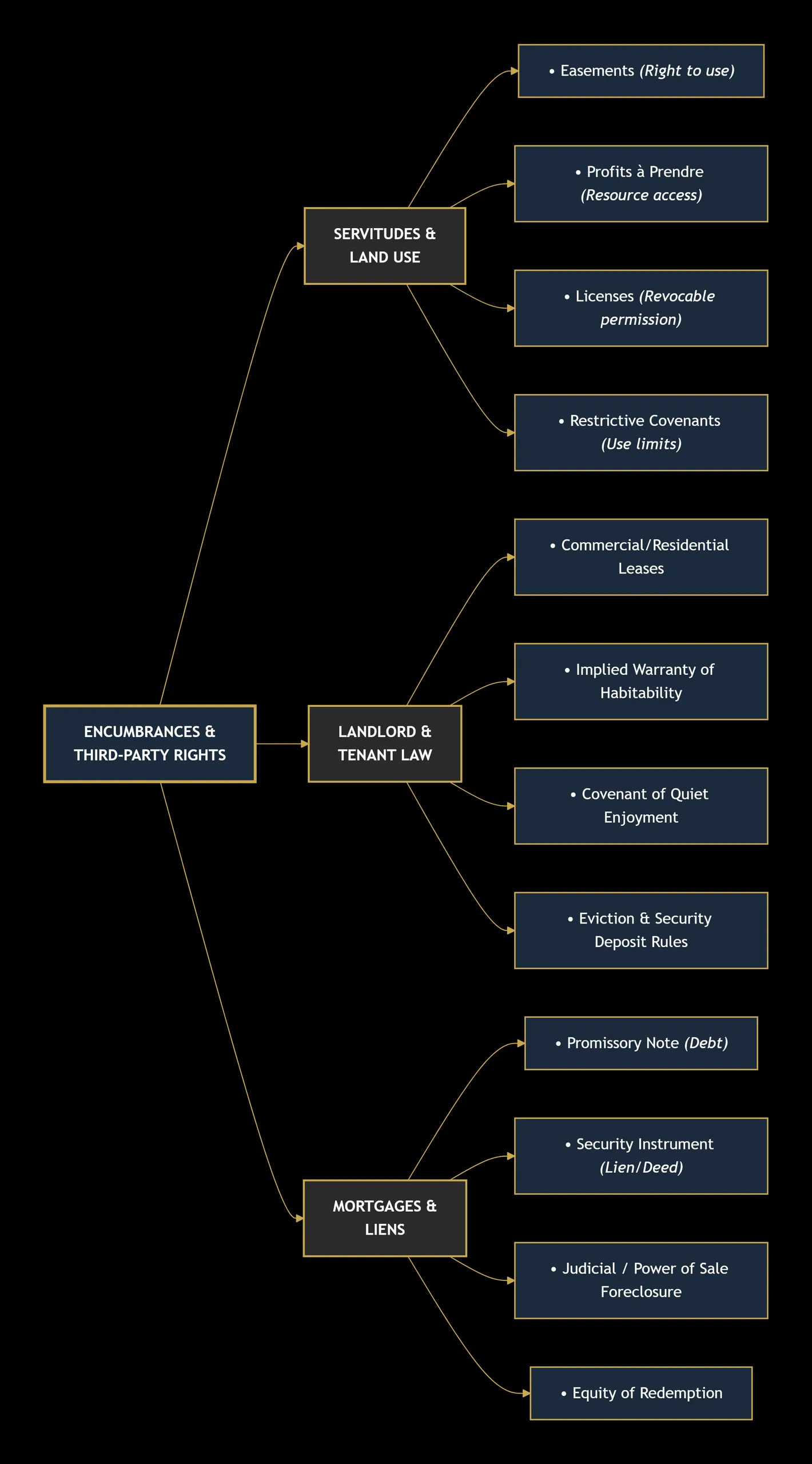
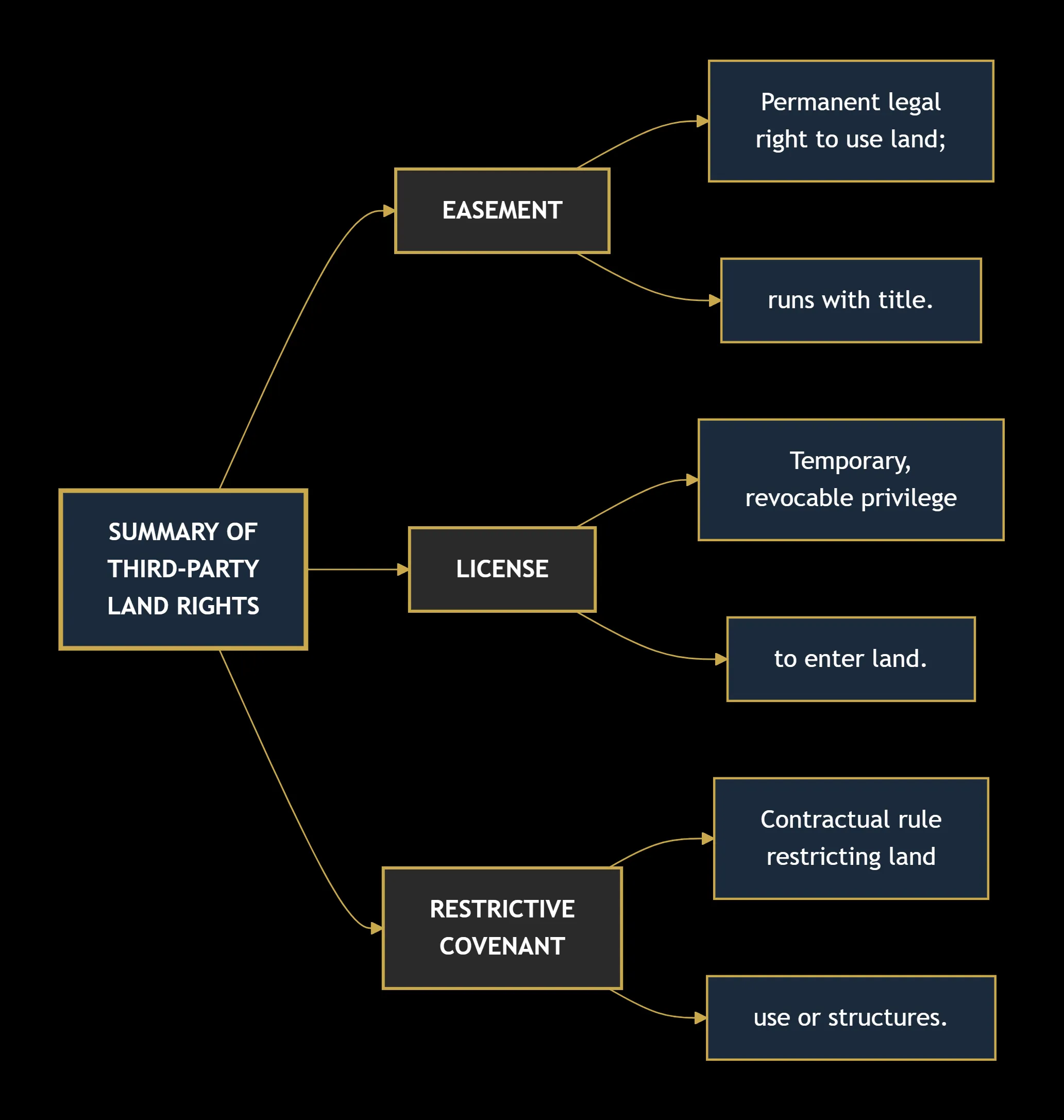
- Easements: A non-possessory right to use another person’s real estate for a specific purpose.
- Easement Appurtenant: Benefits a neighboring parcel of land (the dominant tenement) and runs with the land across future owners.
- Easement in Gross: Benefits a specific individual or commercial enterprise (e.g., utility company pipeline access) rather than a neighboring parcel.
- Profits à Prendre: A non-possessory right to enter someone else’s land and extract natural resources, such as timber, minerals, or game.
- Licenses: Revocable, personal permission to enter land for a specific, limited purpose (e.g., purchasing a stadium ticket to attend a game). Unlike easements, licenses can be canceled by the property owner at any time.
- Restrictive Covenants: Contractual conditions embedded in property deeds that limit how land can be developed, painted, or used. Covenants “run with the land” if they bind future purchasers.
- Rights of Way: A specific form of easement that grants legal authorization to travel across a defined path on private property.
Landlord and Tenant Law (Leasehold Estates)
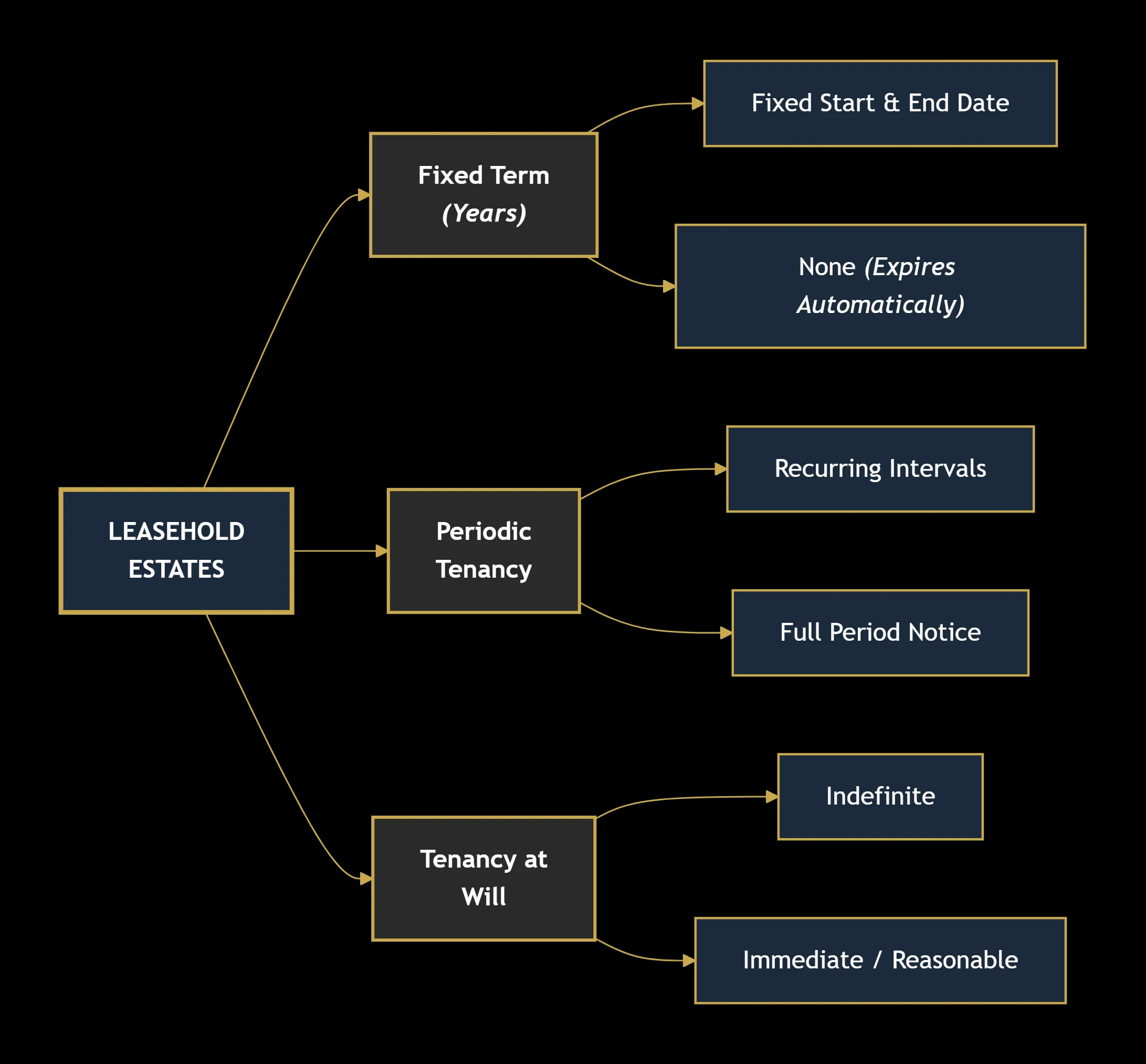
A leasehold creates a temporary possessory interest for a tenant while the landlord retains ultimate ownership (reversionary interest).
- Core Duties of Landlords:
- Implied Warranty of Habitability: Landlords must maintain residential rental property in a safe, healthy, and livable condition.
- Covenant of Quiet Enjoyment: Landlords must not interfere with the tenant’s legal right to peaceably occupy the premises without unlawful entry or disturbance.
- Core Duties of Tenants:
- Duty to pay agreed rent on time.
- Duty to prevent waste and repair damage caused by intentional abuse or neglect.
- Evictions and Security Deposits: Landlords cannot use self-help eviction measures (such as changing locks or cutting off utilities). They must follow formal statutory eviction procedures. Security deposits must be held in escrow accounts and returned within statutory timelines, minus itemized deductions for damages beyond normal wear and tear.
Mortgages and Security Interests
A mortgage is a debt arrangement where real estate serves as collateral for a loan.
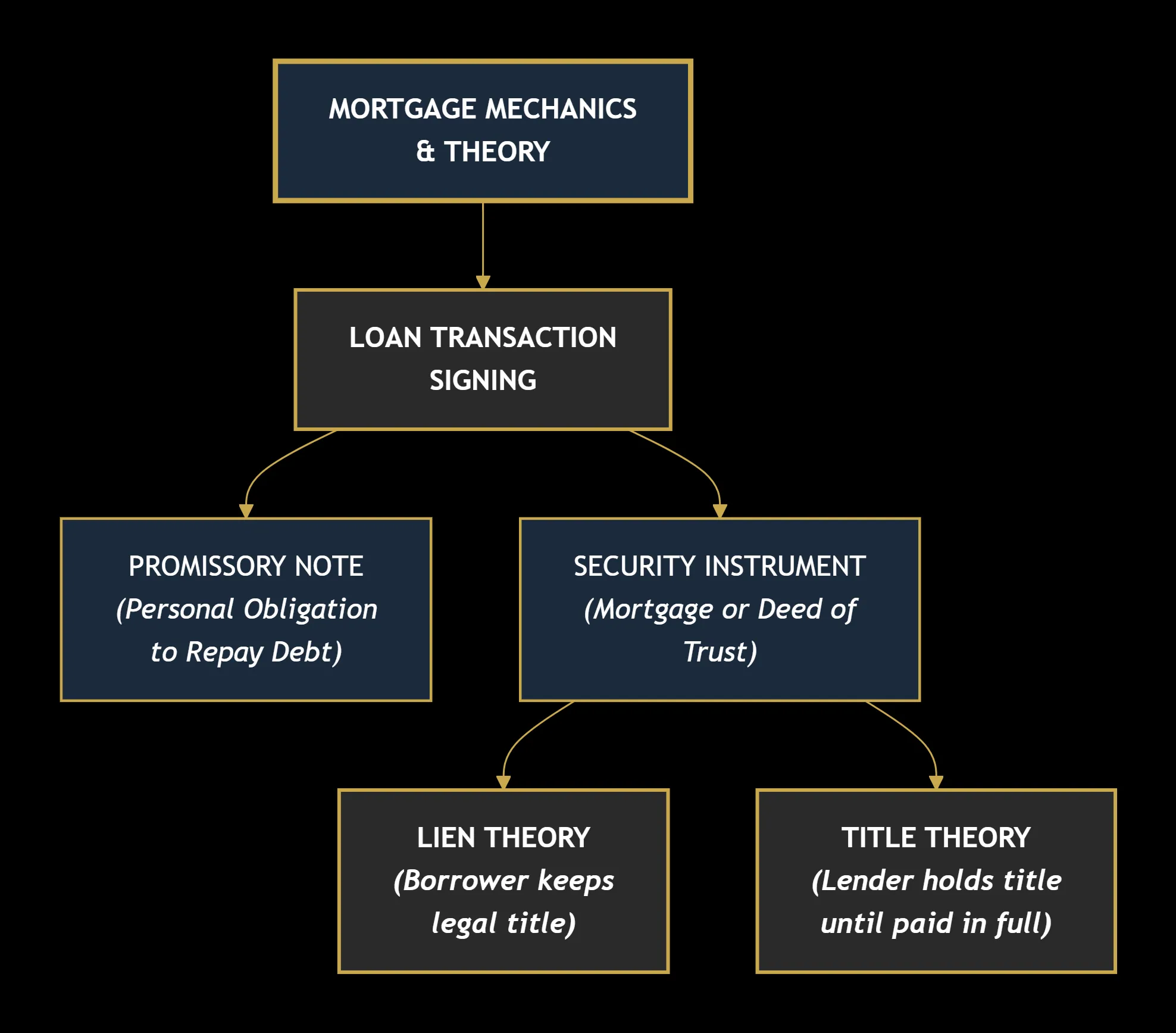
- The Two Core Instruments:
- Promissory Note: The legal document detailing the borrower’s personal obligation to repay the debt, including interest rates and payment terms.
- Security Instrument (Mortgage / Deed of Trust): Creates a legal lien against the real property, securing the debt evidenced by the promissory note.
- Title Theory vs. Lien Theory:
- Lien Theory: The borrower (mortgagor) holds legal and equitable title. The lender (mortgagee) holds a financial lien against the property until the debt is paid off.
- Title Theory: The lender holds legal title to the real estate through a security instrument, while the borrower holds equitable title until the mortgage is fully satisfied.
- Foreclosure and Equity of Redemption: If a borrower defaults, the lender can enforce its security interest through foreclosure (either judicial or power-of-sale) to sell the property and apply the proceeds toward the debt.
- Equity of Redemption: The borrower’s legal right to stop foreclosure proceedings by paying off the full outstanding mortgage debt plus fees before the foreclosure sale occurs.
- Liens: Financial claims attached to real or personal property to secure payment of a debt. Common examples include mechanic’s liens, property tax liens, and court judgment liens.
Module 7: Property Disputes, Key Takeaways, and Frequently Asked Questions
Understanding how courts resolve disputes over land, possession, and boundary lines is essential for protecting ownership rights.
Common Property Disputes and Actions
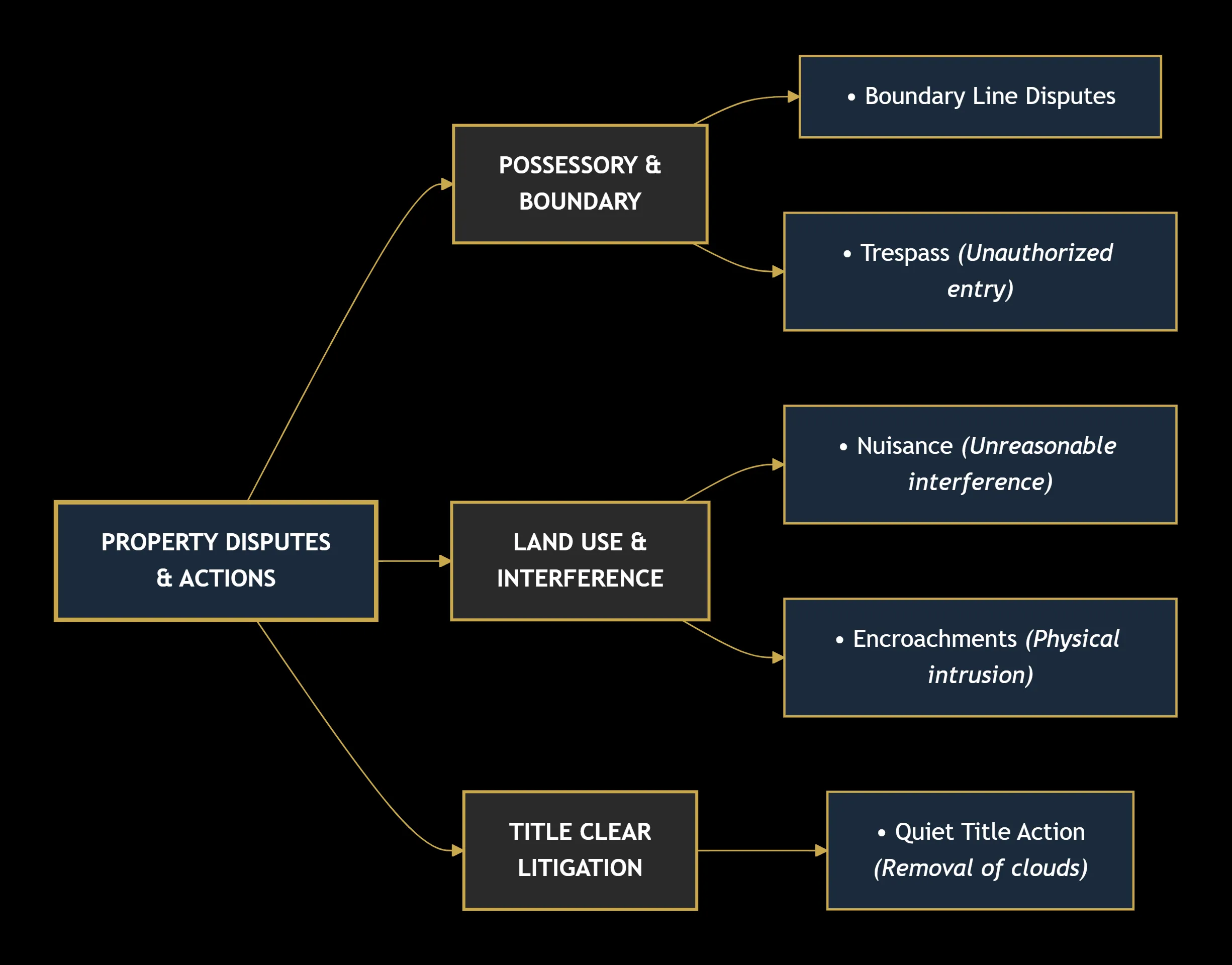
Property disputes often involve competing boundary claims, physical trespass, or land use conflicts:
- Boundary Disputes: Conflicts over the location of property lines. Courts resolve these using historical deeds, physical monuments, land surveys, and legal doctrines like agreed boundaries.
- Trespass to Land: Direct, intentional, unauthorized physical entry onto another person’s private real estate.
- Nuisance: Unreasonable and substantial interference with a property owner’s use and enjoyment of their land.
- Private Nuisance: Affects a specific neighbor or a small group of surrounding property owners (e.g., extreme noise, vibration, or odors from a neighboring business).
- Public Nuisance: Affects the health, safety, comfort, or general convenience of the public at large (e.g., blocking a public road or running an illegal chemical waste site).
- Encroachments: A physical structure or improvement that extends over a boundary line onto neighboring land without permission (e.g., a garage, wall, or roof overhang built past the property line).
- Quiet Title Actions: A lawsuit filed to confirm an owner’s title to real property and eliminate competing claims or historical title defects (“clouds on title”).
Frequently Asked Questions
What is the fundamental difference between real property and personal property?
The core distinction centers on mobility and how the legal system treats transfers and rights. Real property consists of land, natural resources beneath the soil, atmospheric space above, and permanent physical structures attached to the land. Because real estate is fixed in place, its ownership, transfer, and taxation are governed by local land laws and public recording registries.
Personal property consists of assets that are movable and not permanently attached to land. Personal property is split into two categories: tangible personal property (physical goods like machinery, vehicles, and furniture) and intangible personal property (non-physical financial rights like corporate stock, bonds, intellectual property, and contract claims). Personal property transactions are governed by sales codes (such as the Uniform Commercial Code) and standard contract principles, rather than formal deed recording systems.
How does a Joint Tenancy differ from a Tenancy in Common, and why does survivorship matter?
The primary legal distinction between a Joint Tenancy and a Tenancy in Common is the Right of Survivorship:
- Joint Tenancy: Joint tenants hold equal, undivided percentage interests in property created simultaneously through the exact same title deed. When a joint tenant dies, their ownership share automatically terminates and divides among the surviving joint tenants. The deceased owner’s share does not pass through their will or estate, avoiding probate.
- Tenancy in Common: Tenants in common can hold unequal shares (e.g., 60% and 40%) acquired at different times under separate deeds. Crucially, there is no right of survivorship. When a tenant in common dies, their ownership share passes to their named beneficiaries in a will or to their statutory heirs through probate administration.
The right of survivorship determines whether property passes automatically to co-owners or can be inherited by outside family members, making choice of title critical in estate planning.
Can someone gain lawful ownership of land through Adverse Possession?
Yes. Adverse possession allows an individual who occupies land without permission to claim legal title if they satisfy strict common-law and statutory conditions for an uninterrupted period (typically between 5 and 20 years).
To gain legal ownership, the squatter or trespasser must establish that their possession was Hostile (without the true owner’s consent), Open and Notorious (visible so a reasonable owner would notice), Exclusive (not shared with the owner or general public), Actual (using the land as a true owner would), and Continuous for the full statutory timeline. If all requirements are met, the adverse possessor can bring a quiet title action to strip the original owner’s title and obtain legal ownership in their own name.
What is the difference between legal title and equitable title?
Legal title and equitable title split the management responsibilities and economic benefits of real property between different parties:
- Legal Title: Grants formal legal ownership, management authority, and the right to hold recorded deeds in public registries. The legal titleholder represents the property in formal land transactions.
- Equitable Title: Grants beneficial enjoyment, financial use, and the enforceable right to obtain legal title in the future.
Example in Real Estate Conveyancing: When a seller and buyer sign a real estate purchase agreement, the buyer gains equitable title immediately. If the property’s value increases before closing, that financial benefit belongs to the buyer. The seller retains legal title as security until the purchase price is paid at closing, at which point legal title is formally conveyed via deed.
Example in Trust Law: A trustee holds legal title to real estate, while the beneficiary holds equitable title, receiving rental proceeds and possessing the right to occupy the property.
What is an easement, and how does it affect property values and land use rights?
An easement is a non-possessory legal right that permits a person or entity to use a portion of real estate owned by someone else for a specified purpose. The land burdened by the easement is called the servient estate, while the land or party benefiting from the easement is called the dominant estate.
Common examples include utility easements (permitting power lines or water pipes to run across private land) and access easements (allowing a landlocked neighbor to drive across a driveway to reach a public road).
An easement can impact property values depending on its scope. Access or utility easements that serve the property generally preserve or increase land value. However, heavy easements that limit building placement, restrict structural modifications, or allow frequent third-party access can reduce land value and make the real estate harder to sell.
What steps are involved in a Quiet Title Action, and when is one necessary?
A Quiet Title Action is a lawsuit filed in court to establish clear legal ownership of real property and eliminate competing claims, encumbrances, or historic recording defects (“clouds on title”).
- When It Is Necessary:
- Resolving breaks or gaps in historical chains of title.
- Clearing outdated, unreleased mortgages or old mechanics’ liens.
- Settling boundary disputes with neighboring landowners.
- Establishing legal title following a successful adverse possession claim.
- Confirming clear title following tax sales or foreclosure sales.
- Steps Involved:
- Title Search: A comprehensive review of public records to identify all recorded claims, liens, and clouds on title.
- Filing the Complaint: The property owner files a formal quiet title complaint in the jurisdiction where the real estate is located.
- Serving Notice: Formal legal notice is delivered to all named parties, potential claimants, and unknown heirs who might assert an interest in the land.
- Judicial Review: The court evaluates the evidence, title records, surveys, and competing arguments.
- Final Judgment: The court issues a binding decree declaring the plaintiff the sole legal owner and clearing clouds from the public title registry.
What is the “bundle of rights” concept in property law, and how can these rights be split?
The “bundle of rights” concept is a foundational legal metaphor that describes property ownership not as a single physical object, but as a collection of individual legal entitlements (sticks) held over an asset.
The standard bundle includes:
- The right to possess (occupy the property).
- The right to use (exploit or develop the property).
- The right to exclude (keep others off the property).
- The right to transfer (sell, gift, lease, or bequeath the property).
- The right to destroy (alter, dismantle, or consume the property).
These rights can be split and distributed among multiple parties simultaneously. For instance, a fee-simple real estate owner can lease possessory and usage rights to a residential tenant for two years, grant a utility company an easement right to run lines across the backyard, mortgage the legal security interest to a commercial bank, and retain the underlying right to sell the property subject to those active encumbrances.
What happens to a mortgage during a property transfer or foreclosure?
When real property encumbered by a mortgage is transferred or enters default, specific legal principles dictate the outcome:
- Property Transfers (Sales):
- Satisfaction at Closing: The seller uses the sale proceeds to satisfy the outstanding loan balance, releasing the mortgage lien before delivering clean title to the buyer.
- Due-on-Sale Clause: Most modern mortgages include a due-on-sale clause, which accelerates the debt and requires full repayment if the title is transferred without the lender’s prior consent.
- Assuming a Mortgage vs. Taking “Subject To”: If a buyer assumes an existing mortgage, they become personally liable for the debt. If a buyer takes title “subject to” an existing mortgage, the original borrower remains personally liable, but the property remains subject to foreclosure if payments cease.
- Foreclosure:
- Default Trigger: If the borrower defaults on loan payments, the lender can exercise its rights under the security agreement to accelerate the debt and initiate judicial or power-of-sale foreclosure.
- Foreclosure Sale: The real estate is auctioned at a public sale to satisfy the secured debt.
- Equity of Redemption: Prior to the auction, the borrower can redeem the property by paying off the full debt balance plus accrued interest and legal costs.
- Distribution of Proceeds: Sale proceeds pay off senior property tax liens first, followed by the foreclosing lender’s primary mortgage, junior lienholders, and finally any remaining surplus funds to the foreclosed borrower.
Advance Your Legal Analysis
Explore our interactive decision trees, litigation pipeline builders, and procedural court simulators designed specifically for law students and practitioners.
Access Interactive Tools →