Topic: Understanding the Role of Mediation in Legal Disputes
Need Official Legal Templates or Documents?
Access attorney-reviewed, fully editable Word (.docx) contracts and printable PDF guides formatted for immediate legal protection.
- ✓ Fully Editable: Includes Word (.docx) & printable PDF
- ✓ Key Clauses: IP transfer, non-solicitation, indemnification & remedies
- ✓ Practitioner Guide: Includes line-by-line filling instructions
Select the specific document below that best fits your requirements:
Table of Contents

Key Takeaways
- Party Autonomy: Unlike litigation or arbitration where a third party forces a binding verdict, mediation leaves complete decision-making authority in the hands of the conflicting parties.
- Confidentiality Protections: Under evidentiary rules like Federal Rule of Evidence 408, disclosures, offers, and statements made during mediation are strictly confidential and inadmissible in subsequent court proceedings.
- Cost and Efficiency: Mediation routinely resolves disputes in days or weeks at a fraction of the financial cost associated with multi-year courtroom litigation.
- Enforceable Final Outcomes: Once a settlement agreement is executed by all parties, it transforms from an informal compromise into a legally binding, enforceable civil contract.
- Broad Domain Application: Mediation is utilized extensively across family law, commercial contract disputes, tort litigation, employment claims, and international trade.
Introduction to Mediation in Modern Legal Systems
In any developed legal system, court proceedings represent a structured, binding, and formal mechanism for resolving conflict. However, traditional adversarial litigation carries inherent drawbacks: mounting financial expenses, multi-year scheduling delays, rigid procedural rules, and public trial dockets. As court calendars become increasingly congested, modern legal frameworks rely heavily on Alternative Dispute Resolution (ADR) to address conflicts efficiently outside the courtroom.
Among the primary mechanisms of ADR, mediation has established itself as one of the most versatile, effective, and widely utilized processes across both civil and commercial legal sectors. Derived from principles of interest-based negotiation, mediation shifts the focus of a dispute away from positional rights and formal legal posturing toward collaborative problem-solving. Rather than placing final decision-making power in the hands of a judge or jury, the process preserves autonomy by entrusting the conflicting parties themselves with the authority to formulate a mutually binding resolution.
Understanding the procedural mechanics, statutory frameworks, and practical applications of mediation is essential for legal practitioners, corporate entities, and private individuals seeking efficient dispute management. As defined by the Cornell Legal Information Institute
, mediation operates as a targeted negotiation process wherein a neutral third party facilitates communication between litigants to assist them in reaching a voluntary, mutually acceptable settlement.
The Foundational Pillars of the Mediation Process
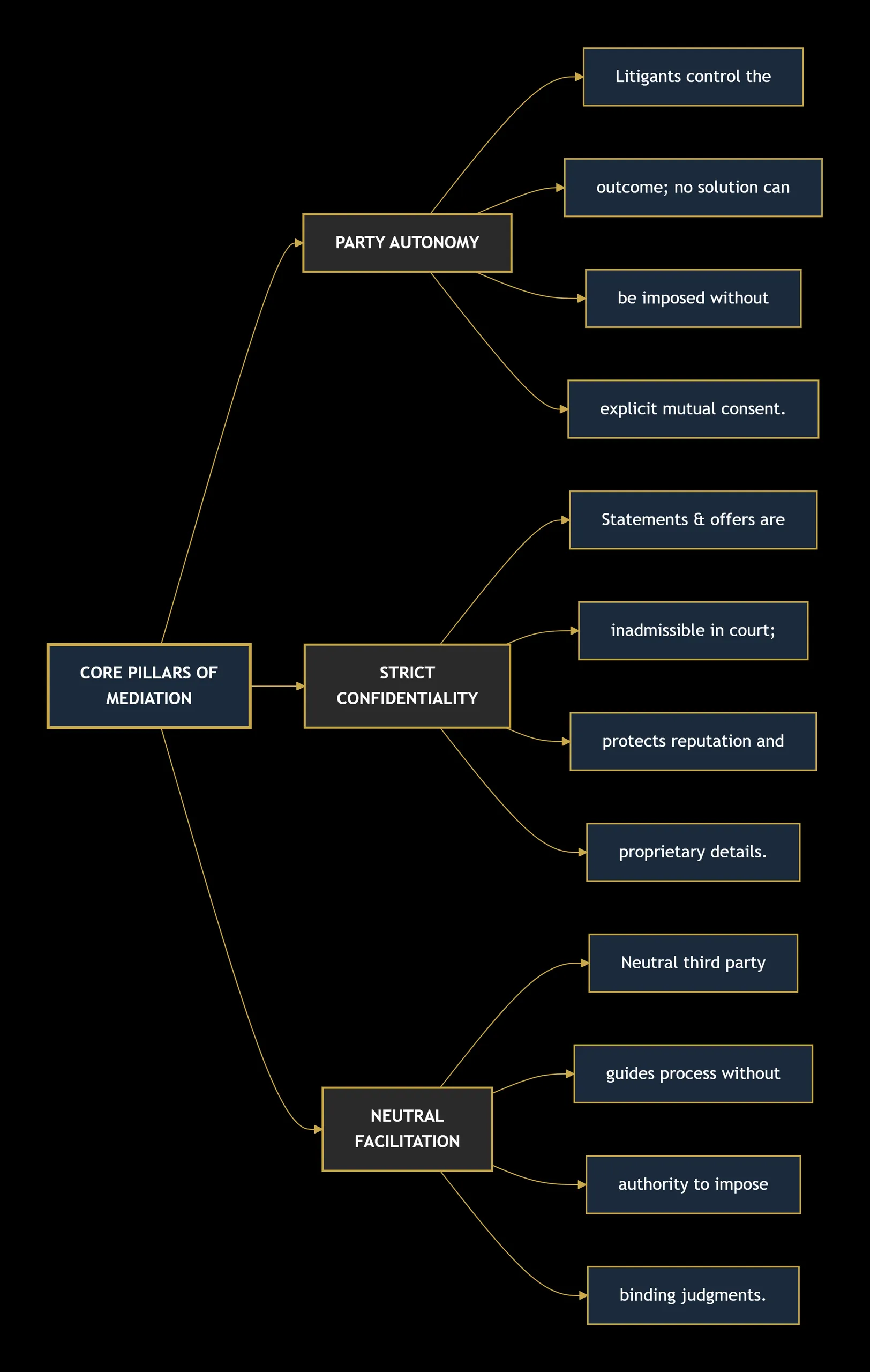
The legal validity, structural integrity, and high success rates of mediation stem from specific core principles. These pillars distinguish mediation from both formal courtroom litigation and other ADR frameworks, such as binding arbitration.
1. Voluntary Participation and Party Autonomy
At its core, classic mediation operates on the principle of self-determination. While courts or contractual clauses may mandate that parties attend an initial mediation session before proceeding to trial, the ultimate decision to execute a settlement rests entirely with the litigants.
- Self-Directed Outcomes: Parties retain full authority over whether to accept or reject any proposed resolution; a mediator has no statutory power to impose a binding decision.
- Freedom to Terminate: Litigants can withdraw from the mediation process at any point prior to executing a formal settlement agreement if they determine negotiations are no longer productive.
- Customized Remedies: Unlike court judgments, which are generally restricted to monetary damages or standardized injunctions, mediation allows parties to construct flexible solutions tailored to their specific operational, financial, or personal needs.
2. Strict Procedural Confidentiality
Confidentiality is the legal cornerstone of mediation. Without robust evidentiary protections, parties would be reluctant to speak candidly, admit potential weaknesses in their legal positions, or explore compromise options during negotiations.
- Inadmissibility in Subsequent Litigation: Under statutory rules of evidence—such as Rule 408 of the Federal Rules of Evidence in the United States and equivalent codifications worldwide—statements made, offers extended, and documents prepared specifically for a mediation session are strictly inadmissible in court should negotiations fail.
- Protection of Neutral Communications: Mediators cannot be subpoenaed to testify in subsequent court proceedings regarding disclosures made by either party during private or joint sessions.
- Protection of Trade Secrets and Reputation: Unlike public courtroom trials, mediation proceedings take place in private settings, shielding sensitive commercial data, proprietary technology, and personal disclosures from public record access.
3. Neutrality and Impartiality of the Third Party
The efficacy of mediation depends directly on the parties’ confidence in the mediator’s complete objectivity.
- Absence of Conflict of Interest: A mediator must disclose any prior personal, financial, or professional relationships with either party or their legal counsel before accepting an appointment.
- Procedural Fairness: The mediator maintains absolute procedural neutrality, ensuring that neither side dominates discussions, exercises undue coercion, or suffers procedural disadvantages during caucus sessions.
- Distinction from Judicial Decision-Makers: While a judge evaluates past facts to assign fault or liability under strict legal rules, a mediator evaluates present interests to facilitate forward-looking agreements.
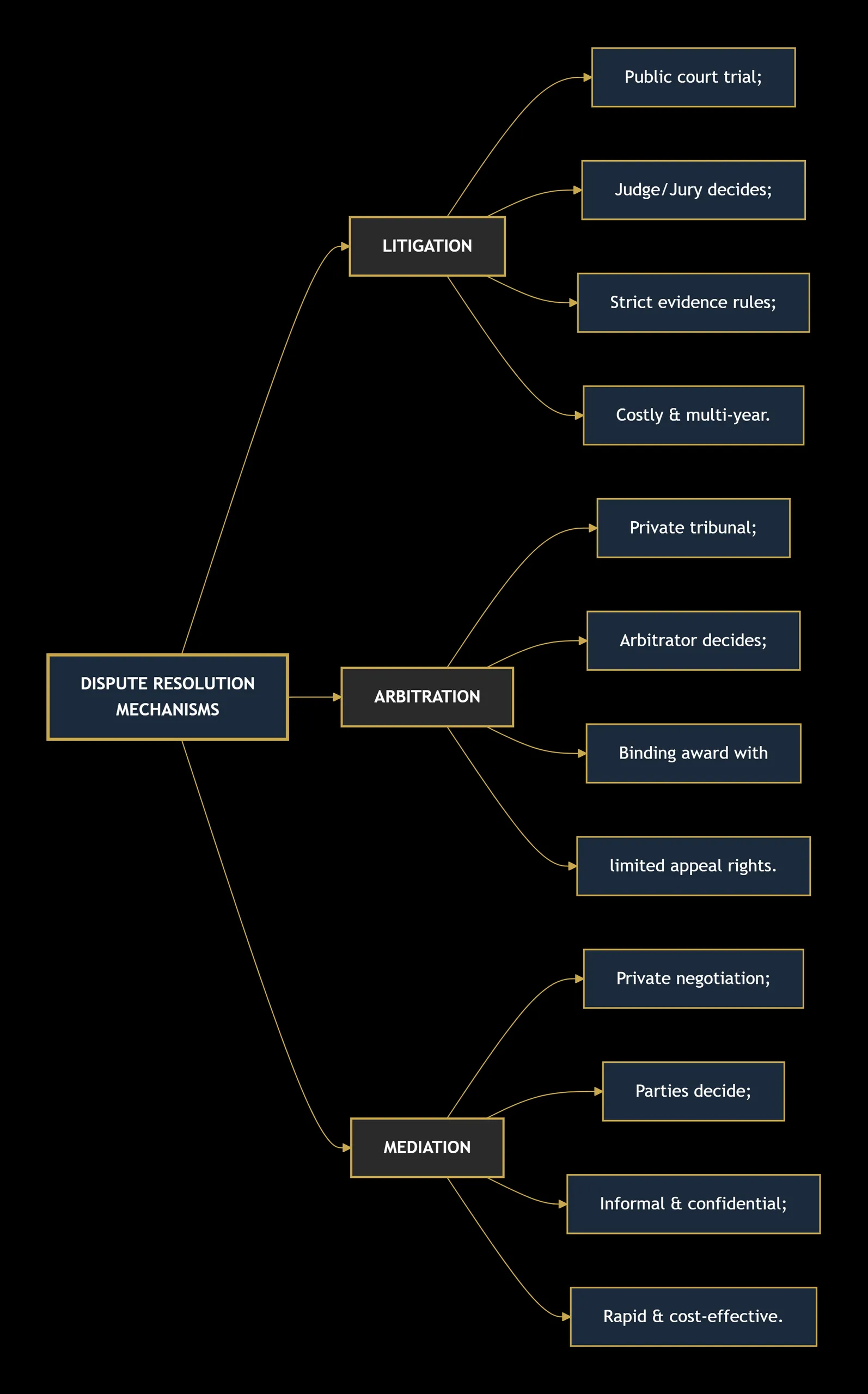
Comparative Analysis: Mediation vs. Litigation vs. Arbitration
To select the most appropriate dispute resolution forum, legal counselors evaluate how mediation compares directly against formal court litigation and binding arbitration across key operational criteria.
Decision-Making Authority
In litigation, a judge or jury holds complete authority to render a binding verdict based on strict statutory frameworks and common law precedents. In arbitration, an appointed arbitrator or panel acts as a private judge, issuing a final arbitral award that binds both sides. In mediation, decision-making power remains entirely with the conflicting parties; the mediator possesses zero legal authority to impose an outcome.
Procedural Formalism and Evidence Rules
Court litigation is strictly bound by formal rules of civil procedure and statutory rules of evidence, requiring extensive motion practice, formal depositions, and rigid trial phases. Arbitration reduces some procedural friction but still requires formal hearings, witness examinations, and evidence submissions. Mediation utilizes an informal, adaptable framework tailored to the immediate emotional, financial, and legal dynamics of the dispute.
Public Access versus Privacy
Courtroom litigation is a matter of public record, accessible to media, competitors, and the general public. Arbitration proceedings are private, though final awards may become public during judicial enforcement proceedings. Mediation remains strictly private and confidential from start to finish, protecting proprietary trade secrets and corporate reputations.
Cost Structures and Timelines
Litigation frequently spans several years, incurring massive legal fees, expert witness costs, and administrative expenses. Arbitration speeds up timelines relative to public trials but still incurs substantial tribunal fees and advocate costs. Mediation is typically completed in a single day or over a few weeks, yielding massive financial savings for all participants.
Finality and Appeal Rights
Court judgments are subject to multi-tiered appellate review, which can prolong final resolution for years. Arbitration awards are final and binding, with court intervention limited strictly to rare instances of fraud, corruption, or procedural misconduct. A mediated agreement, once signed, becomes a binding civil contract enforceable in court, though non-executed verbal proposals carry no legal force.
Essential Roles and Responsibilities of a Mediator
While a mediator lacks the authority to dictate legal outcomes, their administrative, analytical, and interpersonal responsibilities are extensive. Mediators deploy structured communication strategies to move parties past emotional impasses and rigid legal positions.
Primary Functions of the Neutral Facilitator
- Establishing Ground Rules: Opening the session by setting procedural expectations, confirming confidentiality agreements, and securing mutual commitments to respectful communication.
- De-Escalating Hostility: Neutralizing aggressive rhetoric, reframing hostile statements into actionable business concerns, and maintaining a productive atmosphere.
- Identifying Root Interests: Distinguishing between a party’s stated legal position (what they say they demand) and their underlying interest (what they actually need to achieve a viable solution).
- Managing Private Caucuses: Conducting confidential, separate meetings with each side to test the strength of their legal arguments, discuss realistic trial risks, and explore settlement boundaries privately.
- Facilitating Reality Testing: Tactfully questioning unrealistic legal assumptions or inflated damages claims to bring both sides toward commercially reasonable settlement ranges.
- Drafting the Settlement Memorandum: Assisting legal counsel in memorializing agreed-upon terms into a clear, enforceable written instrument before the parties adjourn.
The Procedural Stages of a Mediation Proceeding
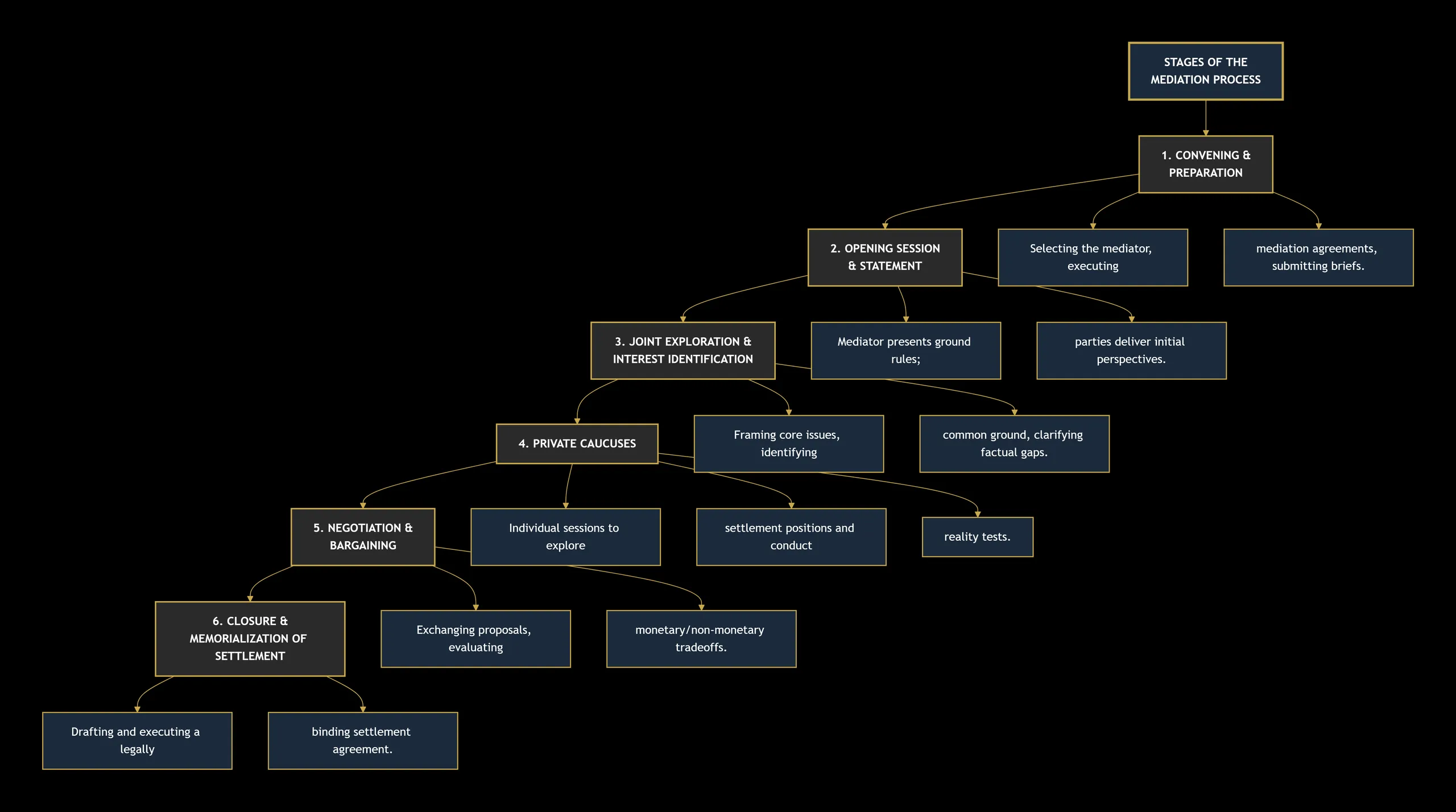
Although mediation is less formal than a court trial, successful proceedings follow a structured procedural progression designed to guide parties systematically from initial conflict to formal agreement.
Stage 1: Convening and Selection
The process begins when parties mutually agree—or are ordered by a court pursuant to pre-trial case management rules—to enter mediation. The parties select a mediator with appropriate legal or industry expertise, confirm impartiality, and execute a formal Mediation Agreement outlining fee structures and confidentiality protections. Prior to the session, legal counsel typically submit confidential mediation briefs detailing the factual background, key legal arguments, and previous settlement discussions.
Stage 2: The Opening Joint Session
The mediator initiates the formal proceeding with an opening statement establishing procedural ground rules, explaining confidentiality, and defining the collaborative goal of the session. Following the mediator’s remarks, legal counsel or the parties themselves deliver brief opening statements presenting their perspective on the dispute without interruption.
Stage 3: Joint Exploration and Framing
After opening statements, the mediator facilitates open dialogue to define the specific legal, financial, and personal issues requiring resolution. During this stage, the mediator works to reframe adversarial statements into shared problems, isolating areas of agreement from points of active contention.
Stage 4: Private Caucuses
When joint discussions stall or high emotional tension impedes progress, the mediator moves the parties into separate breakout rooms (caucuses). The mediator shuttles between rooms, discussing sensitive matters that parties are reluctant to state publicly. Information shared in caucus remains strictly confidential within that room unless a party explicitly authorizes the mediator to share specific details or settlement offers with the opposing side.
Stage 5: Negotiation and Option Generation
Using information gathered during caucuses, the mediator helps parties generate and evaluate settlement proposals. This phase involves extensive “reality testing,” where the mediator prompts attorneys to re-evaluate trial costs, witness credibility issues, appeals risks, and potential enforcement obstacles if the case fails to settle.
Stage 6: Closure and Settlement Execution
If negotiations succeed, the parties and their legal counsel draft a formal written settlement agreement outlining specific obligations, payment schedules, releases of liability, and dismissal stipulations. Once signed by all parties, this document transitions from an informal negotiation record into an enforceable civil contract. If an impasse is reached, the mediator declares negotiations concluded, allowing the parties to proceed with formal court litigation.

Free Presentation
Manslaughter
Homicide without the intent that defines murder.
A short, downloadable slide deck explaining this term in depth — free to open this week, no account needed.
Open This Week's Presentation →All-Access subscribers get the entire growing library, any time — see the full catalog.
Primary Applications of Mediation Across Legal Sectors
Mediation is utilized extensively across diverse substantive areas of law, adapting its collaborative framework to meet the distinct demands of varying legal contexts.

1. Family Law and Domestic Relations
Family law was among the first legal sectors to integrate mandatory mediation protocols. Because domestic disputes involve ongoing personal dynamics, traditional adversarial court battles often exacerbate emotional trauma and long-term conflict.
- Child Custody and Co-Parenting Plans: Mediators assist divorcing spouses in drafting detailed parenting schedules, decision-making protocols, and holiday arrangements focused strictly on the best interests of the children.
- Division of Marital Assets and Support Obligations: Spouses work collaboratively to inventory marital property, evaluate business valuations, and determine equitable property divisions or spousal support terms without public court battles.
2. Commercial, Corporate, and Contract Disputes
In commercial settings, businesses prioritize speed, cost control, predictability, and the preservation of professional relationships. Prolonged court disputes can disrupt supply chains and drain corporate reserves.
- Vendor and Supply Chain Conflicts: Resolving breach of contract claims, delivery delays, or quality disagreements quickly allows commercial partners to restructure agreements and continue operations.
- Partnership and Shareholder Dissolutions: Mediators guide co-owners through complex corporate separations, buyout structures, and asset valuations privately, protecting business valuation and market reputation.
3. Civil Litigation and Personal Injury Claims
Torts, personal injury lawsuits, and insurance claims constitute a significant portion of general civil court dockets. Insurance carriers and injured plaintiffs routinely utilize mediation to manage litigation exposure.
- Insurance Claims Settlement: Injured parties and insurance adjusters evaluate medical records, wage loss documentation, and liability risks to establish realistic lump-sum financial settlements.
- Property Damage and Construction Defect Claims: Complex multi-party construction disputes—involving general contractors, subcontractors, architects, and property owners—utilize specialized mediators to allocate financial responsibility without years of technical court trials.
4. Employment and Workplace Controversies
Employment disputes involve delicate statutory rights, statutory damage exposures, and workplace dynamics.
- Discrimination and Harassment Allegations: Mediation provides a private forum to address complex statutory claims, allowing employers and employees to explore resolution without public reputational damage.
- Wage, Hour, and Severance Negotiations: Employers and departing executives utilize mediation to resolve severance packages, non-compete covenants, and unpaid compensation disputes efficiently.
Enforceability of Mediated Agreements
A common misconception is that because mediation itself is a non-binding process, the resulting agreement carries no legal weight. In reality, once parties reach a consensus and memorialize their terms into an executed settlement agreement, the legal status of the dispute changes fundamentally.
The Contractual Basis of Enforcement
A signed mediation settlement agreement functions as a valid, legally binding contract governed by standard contract law principles.
- Enforceable Obligations: If one party subsequently breaches the terms of a signed settlement agreement, the non-breaching party can file a civil action for breach of contract to enforce compliance or recover financial damages.
- Incorporation into Judicial Orders: In pending litigation, the executed agreement is typically submitted to the presiding judge alongside a joint stipulation for dismissal. The court may incorporate the settlement terms directly into a formal court order or consent decree, granting the court ongoing jurisdiction to enforce compliance through contempt powers.
Statutory Enforcement Frameworks
To promote stability in cross-border commerce, international legal bodies have codified standardized enforcement mechanisms for international commercial mediation.
- The Singapore Convention on Mediation: Adopted by the United Nations General Assembly, the Singapore Convention allows parties to enforce international commercial settlement agreements directly through the courts of signatory nations, bypassing the need to file a separate breach of contract lawsuit.
Strategic Advantages and Potential Limitations
While mediation offers profound structural benefits, it is not universally applicable to every legal conflict. Legal practitioners analyze specific case characteristics to determine whether mediation is appropriate.
Strategic Advantages
- Substantial Financial Savings: Eliminates extensive trial preparation costs, expert witness deposition fees, and court appearance expenses.
- Rapid Resolution Timelines: Disputing parties can schedule and complete mediation within weeks, whereas civil litigation typically requires months or years to reach trial.
- Total Privacy: Shielding settlement terms and admissions from public dockets protects personal reputations and commercial trade secrets.
- Preservation of Long-Term Relationships: Collaborative problem-solving reduces personal hostility, allowing business partners, family members, or neighbors to maintain ongoing communication.
Potential Limitations and Contraindications
- Inappropriate in Situations of Severe Power Imbalances: If one party faces severe intimidation, domestic abuse, or fraud by the opposing side, standard mediation may fail to protect the vulnerable party’s legal rights.
- Unsuitability for Establishing Legal Precedent: Parties seeking to establish binding constitutional interpretations, clarify ambiguous statutes, or set judicial precedents must pursue formal court judgments rather than private settlements.
- Risk of Delay in Bad-Faith Negotiations: If a party enters mediation solely to gain tactical delays, discover opposing trial strategies, or exhaust a weaker opponent’s financial resources, the process can add unnecessary expense before formal litigation resumes.
Frequently Asked Questions
Can a mediator force either party to accept a settlement proposal?
No. Mediators possess no statutory or judicial authority to impose decisions, issue orders, or force parties into an agreement. The power to accept or reject any proposed settlement term remains exclusively with the litigants.
What occurs if parties fail to reach an agreement during mediation?
If parties reach an impasse, the mediator simply declares the session concluded without resolution. The litigation process resumes exactly where it left off, and statements made during the mediation remain confidential and inadmissible at trial.
Is legal counsel required during a mediation session?
While legal representation is not strictly mandatory in all civil mediations, retaining legal counsel is strongly advised. Attorneys provide critical legal advice, evaluate settlement proposals against trial risks, ensure rights are protected, and draft the final binding settlement documentation.
How are the financial costs of mediation typically allocated between disputing parties?
In standard civil and commercial mediations, the professional fees of the mediator and facility expenses are split equally between the participating parties, unless a prior contract or statutory provision dictates a different cost allocation.
What is the legal difference between mediation and an affidavit?
Mediation is an interactive negotiation process designed to resolve disputes out of court. An affidavit is a formal written statement of facts sworn under oath before a notary. For a detailed breakdown of sworn legal instruments, see our comprehensive guide on Affidavits in Law.
Mediation remains one of the most effective and adaptable mechanisms within the modern legal landscape. By combining procedural flexibility, strict confidentiality, and party autonomy, it provides a structured alternative to courtroom litigation. For further details on statutory definitions, formal dispute resolution standards, and regulatory frameworks, explore the complete jurisdictional analysis on The Law to Know.

Daily Quiz
Contract Law
10 questions, new every day. See how many you get right — then come back tomorrow for a new category.
Question 1 of 10
What is "promissory estoppel"?
Promissory estoppel lets courts enforce a promise — even one made without formal consideration — when someone reasonably relied on it and would be unfairly harmed if the promise were not kept.
Question 2 of 10
Contracts for the sale of goods are generally governed by which body of law in the U.S.?
The UCC (adopted, with variations, in every U.S. state) governs contracts for the sale of goods, with somewhat different rules than the common law that governs contracts for services or real estate.
Question 3 of 10
What is a "condition" in contract law, broadly speaking?
Conditions are a core structural tool in contract drafting — they let parties make performance contingent on events (financing being approved, an inspection passing) rather than making every promise absolute and unconditional.
Question 4 of 10
When might a court order "specific performance" instead of money damages?
Specific performance is an equitable remedy, reserved for situations where money genuinely cannot make the injured party whole — the classic example is real estate, since every parcel of land is considered legally unique.
Question 5 of 10
What is an "adhesion contract"?
Adhesion contracts (like many standard consumer terms of service) are enforceable in general, but courts scrutinize unusually one-sided or buried terms within them more closely than terms in a contract both sides genuinely negotiated.
Question 6 of 10
What is a "quasi-contract" (or contract implied in law)?
Quasi-contract is not a real contract at all — it is a remedy courts impose to prevent one party from unfairly keeping a benefit received from another without paying for it, even absent any actual agreement.
Question 7 of 10
What does it mean for a contract to be "unconscionable"?
Unconscionability is a narrow doctrine — courts use it sparingly, for contracts so oppressive or one-sided (often combined with unequal bargaining power) that enforcing them would be fundamentally unfair.
Question 8 of 10
What does a "severability" clause do?
Severability clauses protect the overall deal — without one, a single unenforceable provision could sometimes threaten to unravel an entire contract; with one, courts can strike just that provision and leave everything else intact.
Question 9 of 10
What's the usual remedy when one party breaches a contract?
Contract law is generally compensatory, not punitive — the standard remedy is "expectation damages," designed to put the non-breaching party in the position they'd have been in if the deal had gone through.
Question 10 of 10
What is an "option contract"?
An option contract is created when the offeree pays (or otherwise provides consideration) to keep an offer open for a set period — unlike an ordinary revocable offer, the offeror cannot simply withdraw it during that period.
Come back tomorrow for Property Law.
Enjoyed Contract Law? Go deeper:
Take the free Contract Law course → Try the Contract Negotiation Simulator →A quick trivia game for general legal knowledge — not legal advice, and not affiliated with any bar exam or licensing body.
Advance Your Legal Analysis
Explore our interactive decision trees, litigation pipeline builders, and procedural court simulators designed specifically for law students and practitioners.
Access Interactive Tools →Related in Foundations of Law
The information provided in this article ("The Important Role of Mediation in Legal Disputes") is for general educational and informational purposes only and does not constitute formal legal advice. Reading this content does not create an attorney-client relationship. Laws vary by jurisdiction; consult a licensed attorney for specific legal matters.


0 Comments