Table of Contents
Contract Law: The Master Framework & Architecture of Obligations
Module 1: Foundations of Contractual Liability, Taxonomy, and Will Theory
1.1 The Genesis of Private Ordering: A Plain English Starting Point
Imagine two private individuals entering a crowded marketplace. One agrees to sell a cargo vessel of grain, and the other agrees to pay a designated sum upon delivery next month. Neither party is a government officer, and no public legislation mandated their transaction. Yet, the moment they seal their bargain, the sovereign judicial power of the state steps in to enforce their private word as legally binding.
Contract Law is the legal system’s engine of private ordering. While constitutional law structures state power and tort law redresses unexpected civil harms, contract law empowers private individuals and commercial entities to create customized, legally enforceable obligations out of voluntary promises.

At its core, contract law answers three fundamental questions:
- Enforceability (Which promises count?): Why should the legal system mobilize courts and law enforcement to hold someone to their word, while ignoring social invitations or moral commitments?
- Interpretation (What was agreed upon?): How do courts determine the true meaning of contractual terms when disputes arise?
- Remedies (What happens upon breach?): How does the law compensate a party when a voluntary promise is broken?
1.2 Philosophical Snippet: Fried, Kant, and the Morality of Promising
Charles Fried (Contract as Promise, 1981):
“The obligation to keep a promise is grounded in respect for individual autonomy and trust. When I promise, I invoke a convention that invites another to rely on my moral agency. To break a promise is to use another human being merely as a means rather than an end.”
The moral foundation of contract law rests heavily on Immanuel Kant’s concept of autonomy and the ancient canon of pacta sunt servanda legal principle—the doctrine that promises must be kept.
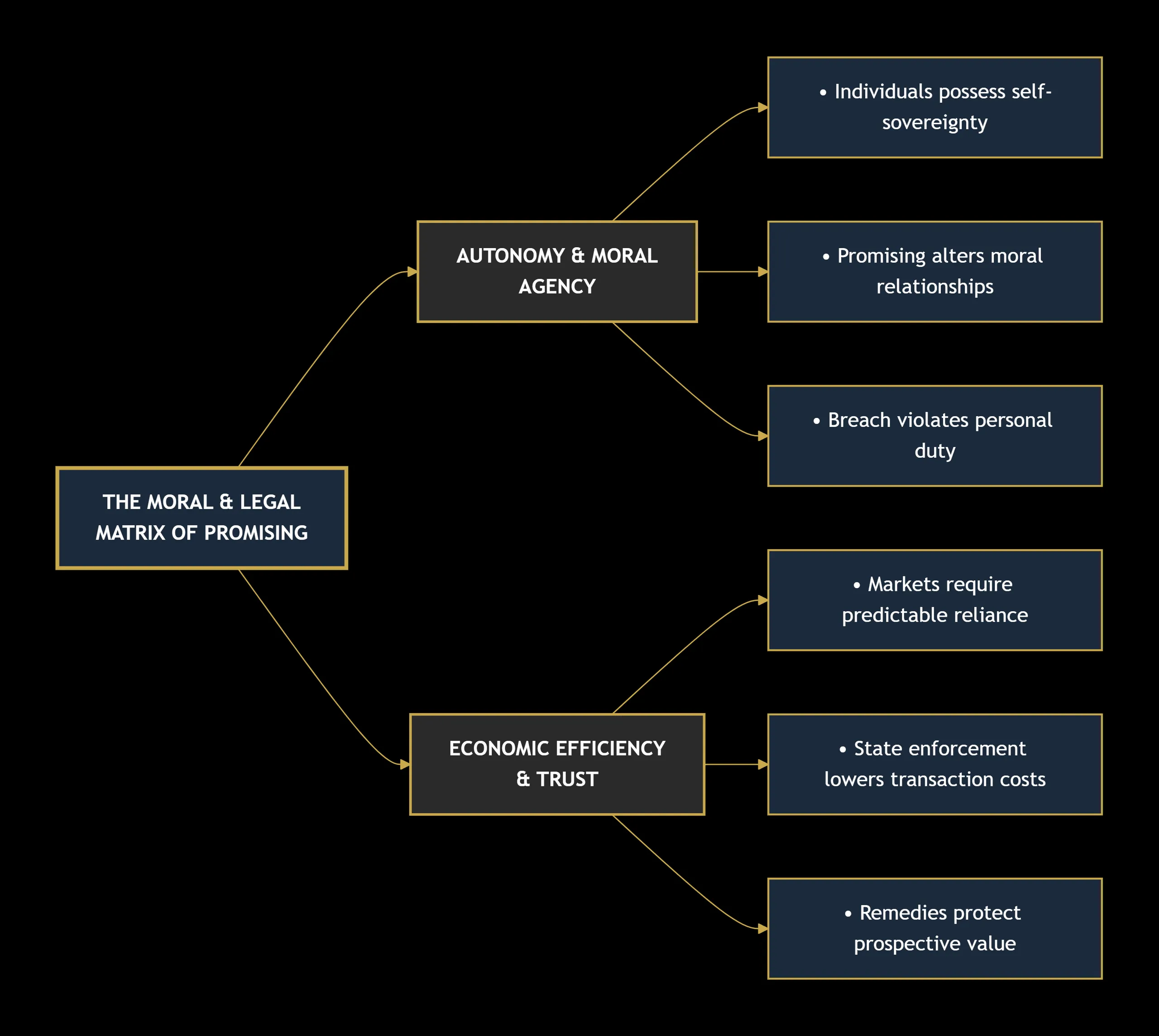
Under Will Theory, contractual liability derives from the self-imposed obligation of free moral agents. By making a voluntary promise, a promisor intentionally restricts their future liberty, creating a corresponding legal right in the promisee. Thus, the legal enforcement of contracts is not an authoritarian imposition by the state, but the supreme realization of individual freedom of contract.
1.3 The Theoretical Evolution: Will Theory vs. Objective Reliance vs. Economic Efficiency
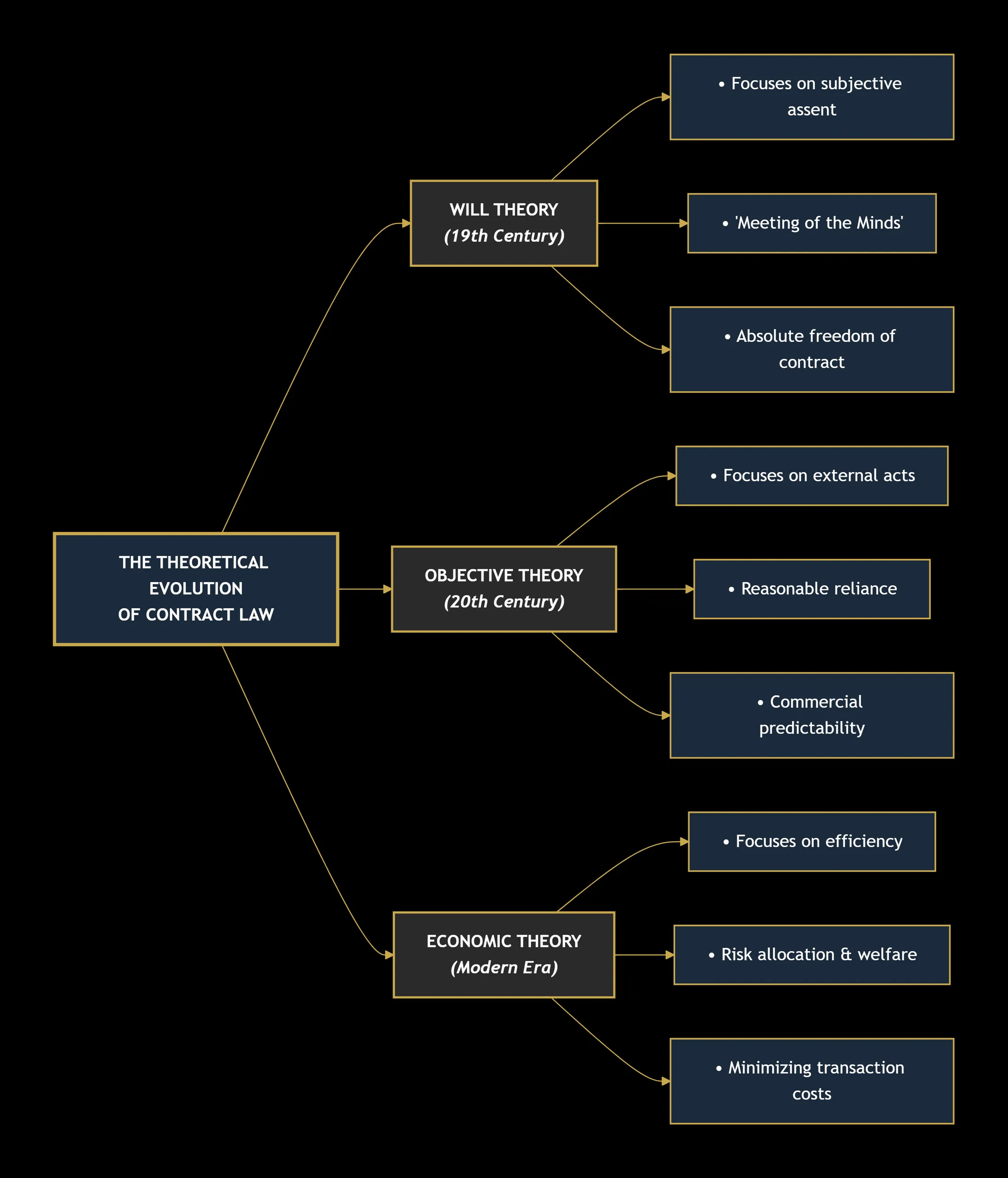
Jurisprudence has continually debated the true normative basis of contractual enforcement, evolving across three primary theoretical paradigms:
1. Nineteenth-Century Will Theory
Classical contract theory prioritized the subjective internal intent of the parties. Under this doctrine, a contract required a literal, subjective consensus or meeting of minds. If the internal intentions of the parties diverged, no binding contract could exist.
2. Twentieth-Century Objective Theory
As industrial commerce expanded, relying on unexpressed subjective intent proved unworkable. Courts transitioned to an Objective Theory of Contract. Under this standard, courts judge intent based on outward manifestations—what a reasonable person in the position of the promisee would conclude from the promisor’s words and conduct. This standard safeguards commercial transactions by requiring an objective meeting of the minds consensus to solidify legal assent.
3. Law and Economics (Efficiency Theory)
Pioneered by jurists like Richard Posner, economic theories of contract view legal enforcement as a mechanism to maximize social wealth and allocate risk efficiently. Rather than focusing purely on moral duty, economic analysis evaluates how default contract rules minimize transaction costs, reduce opportunistic behavior, and incentivize optimal performance or “efficient breach.”
1.4 Categorical Taxonomy of Contracts
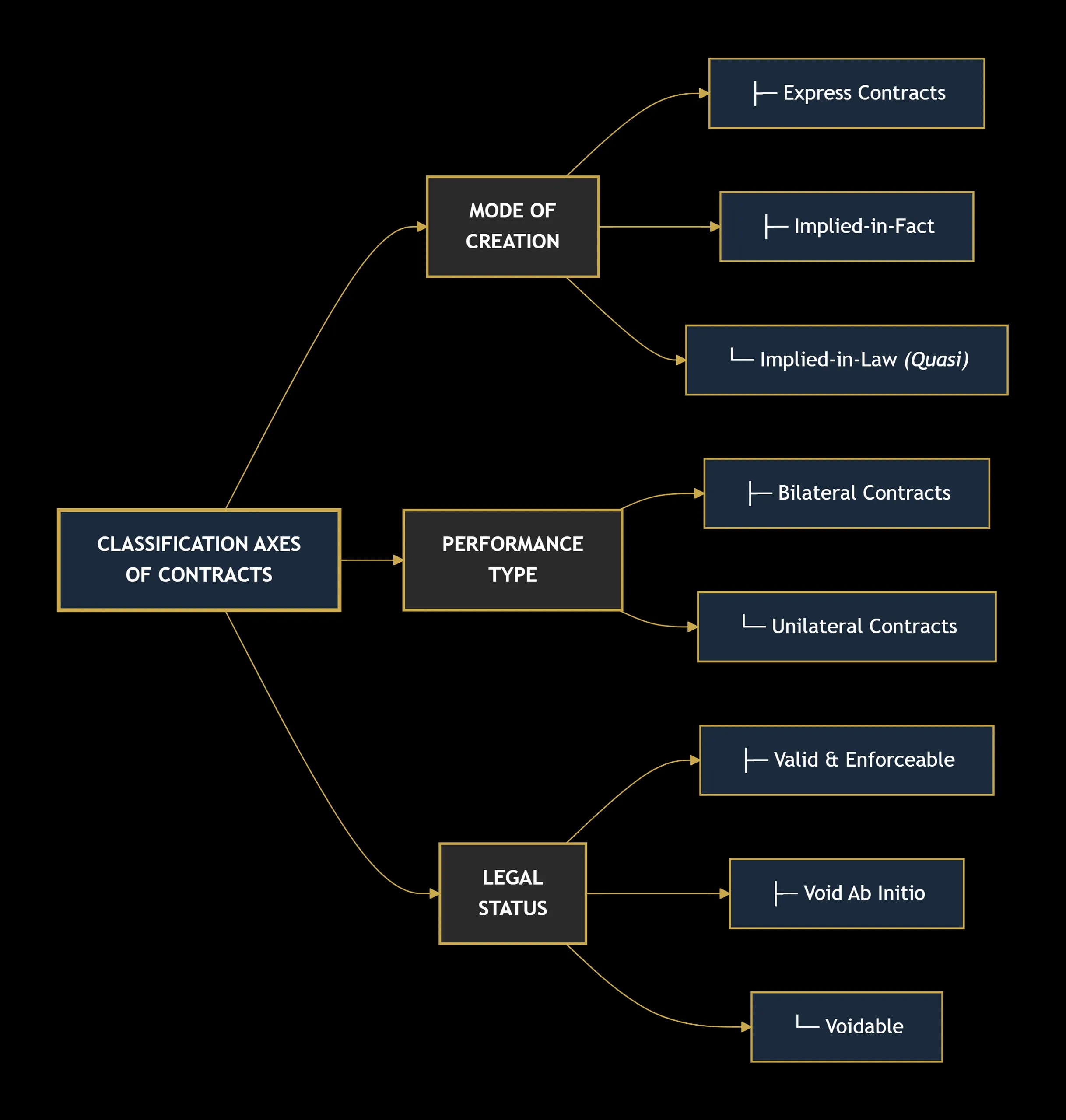
To analyze contractual disputes effectively, legal systems classify agreements along distinct structural and operational axes. Understanding the broad classification of contract types establishes the framework for determining when and how obligations attach:
1. Express vs. Implied Contracts
- Express Contracts: Formed by explicit words, whether written or spoken aloud.
- Implied-in-Fact Contracts: Formed by non-verbal conduct and surrounding circumstances that clearly manifest mutual assent (e.g., pulling into a taxi stand and stating your destination).
- Implied-in-Law Contracts (Quasi-Contracts): Not true contracts; equitable remedies imposed by courts regardless of intent to prevent unjust enrichment.
2. Bilateral vs. Unilateral Contracts
- Bilateral Contracts: Formed by an exchange of mutual promises (“A promise for a promise”). Both parties become bound simultaneously upon agreement (e.g., a contract to purchase real estate).
- Unilateral Contracts: Formed by an exchange of a promise for an act (“A promise for performance”). The offeree accepts not by promising to act, but by completing the requested performance (e.g., a public reward offer for a lost pet).
1.5 Comparative Matrix: Contract Foundations Across Legal Traditions
| Architectural Dimension | Common Law Tradition (e.g., US, UK) | Civil Law Tradition (e.g., France, Germany) |
| Primary Requirement for Enforceability | Requires Consideration (bargained-for legal detriment) or formal seal | Requires Cause or valid legal objective (Causa); consideration is absent |
| Standard of Intent | Strictly Objective Standard (reasonable person interpretation) | Mixed; searches more deeply for subjective mutual intention (intention commune) |
| Good Faith Obligation | Limited during formation; implied primarily in performance (UCC / Restatement) | Universal doctrine of Good Faith (Bonne foi / Treu und Glauben) across negotiations and execution |
| Promissory Estoppel | Robust equitable doctrine enforcing reliance without consideration | Handled primarily through pre-contractual tort liability (Culpa in contrahendo) |
Module 2: The Core Mechanics of Contract Formation: Offer, Acceptance, Consideration, and Legal Intent
2.1 The Mechanics of Assent: Offer vs. Invitation to Treat
For legal liability to attach to a promise, the law requires an outward demonstration of mutual consent. Contract formation begins with an offer—a specific, definitive expression of willingness to enter into a contract on specified terms, made with the intent that it will become binding as soon as it is accepted by the person to whom it is addressed.
1. Distinguishing Offers from Invitations to Treat
Not every commercial proposal or statement of interest constitutes an offer. The law distinguishes an offer from an invitation to treat (invitatio ad offerendum)—an expression of willingness to negotiate or solicit offers from others.
- Advertisements and Price Lists: Generally construed as invitations to treat rather than binding offers. This protects sellers from being bound to contracts exceeding their available inventory (Pharmaceutical Society of Great Britain v Boots Cash Chemists [1953]).
- Unilateral Offer Exception: An advertisement becomes a binding unilateral offer if it contains clear, definitive terms and requests a specific act without leaving room for negotiation (Carlill v Carbolic Smoke Ball Co [1893]).
- Display of Goods: Shelved goods with price tags in a retail store are invitations to treat; the customer makes the offer at the checkout counter, which the merchant may accept or decline.
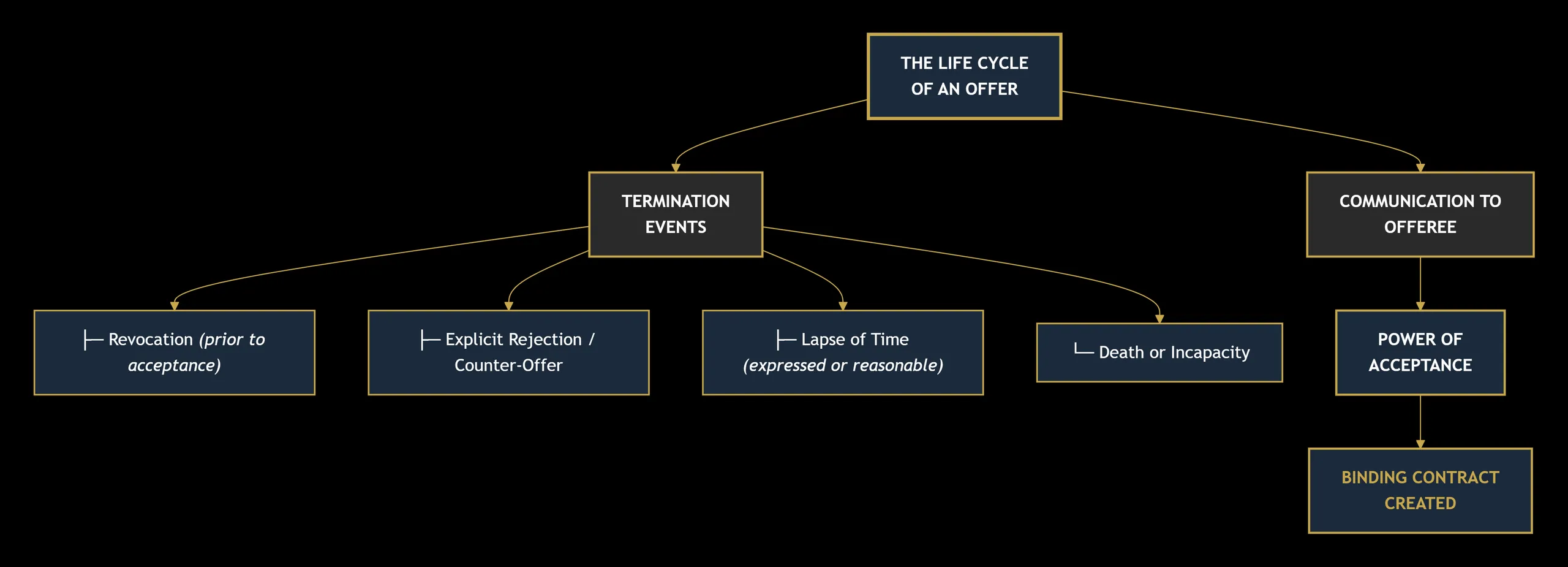
2. Termination of the Power of Acceptance
An offer does not remain open indefinitely. It may be terminated prior to valid acceptance through:
- Revocation: The offeror withdraws the offer. Under common law, an offeror may revoke an offer at any time before acceptance unless consideration was paid to keep the offer open (an option contract).
- Counter-Offer: An offeree’s response that purports to accept the offer but alters or adds terms operates as a rejection of the original offer and creates a new counter-offer (Hyde v Wrench [1840]).
- Lapse of Time: The offer expires at the time specified within its terms or, if no time is stated, after a reasonable period based on the subject matter.
2.2 Philosophical Snippet: Hume, Locke, and the Artifice of Promising
David Hume (A Treatise of Human Nature, 1740):
“A promise is not any natural act of the mind, but a social convention invented for the utility of society. When a man says he promises, he expresses a resolution of performing something, but withal, by using this form of words, subjects himself to the penalty of never being trusted again in case of failure.”
From a philosophical perspective, how can vocal sounds or marks on paper alter a human being’s moral and legal duties?
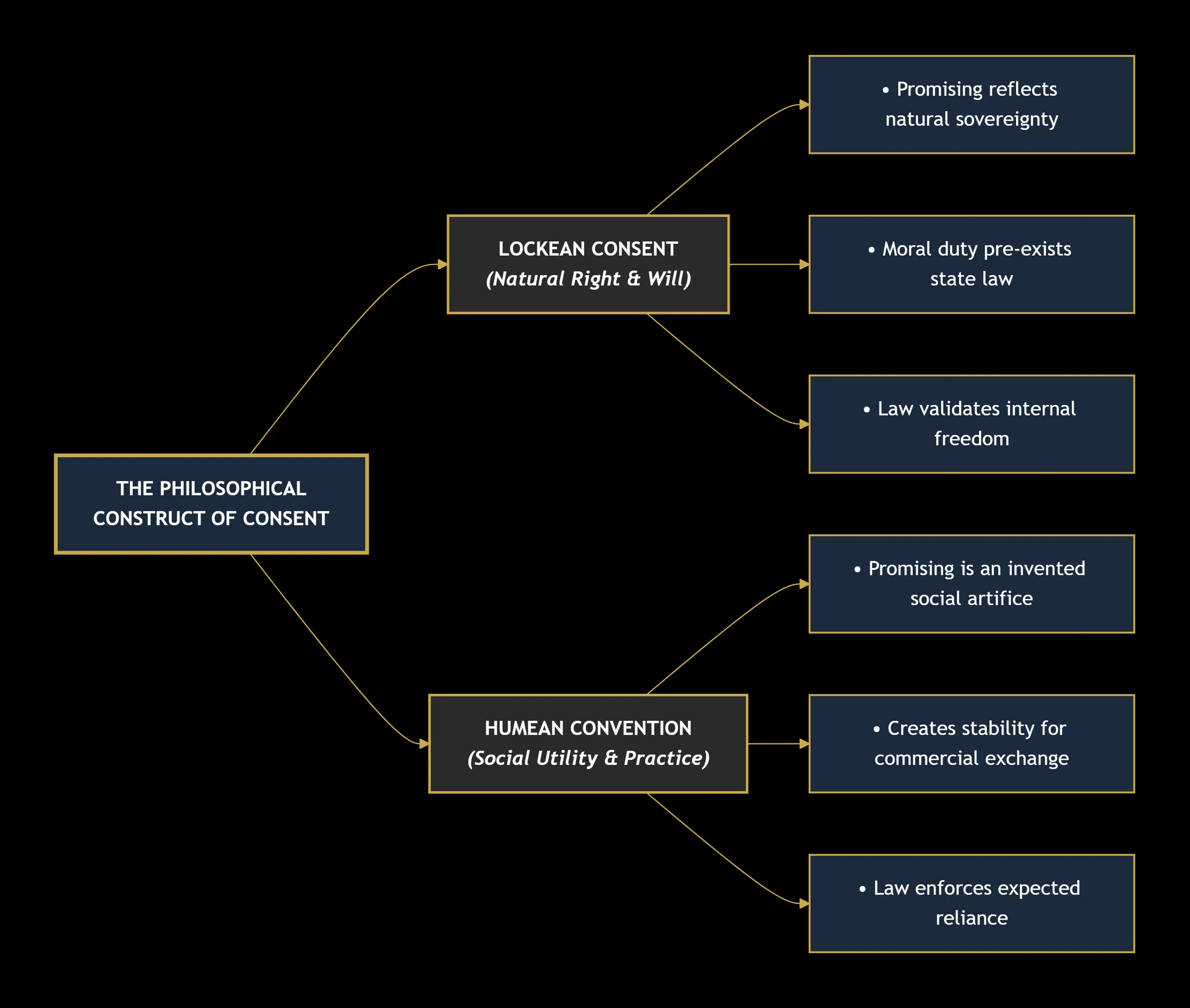
John Locke argued that freedom of contract derives from natural property rights over oneself; an individual can transfer rights or bind future conduct through voluntary consent. David Hume counterbalanced this by demonstrating that promising is an artificial virtue—a societal invention created because mutual trust cannot survive in complex markets without established conventions. The law of offer and acceptance provides the precise formal procedure through which this convention operates.
2.3 Acceptance and the Architecture of Communication
Acceptance is an unqualified, final assent to all the terms of an offer. Under the strict common law Mirror Image Rule, the acceptance must correspond exactly to the terms of the offer without modification.
1. The Mirror Image Rule vs. UCC 2-207 (“Battle of the Forms”)
While traditional common law holds that any variance in terms converts an acceptance into a counter-offer, modern commercial codes recognize that businesses routinely exchange standardized forms with conflicting terms. Under American law, Section 2-207 of the Uniform Commercial Code (UCC) modifies the mirror image rule for the sale of goods: a definite expression of acceptance operates as a valid acceptance even if it states additional or different terms, preventing parties from escaping commitments over minor boilerplate discrepancies.
2. Communication Rules: Receipt vs. The Mailbox Rule
An acceptance generally takes effect when communicated to the offeror. However, an important exception exists:

- The Mailbox Rule (Adams v Lindsell [1818]): Where acceptance by mail is a reasonable medium of communication, the acceptance is effective upon dispatch (when posted), not upon receipt.
- Revocation Rule: Conversely, revocations and rejections are effective only upon actual receipt by the offeree.
- Modern Electronic Communications: Text messages, emails, and instant electronic transmissions are generally excluded from the mailbox rule; they are governed by instantaneous communication rules, taking effect when accessible in the recipient’s system.
2.4 Consideration: The Bargain Element and Promissory Estoppel
Common law systems require a fourth element that distinguishes legal contracts from mere gratuitous promises: Consideration.
1. The Bargain Theory of Consideration
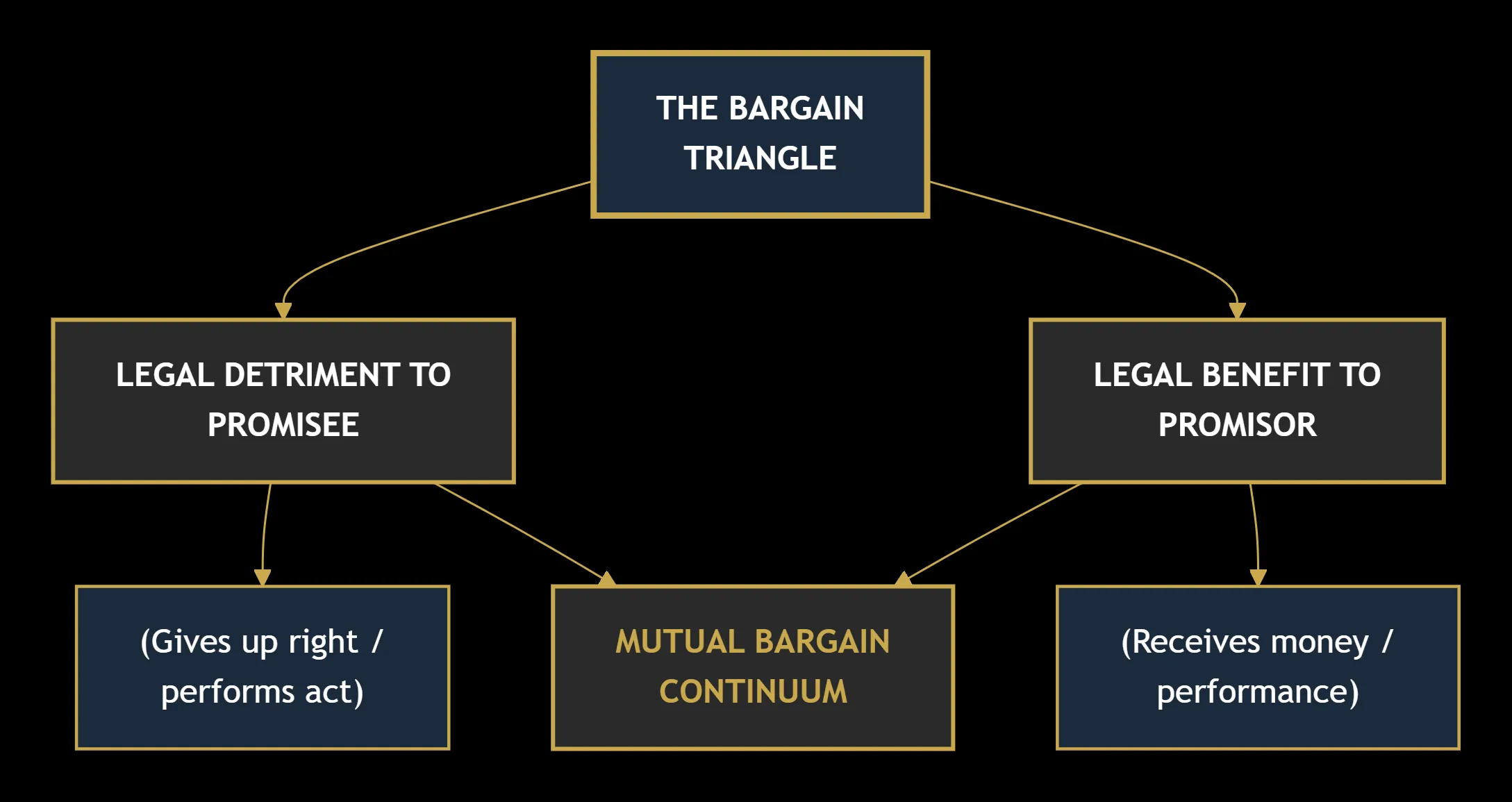
Consideration is defined as something of value given in exchange for a promise. It requires a bargained-for exchange involving either a legal benefit to the promisor or a legal detriment to the promisee (Currie v Misa [1875]).
- Adequacy vs. Sufficiency: Courts evaluate whether consideration is sufficient (legally recognized), but will not inquire into whether it is adequate (fair economic market value). A nominal item—such as a single peppercorn or one dollar—can constitute valid consideration for real property (“The Peppercorn Rule”).
- Past Consideration: A promise made in recognition of a benefit already conferred in the past is not valid consideration (Re McArdle [1951]). Consideration must move present with or prospective to the promise.
- Pre-Existing Legal Duty: Promising to perform an obligation that one is already legally bound to execute does not constitute valid consideration (Stilk v Myrick [1809]).
2. The Equitable Shield: Promissory Estoppel
Where formal consideration is absent, equity may intervene to prevent injustice through the doctrine of Promissory Estoppel (Central London Property Trust Ltd v High Trees House Ltd [1947]).
Promissory estoppel requires four elements:
- A clear and unambiguous promise by the promisor.
- Reasonable and foreseeable reliance on that promise by the promisee.
- Actual reliance causing economic or legal detriment to the promisee.
- An unconscionable result if the promise is not enforced.
2.5 Intention to Create Legal Relations & Comparative Matrix
Not every valid bargain between capable parties forms a legal contract. The law requires an objective intention to create legal relations.
To streamline disputes, the common law applies two rebuttable evidentiary presumptions:
- Social and Domestic Agreements: Presumed not intended to create legally binding obligations (Balfour v Balfour [1919]). This presumption can be rebutted by clear evidence of commercial intent or where spouses are separating.
- Commercial and Business Agreements: Strong presumption in favor of legal enforceability (Rose & Frank Co v JR Crompton & Bros [1925]). Rebutting this presumption requires explicit “honor pledge” language stating that the arrangement is not a legal agreement.
In commercial settings, especially for modern ventures, failing to formalize intended commitments early or relying on informal assurances remains one of the most common startup legal mistakes that leads to litigation over enforceability.
Comparative Matrix: Contract Formation Requirements Across Legal Traditions
| Legal Element | Common Law Jurisdiction (US, UK, Commonwealth) | Civil Law Jurisdiction (France, Germany, Latin America) |
| Enforceability Requirement | Requires Offer + Acceptance + Consideration | Requires Offer + Acceptance + Cause (Causa) |
| Role of Consideration | Mandatory element for unsealed promises | Absent; non-gratuitous transactions rely on causa debendi (lawful cause) |
| Revocability of Offers | Offers are freely revocable prior to acceptance unless option consideration is paid | Offers are generally binding for the stipulated or reasonable period (Firm Offer Rule) |
| Mailbox Rule Application | Applies to postal acceptance (effective upon dispatch) | Generally rejected; acceptance takes effect upon receipt (Reception Theory) |
| Gratuitous Promises | Enforceable only by formal Deed/Seal or via Promissory Estoppel | Enforceable if executed before a Notary Public (Notarial Deed) |
Module 3: Vitiating Factors, Voidability, and the Pathology of Assent
3.1 Structural Integrity of Consent: Void vs. Voidable Contracts
Even when an agreement possesses the outward appearance of contract formation—offer, acceptance, and consideration—it may remain legally fragile or entirely unenforceable due to defects in the bargaining process. These defects are known as vitiating factors.
When a vitiating factor is present, the legal status of the transaction hinges on a critical distinction: whether the agreement is void or voidable.
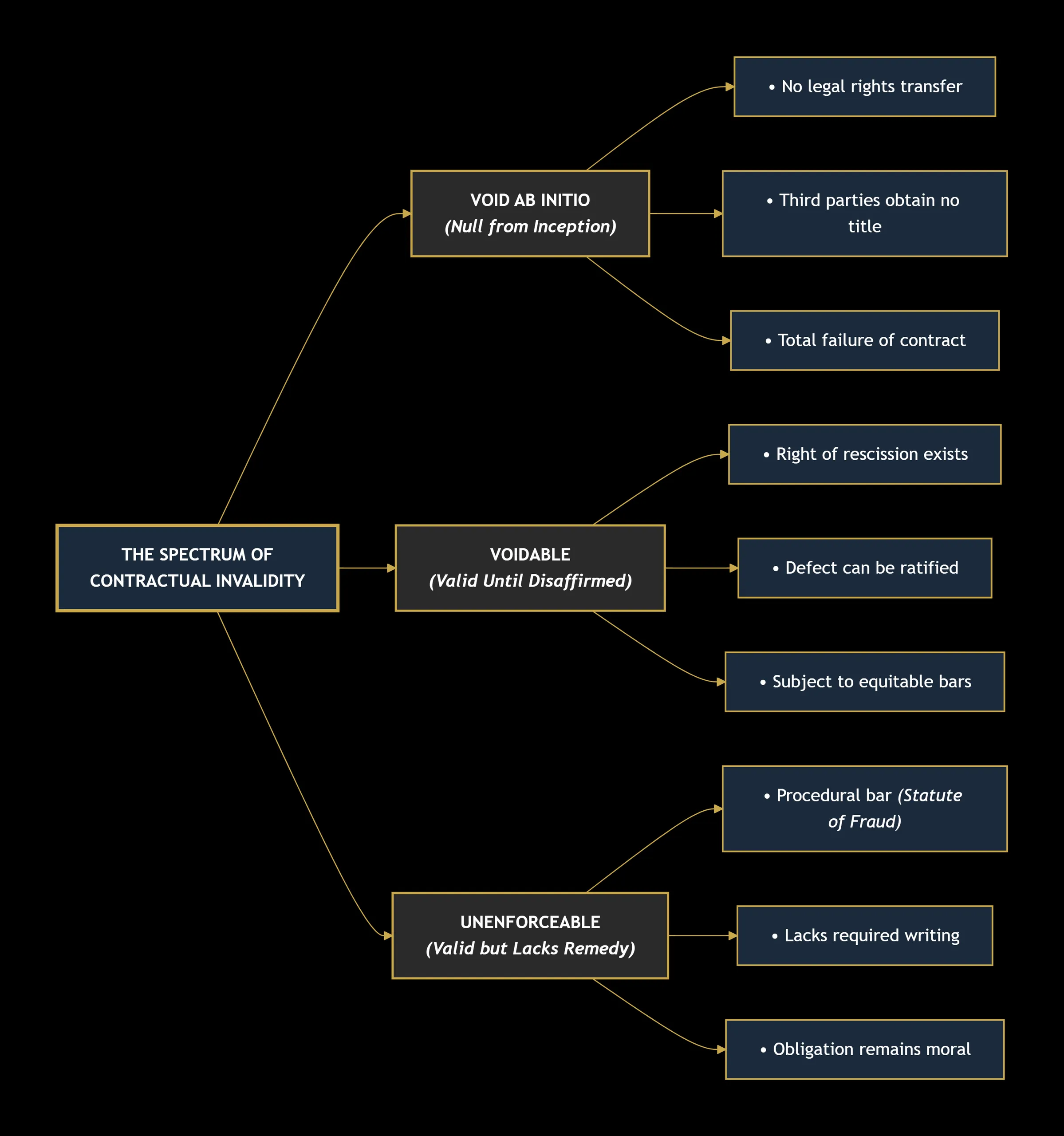
1. Void Ab Initio
A contract that is void ab initio (from the beginning) is a legal nullity. In the eyes of the law, the transaction never existed. Neither party can enforce performance, and no property rights can pass under it. A classic instance of this occurs under the void contract doctrine, where the underlying subject matter is illegal, impossible, or infected by fundamental mutual mistake.
2. Voidable Contracts
A voidable contract is valid and operationally binding upon both parties until the injured party exercises an election to rescind it. If the victim of a misrepresentation or duress chooses to disaffirm the agreement, the contract is set aside; if they ratify it (implicitly or explicitly), the contract remains fully enforceable.
3. Unenforceable Contracts
An unenforceable contract meets all basic formation criteria and contains no vitiating factor rendering it void or voidable, yet courts will refuse to enforce it due to a procedural requirement—such as the Statute of Frauds (requiring certain contracts, like those for real estate, to be in writing).
3.2 Philosophical Snippet: Spinoza, Kant, and the Illusion of Coerced Assent
Baruch Spinoza (Tractatus Theologico-Politicus, 1670):
“No man can ever transfer to another his natural right or power to reason so completely as to cease being a man. A promise extracted purely through fear or deceit is bound not by natural law, but by the physical necessity of self-preservation.”
In contract law jurisprudence, a central philosophical question persists: When does a person’s assent cease to be voluntary?
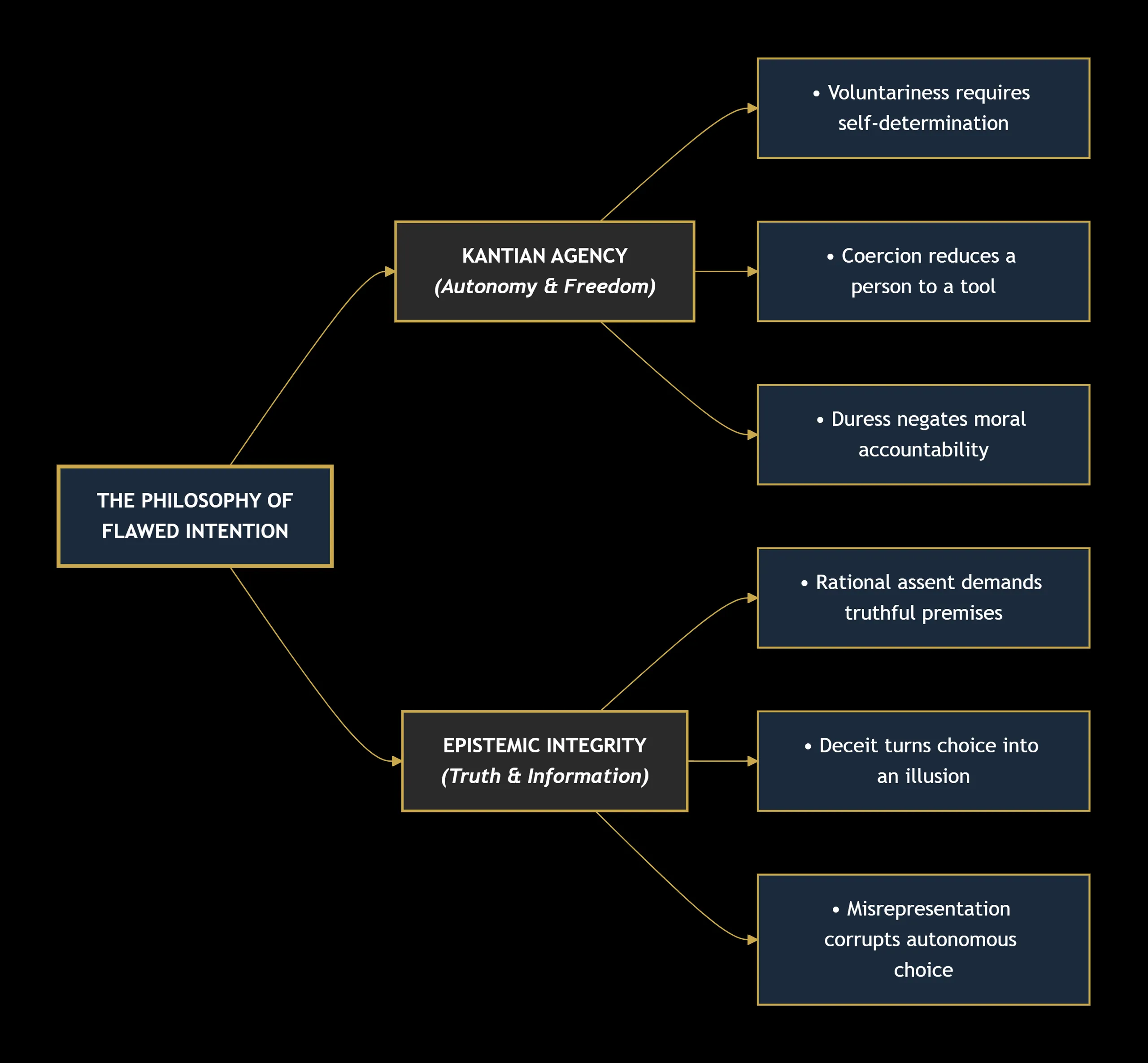
Immanuel Kant established that moral and legal autonomy demands that individuals act as self-governing agents. If an individual is coerced into signing a document under threat of financial ruin or physical violence, their signature is an act of physical compulsion rather than autonomous agency. Similarly, Spinoza observed that an agreement premised on deceit corrupts the intellect: the victim assents not to reality, but to a fabricated fiction. Contract law vitiates agreements under duress or misrepresentation precisely to protect individual agency from external corruption.
Freelance Independent Contractor Bundle
Attorney-reviewed, fully editable Word (.docx) & printable PDF document.
3.3 Misrepresentation and the Distortions of Fact
A contract may be set aside if one party was induced to enter it by an inaccurate statement of fact made by the other party.
1. Elements of Actionable Misrepresentation
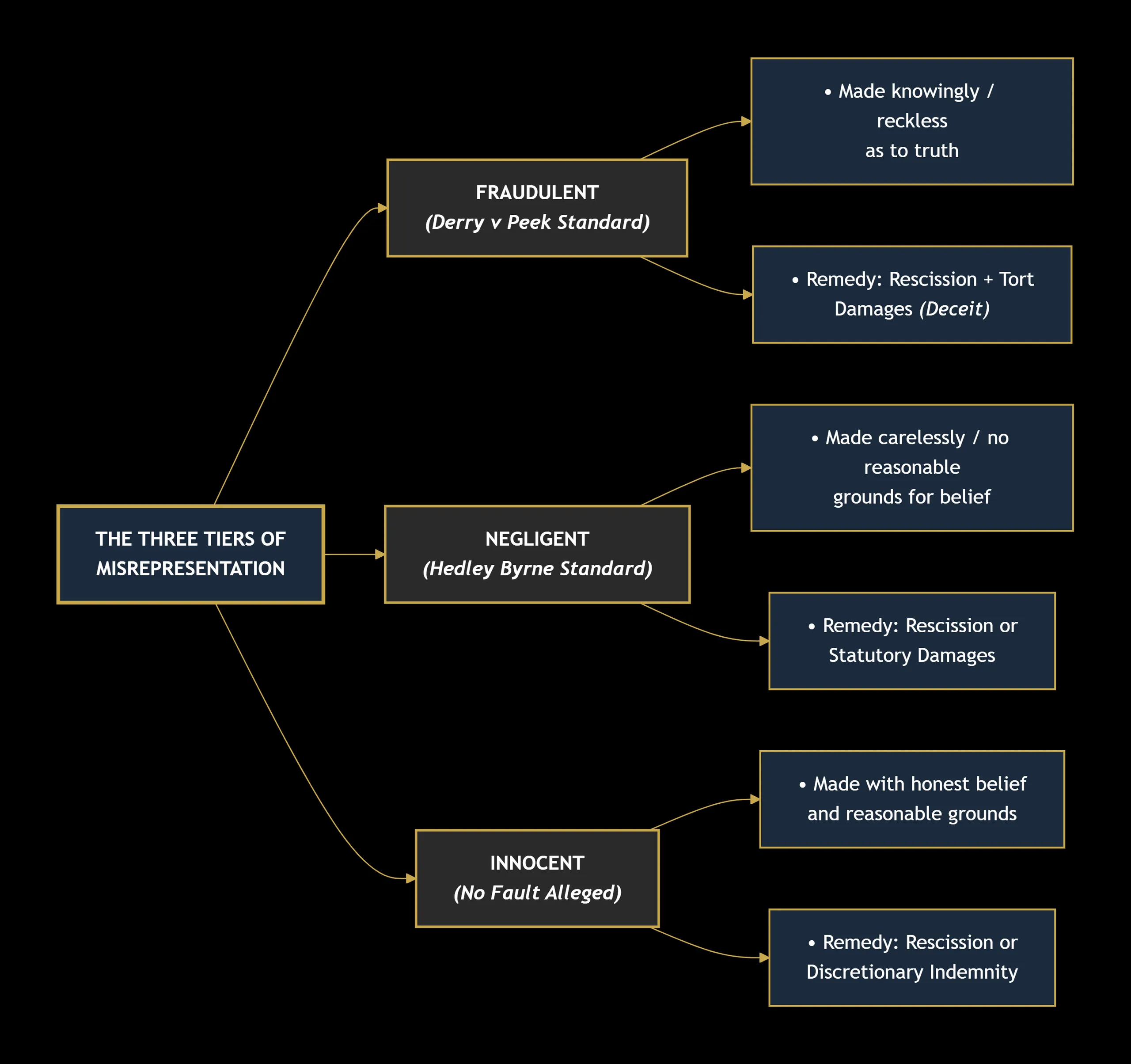
To establish an actionable misrepresentation claim, the claimant must prove four fundamental elements:
2. The Doctrine of Mistake
Unlike misrepresentation (where one party misleads another), the doctrine of mistake addresses fundamental misunderstandings existing at the time of formation:
- Common Mistake: Both parties share the exact same mistaken belief regarding a foundational fact (e.g., both believe a specific cargo ship exists, but it sank the night before).
- Mutual Mistake: The parties are at cross-purposes, each misunderstanding what the other means (e.g., one intends to buy Ship A, while the seller intends to sell Ship B).
- Unilateral Mistake: Only one party is mistaken regarding a material term, and the other party knows—or ought reasonably to know—of the mistake.
3.4 Coercive Defects: Duress and Undue Influence
When assent is procured not by deception, but by improper pressure, the law intervenes through the doctrines of Duress and Undue Influence.
1. Duress: The Pressure of Coercion
Duress involves illegal threats or coercion that leave a party with no reasonable alternative but to submit.
- Duress to the Person: Threats of physical violence or unlawful imprisonment (Barton v Armstrong [1976]).
- Economic Duress: Unlawful commercial pressure exerted by one party to force another into modifying a contract or entering an unwanted deal (North Ocean Shipping Co Ltd v Hyundai Construction Co Ltd [1979]). The threat to breach a contract unless higher payments are made constitutes economic duress if the victim has no viable alternative remedies.
2. Undue Influence: The Abuse of Trust
Where physical or explicit economic threats are absent, equity intervenes to prevent the improper exploitation of a position of trust or dominance.
- Actual Undue Influence: The victim proves that the stronger party actively exerted influence that dominated their free will.
- Presumed Undue Influence: Arises automatically in recognized relationships of trust and confidence (e.g., Fiduciary-Beneficiary, Solicitor-Client, Doctor-Patient, Parent-Child). Once a confidential relationship and a suspicious transaction are established, the burden shifts to the dominant party to prove the vulnerable party exercised independent judgment.
3.5 Equitable Intervention: Unconscionability
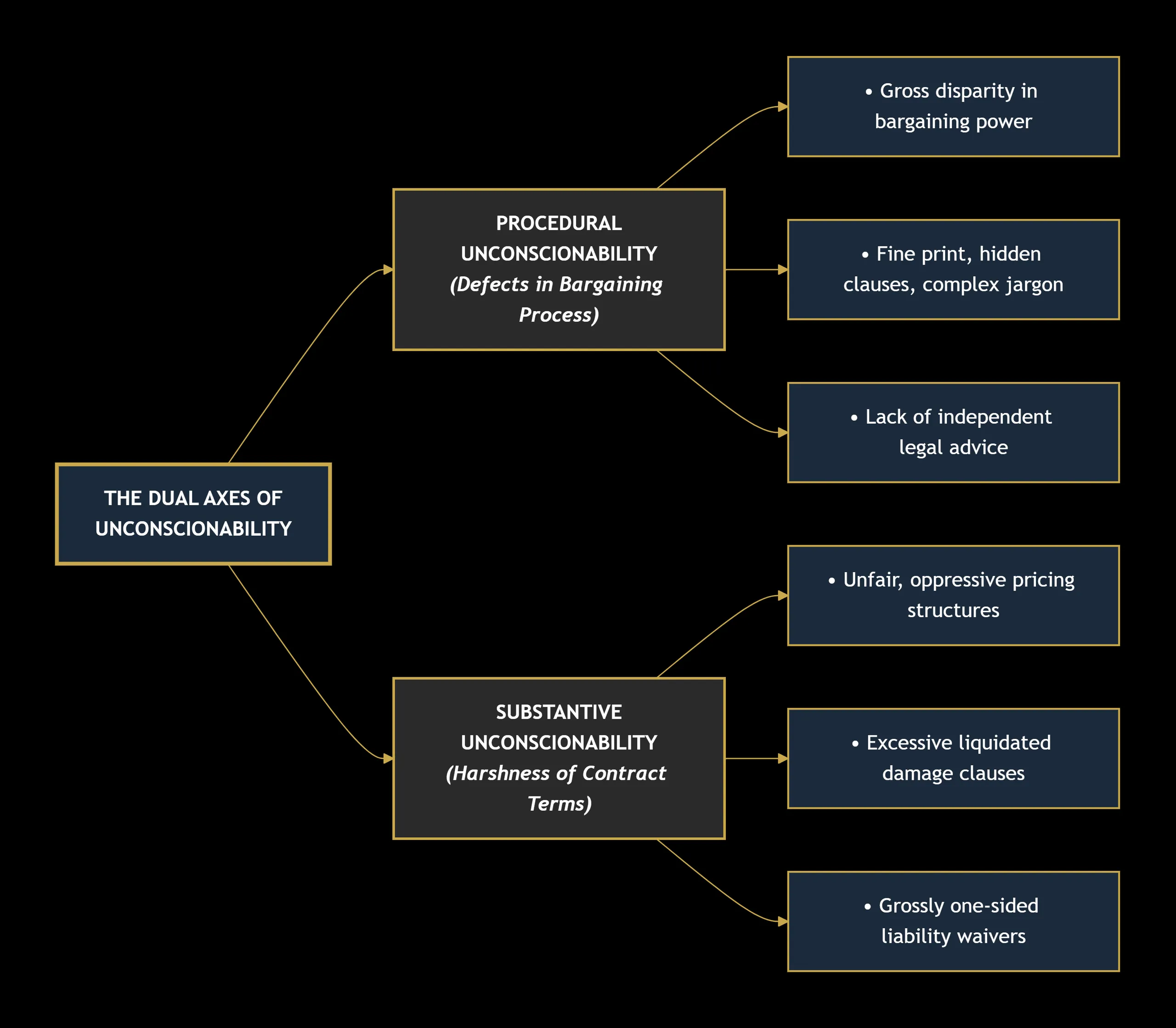
Under modern equity standards, courts apply the complete unconscionability framework to strike down or modify contracts where a dominant party exploits a weaker party’s vulnerability, ignorance, or distress to secure terms so one-sided that they “shock the conscience of the court” (Williams v. Walker-Thomas Furniture Co. [1965]).
Comparative Matrix: Vitiating Factors across Legal Traditions
| Vitiating Factor | Common Law Approach | Civil Law Approach | Primary Legal Remedy |
| Defect of Consent (General) | Divided into distinct sub-doctrines (Mistake, Misrepresentation, Duress) | Unified under general categories of Defects of Assent (Vices du consentement) | Rescission ab initio or damages |
| Economic Duress | Recognized via specific test of illegitimate pressure + lack of reasonable alternative | Evaluated under broad rules of Violence or exploitation of distress | Contract declared voidable |
| Unconscionability | Applied as an equitable doctrine or statutory consumer protection rule | Handled via rules on Lesion (Lésion) or violations of good faith (Bonne foi) | Severance of term or full rescission |
| Innocent Misrepresentation | Governed by misrepresentation acts; allows rescission or discretionary damages | Handled under pre-contractual duties to inform (Obligation d’information) | Rescission or adjustment of contract price |
Module 4: Contractual Terms, Classification, Interpretation, and Risk Allocation
4.1 The Anatomic Architecture of Contracts: Express vs. Implied Terms
Once a contract is formed, legal analysis shifts from determining whether a contract exists to establishing the precise scope, meaning, and legal force of its obligations. The rights and duties of the contracting parties are embodied in the terms of the contract.
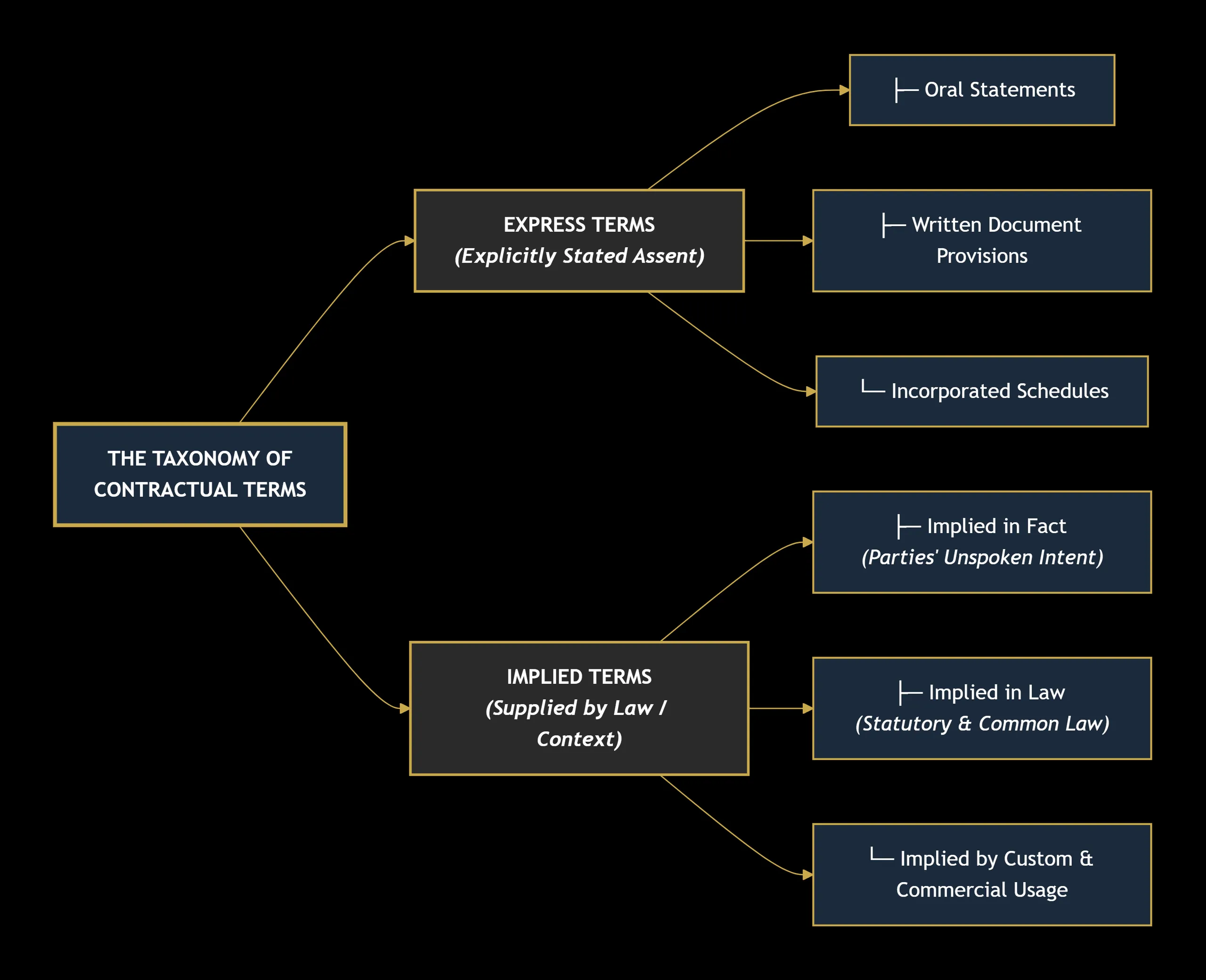
Contractual terms are broadly divided into two main categories based on how they enter the agreement: express terms and implied terms.
1. Express Terms
Express terms are provisions explicitly declared, negotiated, and agreed upon by the parties, whether articulated verbally during discussions or set down in a formal written instrument.
2. Implied Terms
Not every contractual expectation is written explicitly into the text. Legal systems routinely supply implied terms to fill gaps, ensure commercial viability, or enforce public policy standards:
- Terms Implied in Fact: Unspoken terms that the parties intended to include but omitted because they were so obvious as to go without saying. Courts apply two foundational tests to imply terms in fact:
- The Business Efficacy Test: Is the implied term necessary to give the transaction business efficacy—that is, to make the contract workable as a commercial matter (The Moorcock [1889])?
- The Officious Bystander Test: If an officious bystander were to suggest adding the provision while the parties were negotiating, would both parties instantly react with, “Oh, of course!” (Shirlaw v Southern Foundries [1939])?
- Terms Implied in Law: Mandatory or default terms inserted into contracts by statute or judicial precedent regardless of the parties’ actual intent, designed to protect vulnerable parties or regulate specific markets (e.g., statutory warranties of merchantability and fitness for purpose in consumer sales).
- Terms Implied by Custom or Usage: Standard practices within a specific trade, market, or locality that are so well established that contracting parties are presumed to have incorporated them implicitly.
4.2 Philosophical Snippet: Wittgenstein, Textualism, and the Search for Meaning
Ludwig Wittgenstein (Philosophical Investigations, 1953):
“The meaning of a word is its use in the language… Context is not merely an auxiliary guide to understanding an utterance; it is the matrix within which the utterance comes to exist.”
When courts interpret a contract, they confront a classic linguistic problem: How do written words capture subjective intention?
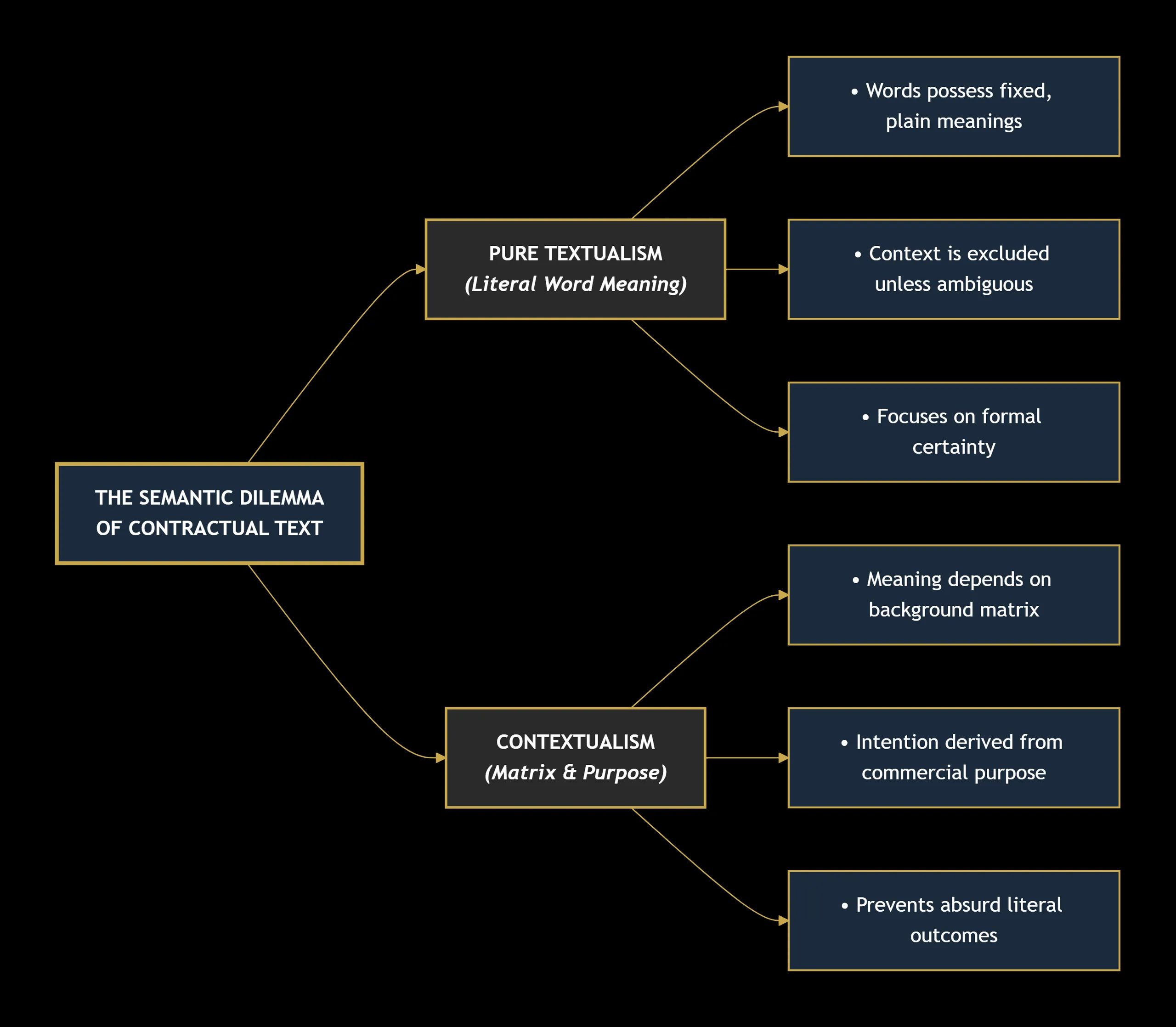
Philosophers of language have long recognized that human communication is inherently imperfect. Formalists argue for Pure Textualism—holding that a written document’s plain literal language must control, ensuring commercial predictability. However, following Wittgenstein’s insights, modern contextualist jurisprudence recognizes that words possess no absolute meaning isolated from their background setting. To discover what parties meant by a specific term, courts must examine the broader commercial matrix, the surrounding circumstances, and the underlying economic purpose of the deal.
4.3 The Hierarchy of Terms: Conditions, Warranties, and Innominate Terms
Not all terms carry equal weight. When a party breaches a contractual term, the legal remedy available to the injured party depends entirely on how the breached term is classified within the legal hierarchy.
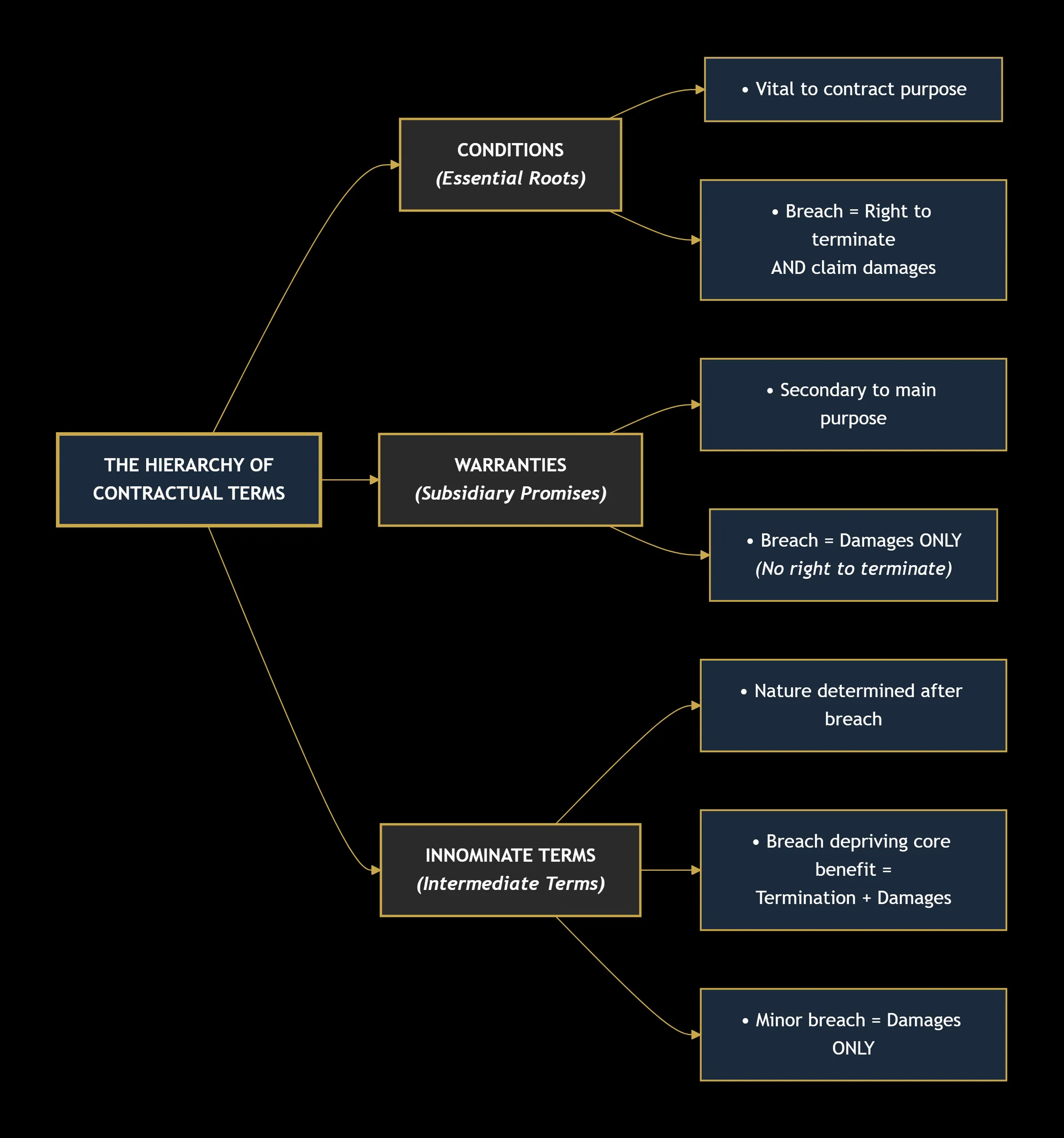
1. Conditions
A condition is a fundamental term that goes directly to the root of the contract. It specifies an obligation so essential that non-performance deprives the innocent party of the main benefit of the transaction.
Remedy for Breach: The innocent party has the right to terminate (repudiate) the contract, discharging all future obligations, and simultaneously claim monetary damages for losses incurred.
2. Warranties
A warranty is a subsidiary or collateral term that is secondary to the main purpose of the contract. While it creates a binding obligation, its breach does not defeat the primary object of the agreement.
Remedy for Breach: The innocent party can claim monetary damages for the loss caused by the breach, but has no right to terminate the contract; they must continue performing their remaining duties.
3. Innominate (Intermediate) Terms
Pioneered in the landmark case Hongkong Fir Shipping Co Ltd v Kawasaki Kisen Kaisha Ltd [1962], the doctrine of innominate terms rejects strict rigid categorization prior to breach. An innominate term is one whose nature can range from minor to fundamental depending on how the breach actually occurs:
- The Consequences Test: Instead of analyzing the term in the abstract, courts evaluate the actual effect of the breach.
- If the breach deprives the innocent party of substantially the whole benefit intended under the contract, it is treated as a breach of a condition (permitting termination).
- If the breach causes minor, easily compensable harm, it is treated as a breach of a warranty (limiting the remedy to damages).
4.4 Canons of Contractual Interpretation & The Parol Evidence Rule
When parties dispute the meaning of express written terms, courts apply established canons of construction to resolve ambiguities objectively.
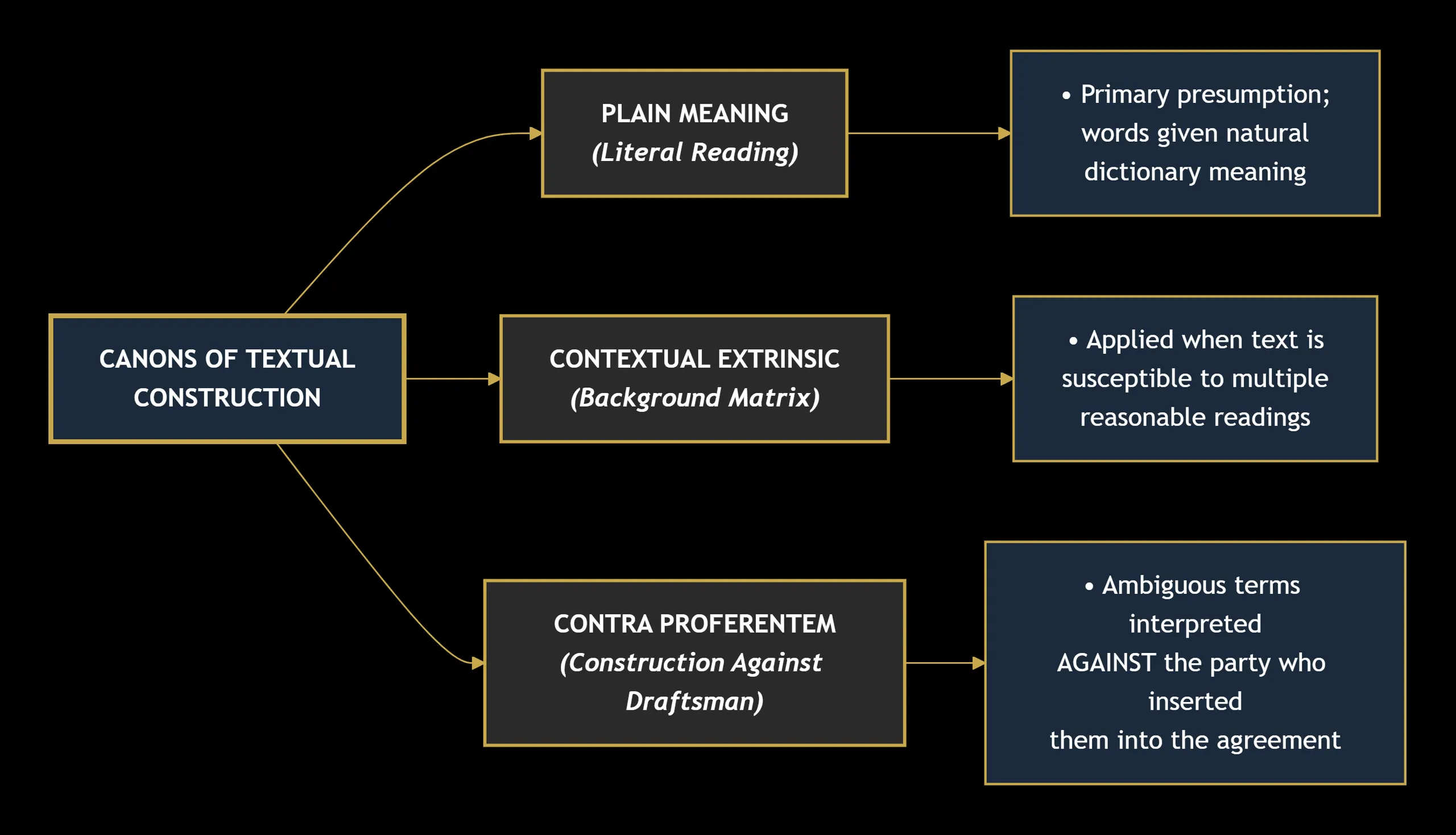
1. Modern Contextual Interpretation
Under modern standards (Investor Compensation Scheme Ltd v West Bromwich Building Society [1998]), contractual interpretation is an objective exercise. Courts ask: What would a reasonable person, possessing all the background knowledge reasonably available to the parties at the time of execution, understand the language to mean?
2. The Parol Evidence Rule
In common law jurisdictions, the Parol Evidence Rule establishes that where a written contract is intended by the parties to be a complete, final integration of their agreement, extrinsic evidence (such as prior oral negotiations, drafts, or subjective statements of intent) is inadmissible to add to, vary, contradict, or subtract from the written terms.
Exceptions to the Parol Evidence Rule:
- Proving vitiating factors (e.g., fraud, duress, misrepresentation, or mutual mistake).
- Resolving latent ambiguity within the text.
- Establishing the existence of a separate collateral contract.
- Showing that the contract has not yet taken effect (e.g., condition precedent).
4.5 Liability Shields: Exclusion Clauses and Risk Allocation Frameworks
Commercial contracts frequently incorporate exclusion clauses (exemption clauses) or limitation clauses designed to limit or eliminate a party’s financial liability in the event of non-performance or negligence.
These clauses represent a primary legal tool for managing structured contractual risk allocation principles, enabling commercial entities to assign specific liabilities to the party best equipped to insure against them.
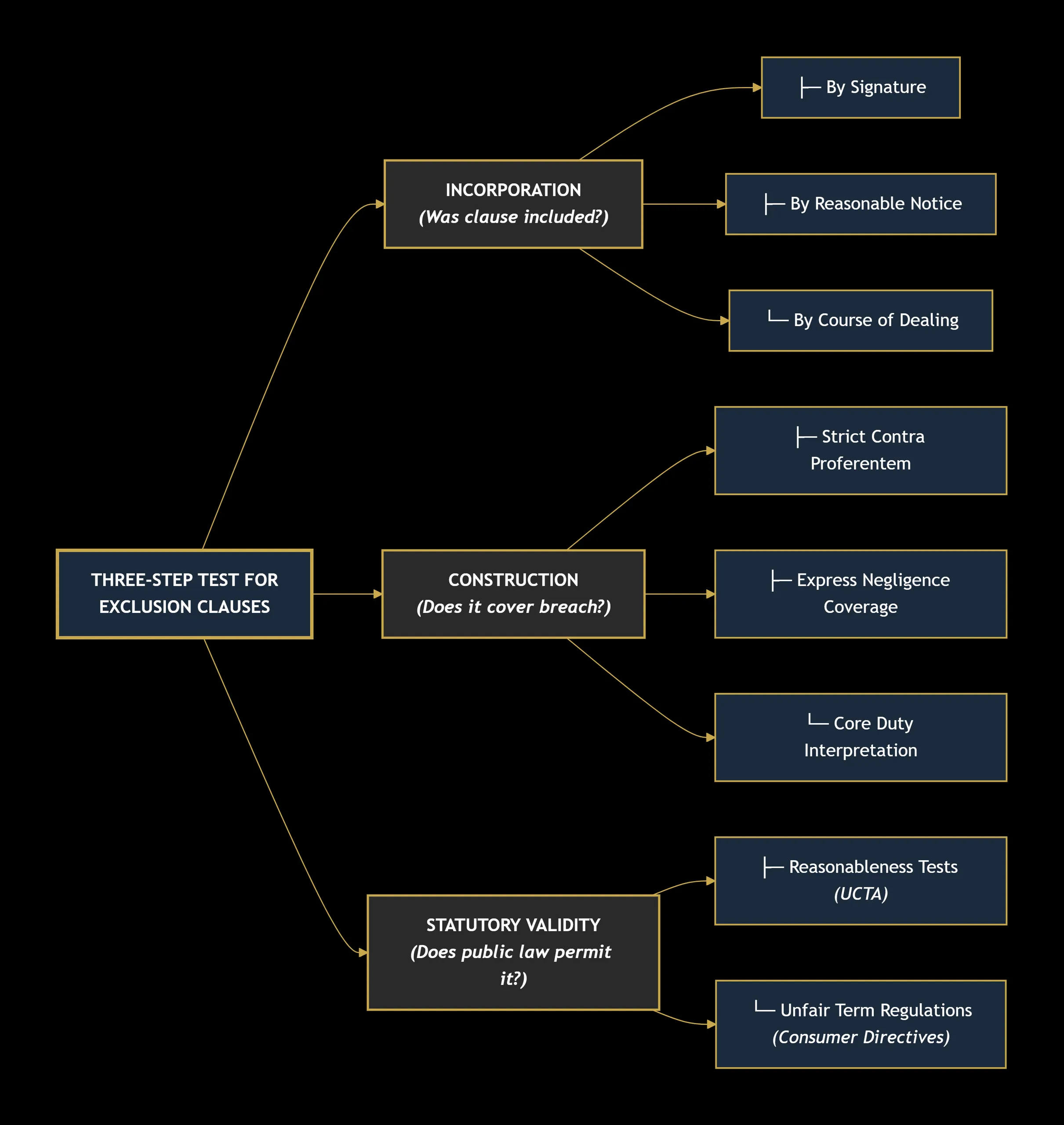
To enforce an exclusion clause, the party relying on it must satisfy a rigorous three-step legal test:
1. Step 1: Incorporation
The clause must be validly incorporated into the contract before or at the time of formation. Incorporation occurs via:
- Signature: A party who signs a contractual document is bound by its terms, regardless of whether they read or understood it (L’Estrange v F Graucob Ltd [1934]), absent fraud or misrepresentation.
- Reasonable Notice: If the document is unsigned, the party seeking to rely on the clause must prove they gave reasonable, timely notice of its existence before the contract was concluded (Parker v South Eastern Railway Co [1877]).
- Course of Dealing: A clause can be incorporated through a consistent, regular past course of dealing between commercial parties on identical terms.
2. Step 2: Construction (Interpretation)
The clause must be drafted with sufficient clarity to cover the specific breach that occurred. Under the doctrine of contra proferentem, any genuine ambiguity in an exclusion clause is construed strictly against the party relying on it. To exclude liability for negligence, the clause must explicitly reference negligence or use language so broad that no other head of liability could have been intended.
3. Step 3: Statutory Controls
Even if an exclusion clause is validly incorporated and clearly drafted, modern legislation restricts its enforceability:
- Gross Negligence and Personal Injury: Public policy strictly prohibits excluding liability for personal injury or death resulting from negligence.
- Reasonableness Tests: Commercial exclusion clauses that limit liability for fundamental breach are subjected to statutory reasonableness standards, evaluating the relative bargaining power of the parties and the availability of commercial insurance.
Comparative Matrix: Contractual Terms Across Legal Traditions
| Legal Standard | Common Law Systems (US, UK, Commonwealth) | Civil Law Systems (France, Germany, Latin America) |
| Hierarchy of Terms | Rigid categories: Conditions vs. Warranties (or Innominate Terms) | Unified classification: Obligations analyzed via Essential vs. Accessory Duties |
| Admissibility of Extrinsic Evidence | Controlled by strict Parol Evidence Rule | No formal Parol Evidence Rule; courts freely consider negotiations and pre-contractual conduct |
| Good Faith in Performance | Variable (implied in UCC/Restatement; strictly limited in English common law) | Universal statutory duty of Good Faith (Treu und Glauben) governing all performance |
| Exclusion Clause Scrutiny | Analyzed via Incorporation, Strict Construction, and Statutory Tests | Invalidated if violating public order, good faith, or if breaching an essential obligation (Obligation essentielle) |
Module 5: Discharge of Contracts, Performance, Frustration, and Breach Mechanics
5.1 The Lifecycle of Contractual Obligations: Pathways to Discharge
Contractual obligations do not endure indefinitely. Every valid contract moves through an operational lifecycle that culminates in discharge—the termination of the binding legal force of the agreement and the release of the parties from their prospective primary duties.
Understanding the legal mechanisms of discharge is essential for identifying when an obligation has been lawfully satisfied versus when a failure to perform opens liability for legal recourse.
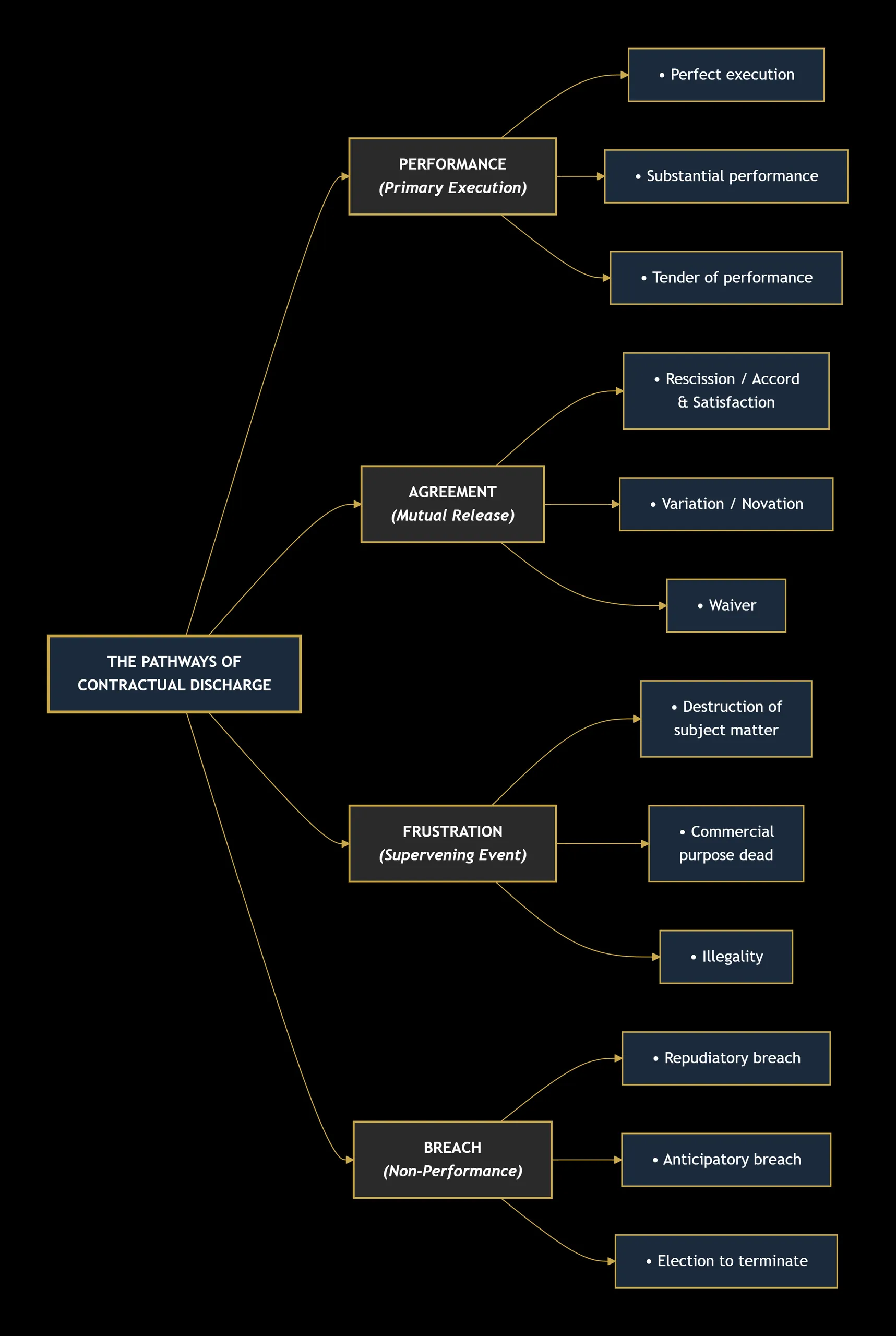
Contractual obligations are discharged through four primary recognized legal pathways:
- Performance: The primary and natural mode of discharge, where both parties fulfill their respective promises according to the terms of the agreement.
- Agreement: The bilateral discharge of obligations through mutual consent, such as through a formal deed of release, accord and satisfaction, or novation.
- Frustration: The automatic discharge of the contract caused by an unforeseen, supervening event beyond the control of either party that renders performance physically impossible, illegal, or radically altered from what was contemplated.
- Breach: The unilateral failure or refusal of one party to perform a fundamental obligation, providing the innocent party with an election to terminate prospective performance and claim damages.
5.2 The Mechanics of Performance: Strict Rules and Equitable Relief
At common law, the baseline rule governing performance is absolute: contractual obligations must be performed fully, precisely, and exactly as promised.
1. The Strict Performance Rule (Cutler v Powell)
Historically, under the rule in Cutler v Powell (1795), partial or incomplete performance—no matter how substantial—did not discharge a party’s obligations nor entitle them to contract payment. Where a contract is entire (requiring complete performance as a condition precedent to payment), anything short of exact execution leaves the performing party unable to sue for the agreed contract price.
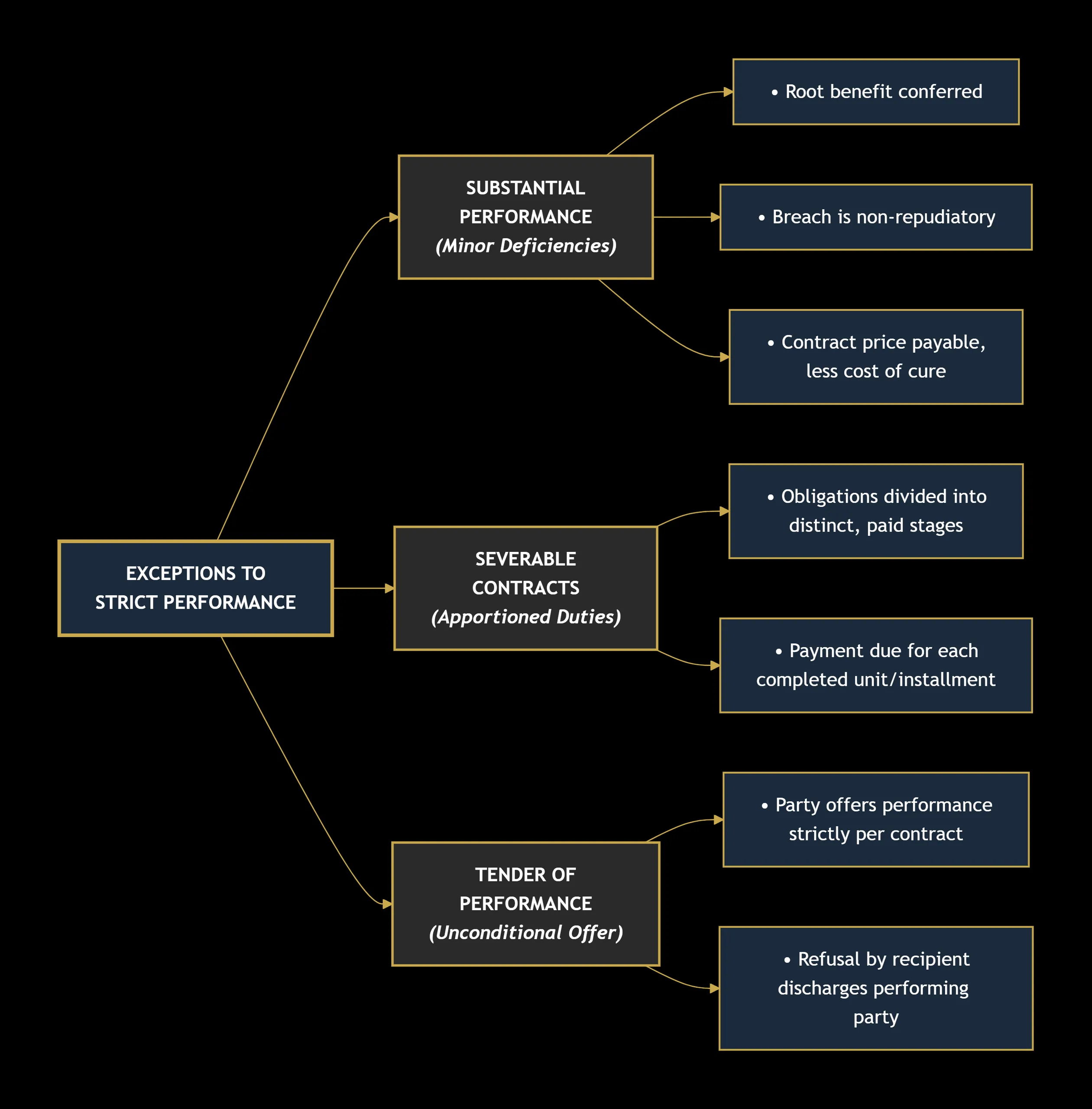
To prevent injustice arising from the rigid strict performance rule, modern law recognizes three major equitable and legal doctrines:
2. The Doctrine of Substantial Performance
Where a party has executed the substance of their obligations—conferring the primary benefit bargained for—but has left minor defects or omitted minor details, the court will treat the obligation as performed (Hoenig v Isaacs [1952]).
- Legal Effect: The performing party can enforce the contract and recover the contract price.
- Offset: The innocent party is entitled to a deduction or counter-claim for the “cost of cure” to remedy the minor deficiencies.
3. Severable (Divisible) Contracts
If a contract explicitly or implicitly apportions the total price to distinct units, installments, or milestones, the contract is severable. Performance of an individual installment entitles the performing party to payment for that specific unit, even if later installments remain unperformed.
4. Tender of Performance
A tender of performance is an unconditional offer by one party to perform their obligation strictly according to the contractual terms (e.g., tendering goods or payment at the designated time and place). If the receiving party refuses to accept a valid tender:
- In the case of goods or services, the tendering party is discharged from further performance and may bring an immediate action for breach of contract.
- In the case of monetary debts, tender does not extinguish the underlying debt, but it stops the accrual of interest and protects the debtor against costs in subsequent litigation.
5.3 Philosophical Snippet: Kant, Grotius, and Ultra Posse Nemo Obligatur
Hugo Grotius (De Jure Belli ac Pacis, 1625):
“No promise can bind a human being to perform that which is inherently impossible. The moral force of an obligation rests upon the tacit assumption that the act remains within the realm of physical and legal possibility.”
The transition from absolute liability to excused non-performance reflects a core ethical dilemma in legal philosophy: Can a moral or legal system demand the impossible?
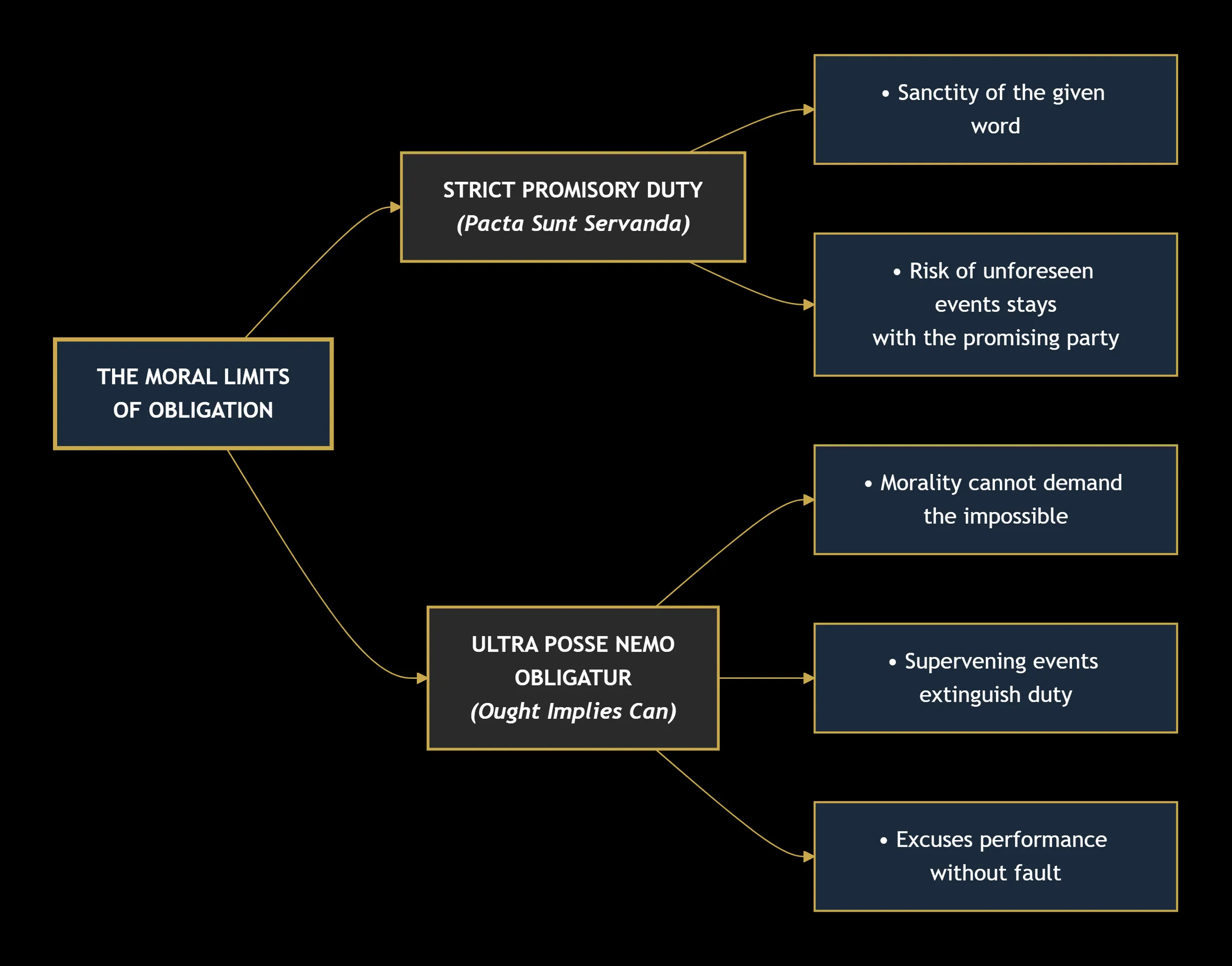
Early common law strictly favored pacta sunt servanda (agreements must be kept). In Paradine v Jane (1647), the court held that if a party binds themselves by contract to perform, they are bound to make it good despite inevitable accidents, because they could have drafted protective language in their agreement.
However, drawing on the philosophy of Immanuel Kant—specifically the axiom that “ought implies can” (ultra posse nemo obligatur)—jurisprudence evolved. Kant argued that a moral imperative requires agency and capability; if a supervening event strips an agent of the physical ability to perform, demanding performance ceases to be a rational moral duty. The modern doctrine of frustration reflects this philosophy by shifting contracts from rigid strict liability to a framework governed by rational possibility.
5.4 The Doctrine of Frustration: Supervening Events and Allocating Risk
The doctrine of frustration operates as a narrow exception to the general rule that parties must perform their contractual promises. Frustration occurs when an unforeseen, post-formation event makes performance impossible, illegal, or radically transforms the nature of the obligation.
1. The Three Recognized Categories of Frustration
Since the decision in Taylor v Caldwell (1863)—where the accidental destruction of a music hall by fire excused the owner from performing—courts recognize three primary categories of frustration:
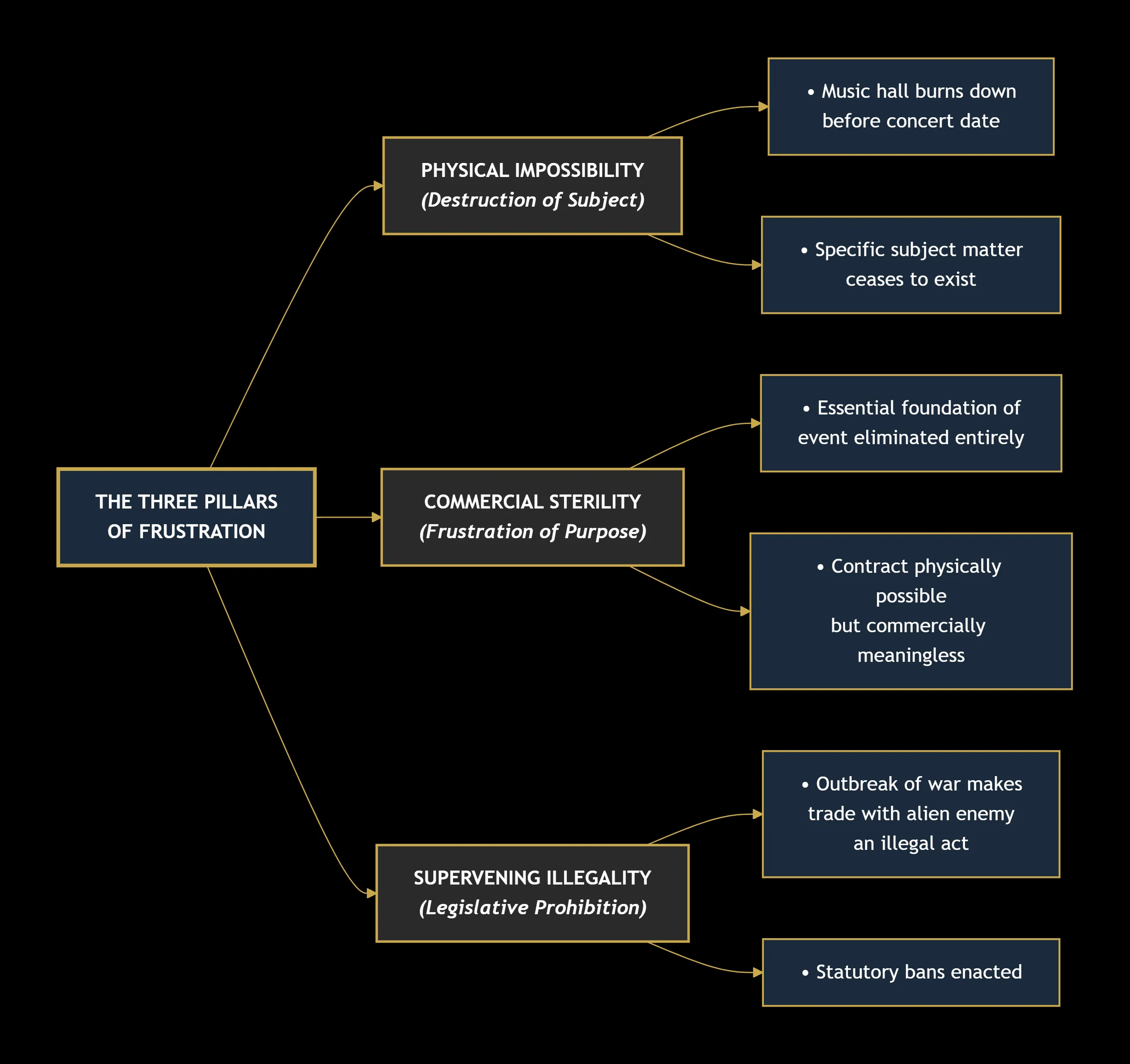
- Physical Impossibility: The subject matter essential to the contract is destroyed without fault of either party (Taylor v Caldwell), or a key person required for personal service dies or becomes permanently incapacitated.
- Frustration of Purpose (Commercial Sterility): The contract remains physically possible to execute, but an event destroys the mutually understood root purpose of the transaction (Krell v Henry [1903], where room rentals overlooking a canceled coronation procession lost all commercial foundation).
- Supervening Illegality: A subsequent change in the law or a war intervention renders performance illegal or prohibited by government command.
2. Barred Frustration: Exclusions and Limits
Frustration is strictly interpreted and cannot be invoked under the following circumstances:
- Self-Induced Frustration: Where the supervening event was brought about by the voluntary act, election, or negligence of the party seeking to rely on it (The Super Servant Two [1990]).
- Foreseeable Events & Express Terms: Where the contract explicitly allocates the risk of the event via a contractual clause (such as a Force Majeure clause) or where the event was fully foreseeable during negotiations.
- Mere Hardship or Bad Bargains: A transaction becoming significantly more expensive, difficult, or commercially unviable does not constitute frustration (Davis Contractors Ltd v Fareham UDC [1956]).
3. Statutory Adjustments and Legal Effects
At common law, frustration terminates the contract automatically from the moment of the frustrating event, releasing both parties from future obligations. Modern legislation (e.g., the Law Reform (Frustrated Contracts) Act 1943) regulates money paid before the event, allowing courts to order the recovery of advance payments or award compensation for valuable non-monetary benefits conferred prior to discharge.
5.5 Breach Mechanics: Repudiation, Anticipatory Breach, and Election
A breach of contract occurs when a party, without lawful excuse, fails or refuses to perform any obligation imposed under the contract when that performance is due.
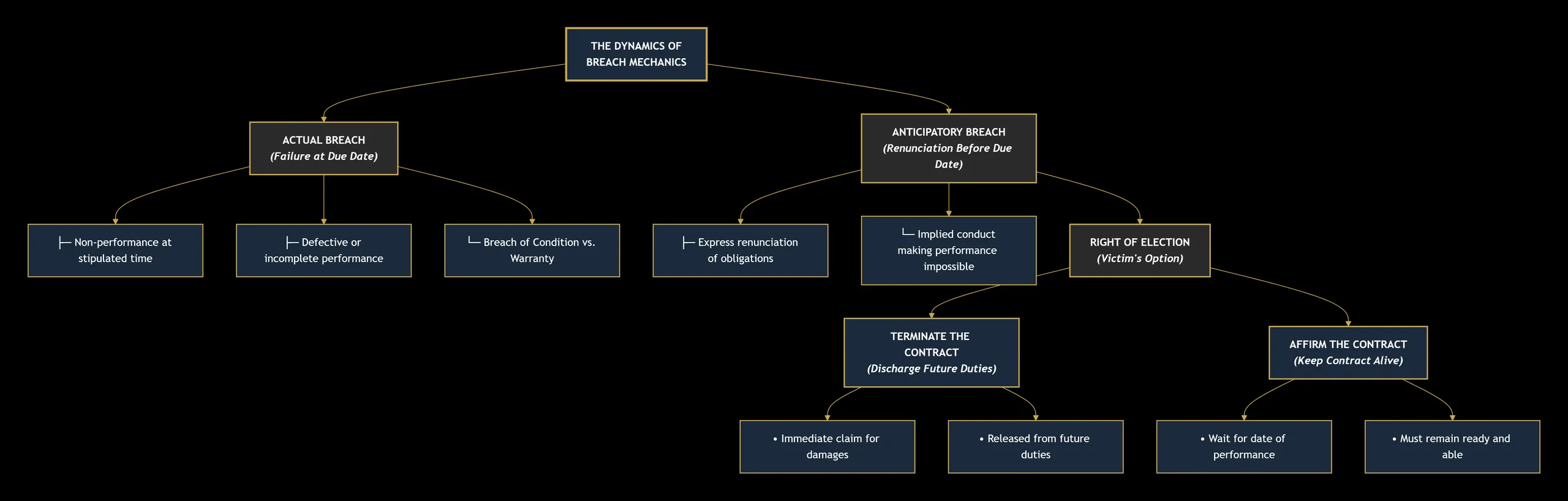
1. Actual Breach vs. Anticipatory Breach
Breaches differ based on when the non-performance manifests:
- Actual Breach: Occurs at the time performance is due under the contract, either through complete non-performance, delayed performance, or defective performance.
- Anticipatory Breach: Occurs when, prior to the arrival of the scheduled performance date, a party unequivocally communicates—by explicit words or clear conduct—that they will not perform their obligations (Hochester v De La Tour [1853]).
2. Repudiatory Breach
Not every breach entitles the innocent party to walk away from the contract. A repudiatory breach is a fundamental breach that goes to the root of the agreement, giving the innocent party the legal option to terminate the contract. A breach is repudiatory if it involves:
- A breach of an essential contractual condition.
- A breach of an innominate term where the actual consequences deprive the innocent party of substantially the whole benefit of the contract.
- An explicit renunciation of the entire agreement.
3. The Doctrine of Election
When a repudiatory or anticipatory breach occurs, the contract is not terminated automatically. Instead, the innocent party holds an absolute right of election:
- Option A: Accept the Repudiation (Terminate)
- The innocent party accepts the breach, extinguishing all unperformed future primary obligations for both sides.
- The innocent party gains an immediate legal right to sue for full loss of expectation damages.
- Option B: Affirm the Contract
- The innocent party rejects the repudiation and treats the contract as remaining fully alive and operative (White & Carter (Councils) Ltd v McGregor [1962]).
- Both parties remain bound to perform their obligations when they fall due. However, affirming parties assume the risk that a supervening frustrating event could later intervene, discharging the breaching party without liability.
Comparative Matrix: Discharge & Supervening Events Across Legal Systems
| Legal Concept | Common Law (US, UK, Commonwealth) | Civil Law (France, Germany) | CISG (UN Sales Convention) |
| Supervening Impossibility | Covered strictly by narrow Doctrine of Frustration | Governed by broad statutory Force Majeure doctrines | Governed by Article 79 (Exemption for Impediments) |
| Commercial Hardship | Hardship/unprofitability never excuses performance (Davis Contractors) | Modern recognition of hardship via Imprévision (French Civil Code Art. 1195; German BGB § 313) | Allows renegotiation/exemption if impediment was unforeseeable and unavoidable |
| Anticipatory Non-Performance | Gives immediate right to accept repudiation and sue for full damages | Known as Anticipatory Breach or anticipatory non-performance; requires notice and cure period | Article 71 & 72 permit suspension or avoidance if fundamental breach is clear |
| Effect of Frustration/Force Majeure | Automatically terminates contract; statutory adjustment for pre-payments | Excuses performance; permits judicial modification or renegotiation before termination | Suspends performance duties and excuses liability for damages during impediment |
Module 6: Contractual Remedies, Judicial Enforcement, and the Calculus of Loss
6.1 The Architecture of Contractual Remedies: Compensatory Principles
When a breach of contract occurs, the legal system shifts from enforcing primary performance obligations to enforcing secondary remedial obligations. The primary objective of contract damages is not to punish the breaching party, but to compensate the injured party for the loss caused by the failure to perform.
The foundational principle of common law remedies was articulated by Baron Parke in Robinson v Harman (1848):
“The rule of the common law is, that where a party sustains a loss by reason of a breach of contract, he is, so far as money can do it, to be placed in the same situation, with respect to damages, as if the contract had been performed.”
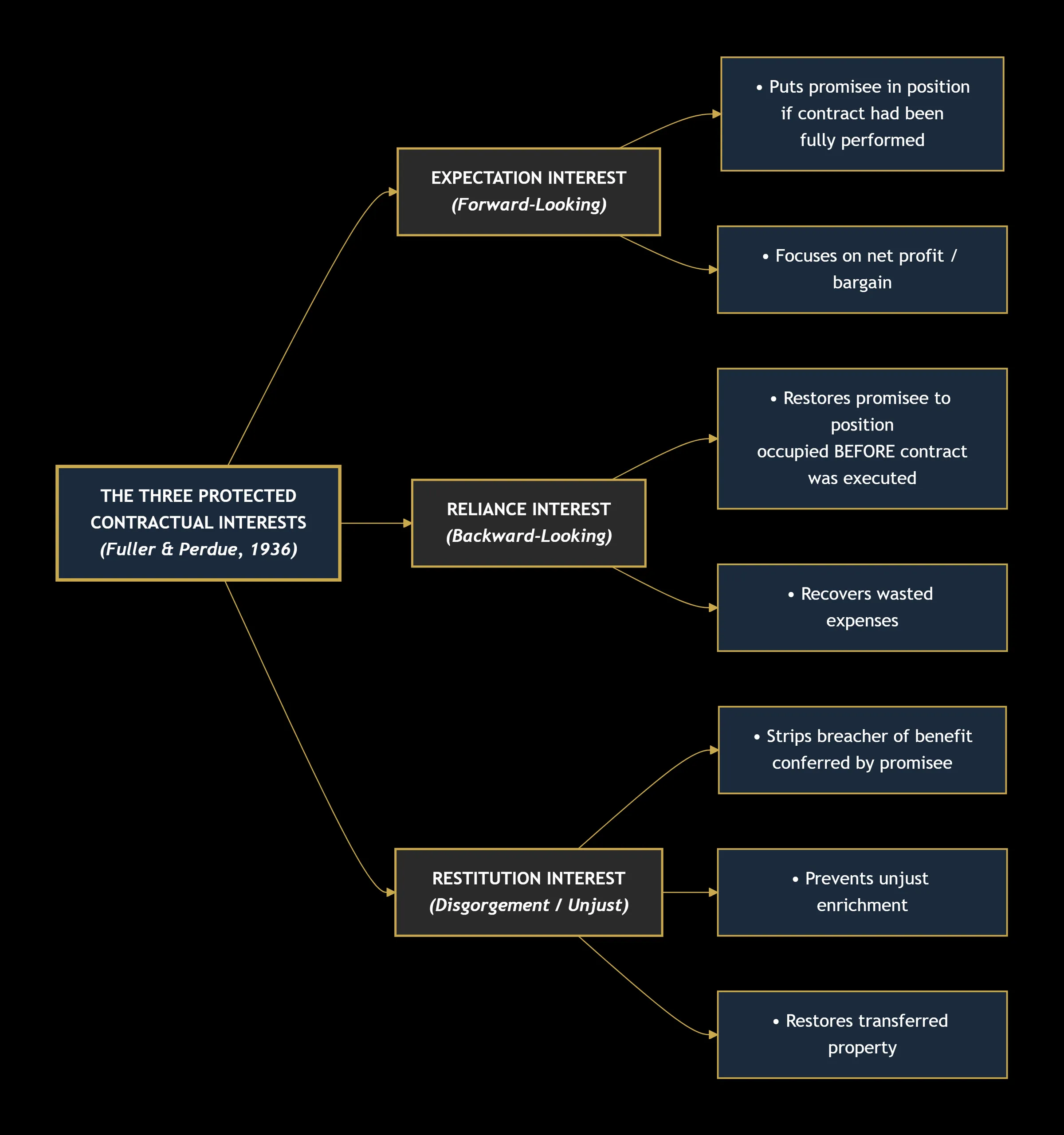
In their seminal analysis (The Reliance Interest in Contract Damages, 1936), Lon Fuller and William Perdue categorized contract remedies into three distinct legal interests:
- The Expectation Interest: The standard measure of damages, designed to give the promisee the value of the expected performance (the “loss of bargain”).
- The Reliance Interest: Designed to put the innocent party back in the position they would have occupied had the contract never been made, compensating for out-of-pocket expenses incurred in reliance on the promise.
- The Restitution Interest: Designed to compel the breaching party to restore any benefit or value conferred upon them by the innocent party, preventing unjust enrichment.
6.2 Monetary Compensation: Expectation, Reliance, and Remoteness
1. Measuring Expectation Loss: Diminution in Value vs. Cost of Cure
When assessing expectation damages, courts must choose between two primary measures of financial loss:
- Cost of Cure: The expenditure required to repair, complete, or reconstruct the work to make it conform strictly to the contractual specifications.
- Diminution in Value: The difference between the market value of the performance as actually delivered and the market value had it been performed strictly according to contract terms.
Where the cost of curing a breach is vastly disproportionate to the actual economic benefit achieved, courts will refuse to award the cost of cure to prevent economic waste (Ruxley Electronics and Construction Ltd v Forsyth [1996], where a swimming pool built 9 inches shallower than specified was awarded nominal damages for loss of amenity rather than the full cost of rebuilding).
2. Reliance Loss: Wasted Expenditure
A claimant may elect to claim reliance damages instead of expectation damages when the expected profit cannot be proven or is too speculative (McRae v Commonwealth Disposals Commission [1951]).
- The Bar on Bad Bargains: A claimant cannot use a reliance claim to escape the consequences of a bad bargain. If the breaching party proves that the claimant would have suffered a loss even if the contract had been fully performed, the reliance recovery is reduced by that loss.
3. Remoteness of Damage: The Limits of Recovery
A breaching party is not liable for all consequences flowing from their default. To be recoverable, the loss must not be too remote.
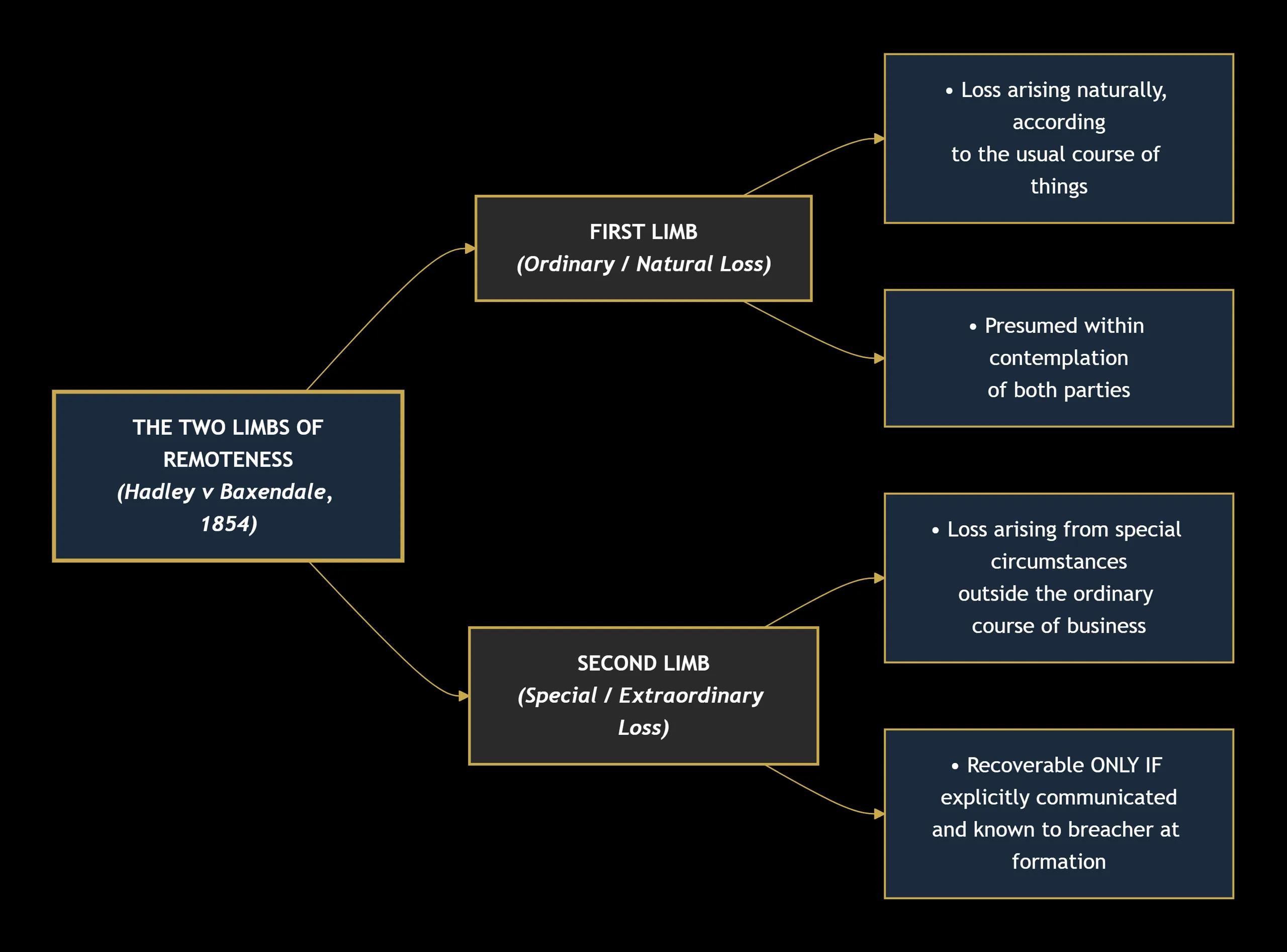
Under the rule in Hadley v Baxendale (1854), damages are divided into two distinct heads:
- General Damages (First Limb): Losses arising naturally and directly in the usual course of things. The law presumes both parties contemplated these losses.
- Special Damages (Second Limb): Exceptional losses arising from special circumstances outside the ordinary course of business. These are recoverable only if the special circumstances were expressly communicated to and known by the breaching party at the time the contract was formed.
Modern refinements (The Achilleas [2008]) further examine whether, against the background of commercial custom, the breaching party can objectively be said to have assumed responsibility for that specific type of risk.
6.3 Philosophical Snippet: Aristotle, Fuller, and Corrective Justice
Aristotle (Nicomachean Ethics, Book V, c. 350 BCE):
“Corrective justice plays a rectifying role in transactions… It treats the parties as equals and asks only whether one has done and the other suffered injustice, or whether one has inflicted and the other suffered harm. The judge endeavors, by means of penalty or award, to equalize the unfair inequality.”
Why does contract law enforce promises to pay for unrealized future expectations, rather than merely compensating for actual physical injuries or tangible property losses?
Philosophers of corrective justice view contract remedies through an Aristotelian lens: a voluntary agreement creates an initial moral equilibrium. When one party breaks their word, they unjustifiably deprive the innocent party of the promised entitlement. Enforcing expectation damages validates human autonomy. By treating an unperformed promise as a legal asset with real financial value, the law converts the moral right to performance into an enforceable monetary equivalent, restoring the ethical balance created by mutual assent.
6.4 Mitigation and Agreed Remedies: Penalties vs. Liquidated Damages
1. The Duty to Mitigate Loss
The law imposes a legal duty on the innocent party to take all reasonable steps to mitigate (minimize) the loss caused by the defendant’s breach (Payzu Ltd v Saunders [1919]).
- Consequences of Failure: The claimant cannot recover damages for any portion of the loss that could have been avoided by taking reasonable post-breach action (e.g., re-selling goods on the open market, seeking alternative employment, or purchasing replacement performance).
- Expenses of Mitigation: Any reasonable expenses incurred by the claimant in taking steps to mitigate their loss are fully recoverable as part of the overall damages claim.
2. Agreed Remedies: Liquidated Damages vs. Unenforceable Penalties
Contracting parties often insert clauses pre-defining the exact sum of money payable upon a breach. The law classifies these provisions as either valid liquidated damages clauses or invalid penalty clauses.
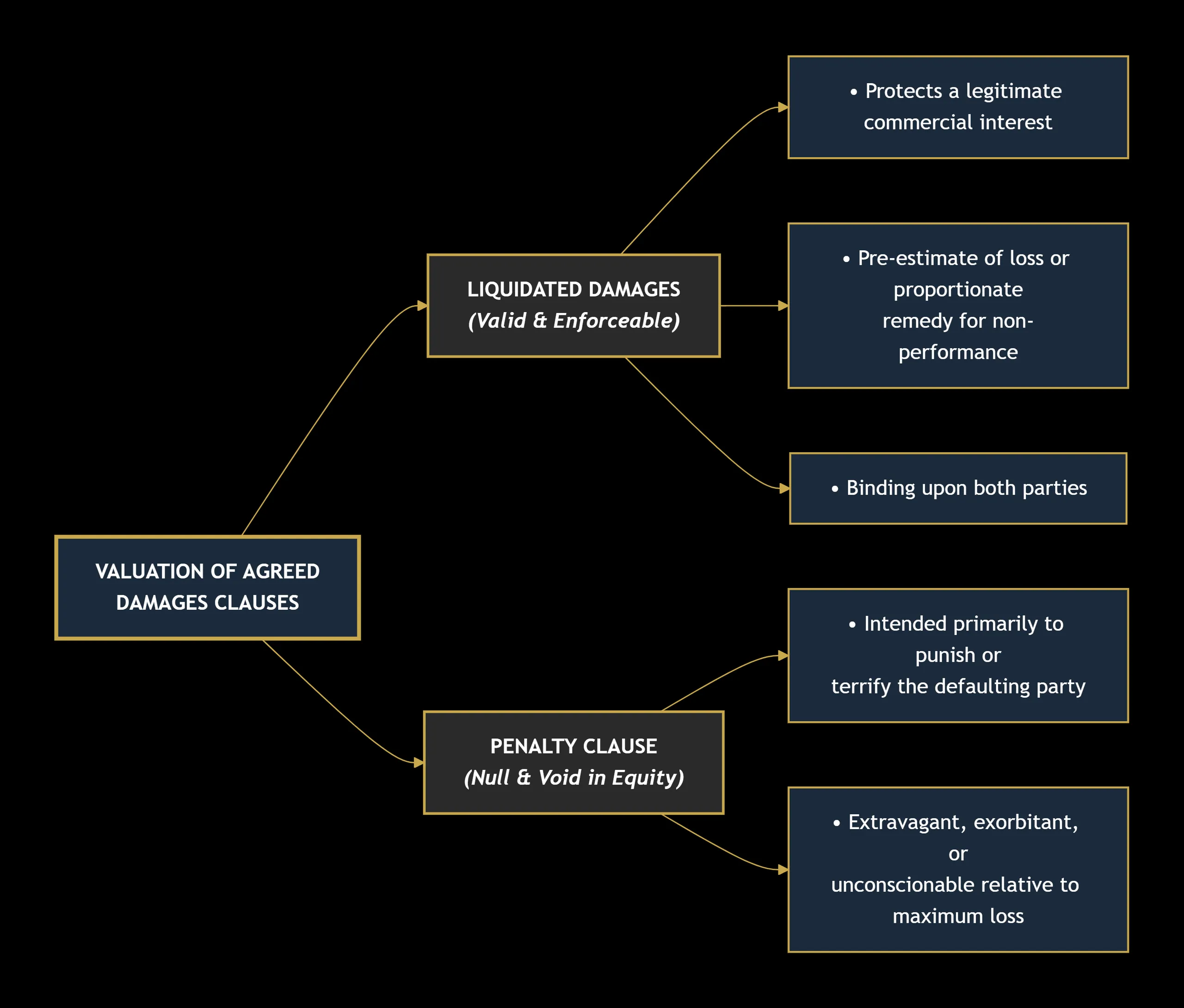
Historically governed by Dunlop Pneumatic Tyre Co Ltd v New Garage & Motor Co Ltd [1915], the modern test was recast in the joined landmark decision of Cavendish Square Holding BV v El Makdessi and ParkingEye Ltd v Beavis [2015]:
The Modern Penalty Test:
A clause is an unenforceable penalty if it is a secondary obligation that imposes a detriment on the party in breach that is extravagant, exorbitant, or unconscionable, completely out of proportion to any legitimate commercial interest of the innocent party in the enforcement of the primary obligation.
6.5 Equitable and Restitutionary Remedies: Compelling Performance
Monetary damages are the primary common law remedy, but they are not always adequate to compensate an injured party. In such cases, courts of equity step in with discretionary remedies.
1. Specific Performance
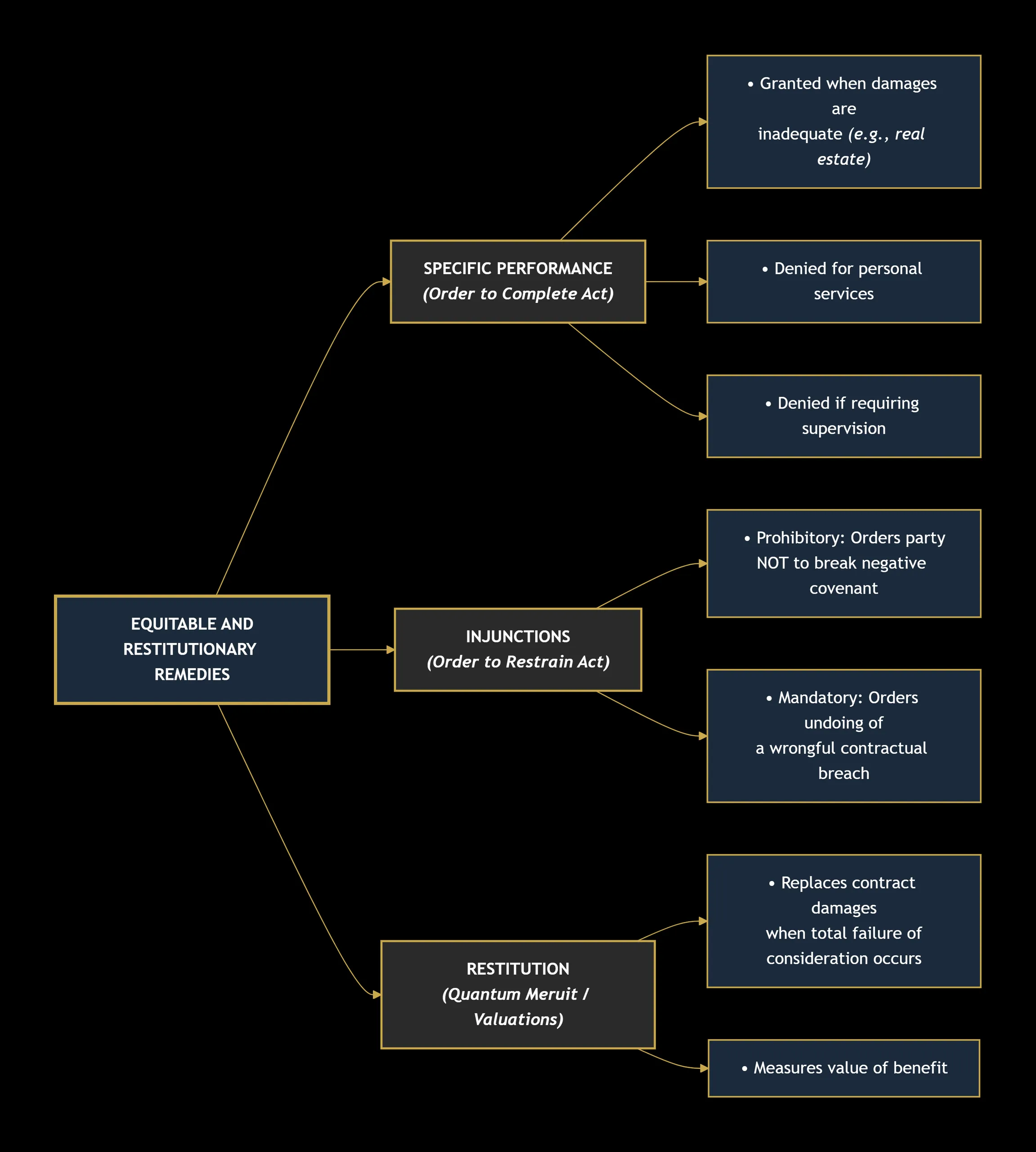
Specific performance is an equitable decree issued by the court ordering the breaching party to execute their promised performance.
- Inadequacy of Damages: Specific performance is granted only when common law damages are an inadequate remedy (e.g., contracts for the sale of unique real estate, rare art, or custom items that cannot be sourced elsewhere on the open market).
- Bars to Relief: Courts will consistently deny specific performance for contracts involving personal services (e.g., employment, artistic performance), contracts requiring ongoing judicial supervision, or where performance is physically or legally impossible.
2. Injunctions
An injunction is an equitable court order restraining a party from performing a specified act:
- Prohibitory Injunction: Prevents a party from committing a breach of a negative contractual covenant (e.g., enforcing a valid non-compete clause).
- Mandatory Injunction: Requires a party to take positive action to reverse the consequences of a breach.
3. Restitution and Quantum Meruit
Restitution claims operate outside standard compensatory damages, focusing on stripping an unjust benefit from the defendant:
- Total Failure of Consideration: Where a claimant pays money under a contract but receives absolutely zero performance in return, they may claim a full refund of the money paid in restitution.
- Quantum Meruit (“As much as he has earned”): A restitutionary remedy evaluating the reasonable value of services rendered or work performed where no fixed price was agreed upon, or where a contract was prematurely discharged following partial performance.
Comparative Matrix: Contractual Remedies Across Legal Traditions
| Remedial Mechanism | Common Law Systems (US, UK, Commonwealth) | Civil Law Systems (France, Germany) | CISG (UN Sales Convention) |
| Primary Remedial Right | Monetary Damages are the primary remedy; Specific Performance is exceptional | Specific Performance (Exécution en nature) is the primary entitlement | Specific Performance is a primary right (Art. 46), subject to national court limits (Art. 28) |
| Test for Remoteness | Foreseeability Test (Hadley v Baxendale: usual course + communicated risks) | Adequate Causation & Direct/Immediate Damage rules | Foreseeability Rule at time of contract execution (Art. 74) |
| Penalty Clauses | Penalty clauses are strictly void (Cavendish Square test applies) | Penalty clauses (Clause pénale) are valid, but courts may judicially reduce excessive sums | Generally recognized; subject to domestic public policy and mandatory law controls |
| Cost of Cure Restrictions | Limited by Reasonableness & Proportion (Ruxley Electronics) | Granted routinely unless performance is impossible or grossly disproportional | Allowed as right of repair/cure unless unreasonable under the circumstances |
Module 7: Synthesis, Key Takeaways, and Frequently Asked Questions
7.1 Conclusion
Contract law represents the legal system’s primary mechanism of private ordering. Across seven comprehensive modules, we have explored how voluntary promises transform into sovereignly enforceable legal duties, balancing the philosophical imperatives of individual moral agency against the practical commercial necessities of market predictability and trust.
From the foundational requirements of formation—offer, acceptance, consideration, and objective assent—to the complex doctrines governing vitiating factors, contractual interpretation, discharge, and corrective remedies, contract law operates as a cohesive matrix. It honors the sanctity of promises while continually refining rules of equity to guard against coercion, unconscionability, and unforeseen impossibilities. Understanding this legal engine equips jurists, scholars, and commercial actors to navigate contractual relationships with conceptual precision and strategic clarity.
7.2 Key Takeaways
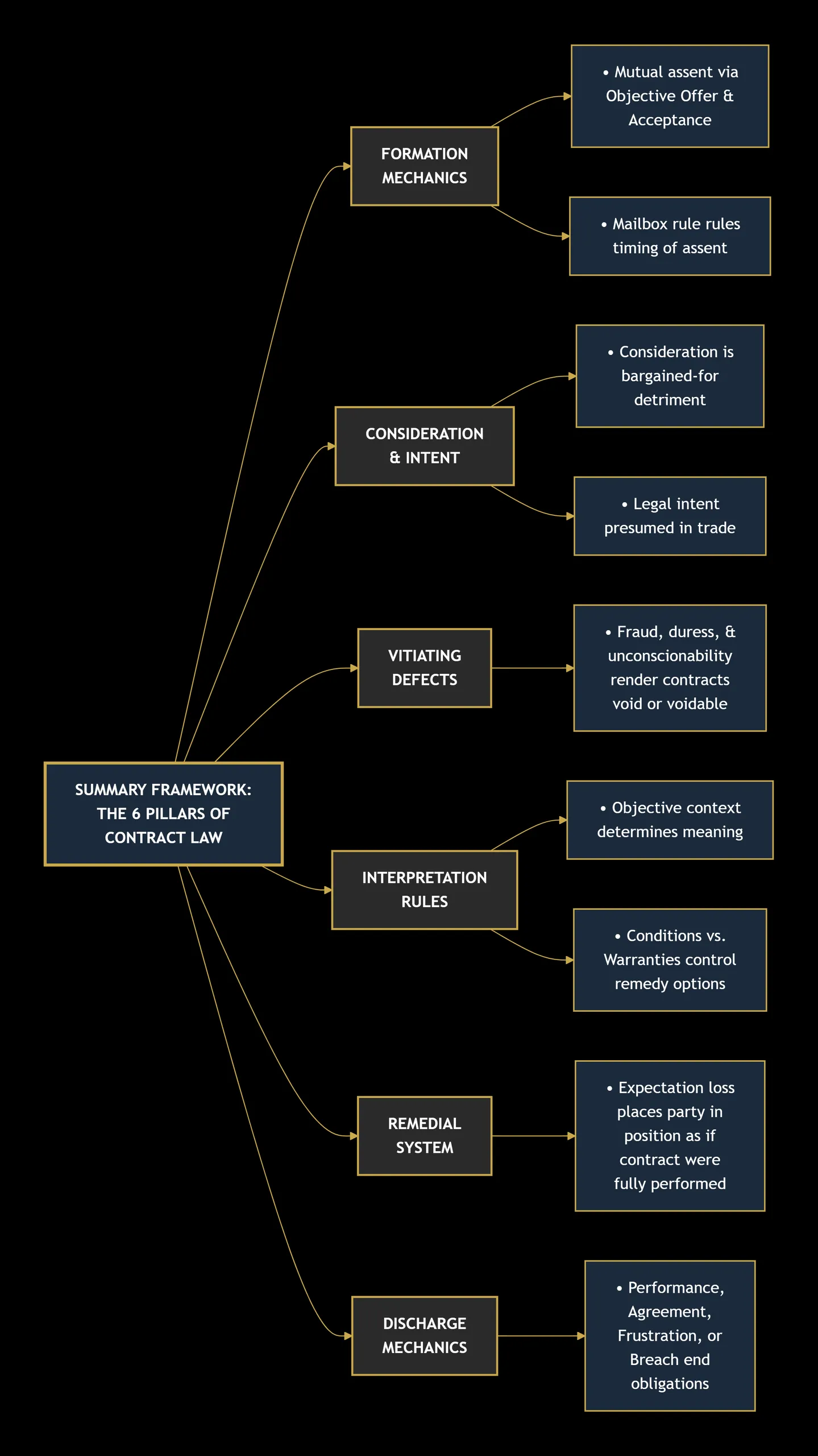
- The Objective Assent Standard: Contract formation does not depend on secret, unexpressed intentions, but on outward manifestations of assent evaluated through the eyes of a reasonable person.
- The Exchange Requirement: Common law systems enforce promises supported by consideration—a bargained-for exchange of legal benefit or detriment—or through formal equitable reliance (promissory estoppel).
- Defects in Consent: Agreements procured through misrepresentation, duress, or unconscionable overreaching lack true assent, rendering them void ab initio or voidable at the option of the aggrieved party.
- Interpretation and Classification: Contractual terms are interpreted within their commercial matrix. Breaches of fundamental conditions allow termination, while breaches of subsidiary warranties limit recovery strictly to monetary damages.
- Discharge Pathways: Contracts are discharged by exact performance, mutual release, frustration (supervening impossibility), or repudiatory breach triggering an immediate right of election.
- Corrective Remedial System: Contract damages are compensatory, primarily designed to protect the expectation interest (Robinson v Harman), subject to rules of remoteness (Hadley v Baxendale) and the duty to mitigate.
7.3 Frequently Asked Questions
Q1: What is the main difference between a void contract and a voidable contract?
A void contract is a total legal nullity from its inception (ab initio). It creates no legally enforceable rights or obligations, and no property rights can pass under it. Examples include contracts formed for an illegal purpose or under a mutual fundamental mistake.
A voidable contract, by contrast, remains valid and legally binding upon both parties unless and until the innocent party chooses to set it aside (rescind it). Voidable contracts arise when assent is flawed by vitiating factors such as misrepresentation, duress, or undue influence. If the innocent party affirms the agreement, it remains fully enforceable.
Q2: Can an agreement be modified or substituted by a new contract without breaching the original deal?
Yes. Parties can modify an existing contract or replace an original party or obligation entirely through a formal novation agreement. Unlike a simple assignment (which transfers rights but not duties), a novation extinguishes the original contractual obligation entirely and substitutes a new, legally binding contract in its place, requiring the explicit consent of all original and incoming parties.
Q3: How do courts determine whether a contract term is a condition or a warranty?
Courts determine the status of a contractual term by examining the objective intention of the parties at the time the contract was formed, as well as the commercial importance of the term to the root of the deal:
- A condition is an essential term that goes directly to the heart of the transaction. A breach of a condition deprives the innocent party of the main benefit of the agreement, granting them the legal right to terminate the contract and claim damages.
- A warranty is a minor or subsidiary term. A breach of a warranty does not defeat the primary object of the contract, limiting the innocent party’s remedy strictly to claiming monetary damages while keeping the main contract intact.
Q4: What happens if performing a contract becomes unexpectedly expensive or difficult?
Mere financial hardship, unexpected market price shifts, or economic unprofitability do not excuse performance, nor do they constitute frustration at common law. Under established precedent (Davis Contractors Ltd v Fareham UDC), a party remains strictly bound to their bargain unless performance becomes physically impossible, legally prohibited, or commercially sterile due to an unforeseen supervening event beyond both parties’ control.
Q5: When can an injured party claim specific performance instead of monetary damages?
Specific performance is an extraordinary equitable remedy granted strictly at the court’s discretion when monetary damages are inadequate to compensate the injured party. It is most commonly ordered in real estate transactions (because land is considered unique) or for contracts involving unique, irreplaceable goods (such as rare artwork or custom items). Specific performance will be denied for personal service contracts, contracts requiring ongoing judicial oversight, or where performance is impossible.
Advance Your Legal Analysis
Explore our interactive decision trees, litigation pipeline builders, and procedural court simulators designed specifically for law students and practitioners.
Access Interactive Tools →